


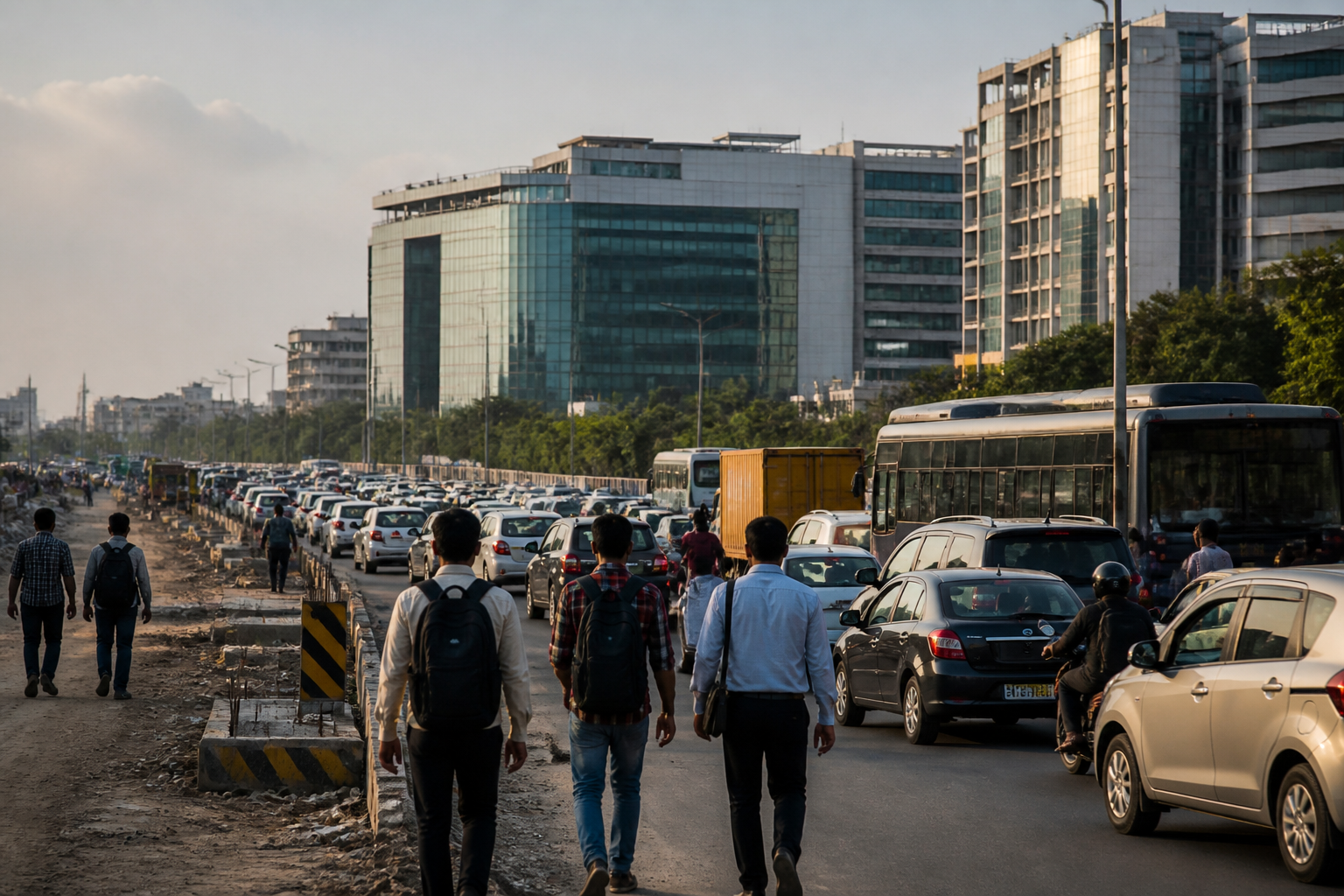
A ₹426 crore allocation for internal roads, a proposed 19.1-kilometre last-mile network around metro stations, a possible public transport hub and discussions over a more permanent water supply have placed Hinjewadi’s infrastructure crisis at the centre of Pune’s urban governance debate. The measures were announced after the first meeting of a high-level committee convened to address congestion and wider infrastructure problems in and around the information technology park.
The meeting, held at the district collector’s office on Friday, was chaired by Pune District Collector Jitendra Dudi. According to a report by Loksatta, Dudi directed the Maharashtra Industrial Development Corporation, or MIDC, to begin urgent work using the sanctioned road funds and prioritise locations where traffic congestion is most severe. The meeting brought together elected representatives, district officials, the Pimpri-Chinchwad municipal transport department, and residents from Hinjewadi, Maan and Marunji.
The immediate issue is traffic. But the range of interventions discussed shows that the problem is not being treated simply as a matter of road widening or junction management. The committee’s agenda included internal roads, metro connectivity, public transport, water supply, parking, construction-vehicle restrictions and area security. Together, these issues describe a technology and employment district that has expanded faster than the systems required to support daily urban life.
The most significant financial announcement is the ₹426 crore allocation for the development of internal roads in the Hinjewadi IT Park area. The report does not specify the complete list of works, the agency-wise allocation, tender schedules or project completion dates. It does, however, state that MIDC has been instructed to initiate action immediately and to take up the most congested locations first.
That distinction matters. A sanctioned allocation is an important administrative step, but it is not the same as completed infrastructure. The eventual impact on commuters will depend on how the funds are divided across road repairs, junction improvements, drainage or other works; how construction is phased; and whether road projects are coordinated with metro access, public transport and pedestrian facilities. None of those implementation details were established in the report.
The committee also discussed the connection between Hinjewadi and nearby metro stations. The proposed last-mile network covers approximately 19.1 kilometres of roads, including about 7.225 kilometres in the Pune Metropolitan Region Development Authority area and 11.974 kilometres within the MIDC area. The stated objective is to connect metro stations with surrounding roads while providing safer movement for pedestrians and cyclists.
The proposal includes paved footpaths, cycle tracks, tactile paths, safer road-crossing arrangements, street lighting and directional signs. The routes are expected to cover areas generally located between 500 metres and 1.5 kilometres from metro stations. The meeting also included instructions to ensure that these routes are accessible to persons with disabilities.
This is a shift in the way metro connectivity is being defined. A station cannot function as a practical public transport option if passengers cannot reach it safely or conveniently. The proposed facilities recognise that the final stretch of a journey may determine whether commuters use mass transit or continue relying on private vehicles. At the same time, the report records these works as proposed rather than completed, and it does not provide a construction timetable or identify the final station-wise route plan.
The proposed last-mile network also exposes the institutional complexity of Hinjewadi. The roads fall across more than one administrative jurisdiction, with the report identifying both PMRDA and MIDC areas. The broader response involves the district administration, the Pimpri-Chinchwad municipal transport department, the metro system, MIDC, the police and potentially the agency responsible for bus operations. The congestion problem may be experienced as one continuous daily crisis by residents and workers, but the responsibility for solving it is distributed across multiple institutions.
That fragmentation has long-term consequences for implementation. Road construction, metro access, bus operations, parking management and pedestrian safety cannot be planned as separate projects if they serve the same commuter flows. The district administration’s decision to bring these concerns into one committee is an attempt to create a common platform. Whether that platform can produce coordinated execution remains to be seen.
Public transport is another central part of the plan. The collector ordered an urgent scientific traffic study, with measures to be based on its findings. The authorities are also considering the development of a transit hub in Hinjewadi. The available space for a Pune Mahanagar Parivahan Mahamandal Limited, or PMPML, depot is to be assessed, along with alternative locations for a depot. The concerned agencies have been asked to submit a report.
The wording indicates that the public transport network is still at the assessment stage. A traffic study could help establish travel patterns, peak-hour demand and the relationship between existing roads, metro stations and bus services, but the source report does not provide its methodology, timetable or expected outputs. It also does not state whether the proposed transit hub would integrate buses, metro services, intermediate public transport, cycling and pedestrian access in a single facility.
The decision to restrict the entry of heavy vehicles carrying construction material during morning and evening peak periods is the most immediate congestion-management measure announced at the meeting. The restriction applies to internal roads in the area and is intended to reduce traffic pressure during the busiest hours. Its effectiveness will depend on enforcement, exemptions, alternative delivery timings and coordination with construction sites. The report says the relevant agencies were instructed to ensure effective implementation, but it does not describe the enforcement mechanism.
Water supply illustrates another dimension of the area’s growth. The administration is discussing the possibility of obtaining water from the Mulshi dam with Tata company representatives to address Hinjewadi’s long-term water needs. The report says necessary action is under way, but it does not establish a final source, allocation, infrastructure plan, cost or approval framework.
The inclusion of water in the same meeting as traffic and metro access is significant because it reflects the scale of the underlying urban challenge. Hinjewadi is not only a workplace cluster requiring better commuting options. It is also a growing urban area requiring reliable utilities, safe streets and institutional capacity. A road fund may address a visible symptom, but the area’s infrastructure needs extend beyond mobility.
Security is included in the committee’s broader response as well. Artificial intelligence-based CCTV cameras are to be installed by the police department, with funding to be made available through the district administration, according to the report. The source does not provide details about the number of cameras, locations, procurement process, data governance or operating arrangements. Those questions will be relevant when the proposal moves from announcement to implementation.
The planned site visit is the next stated milestone. The district administration is expected to inspect development works in Hinjewadi during the following week. Before that visit, departments have been instructed to begin action on the directions issued at the meeting and submit progress reports. This creates a short administrative cycle between the committee’s first meeting and the next review, but the report does not specify a public deadline for the ₹426 crore road programme, the metro access works or the traffic study.
The evidence currently supports three conclusions. First, the administration has acknowledged that Hinjewadi’s congestion cannot be addressed through a single road intervention. Second, the proposed response combines capital works with operational measures such as heavy-vehicle restrictions and traffic studies. Third, implementation will require coordination across agencies that control different parts of the same urban system.
What remains uncertain is equally important. The report does not establish when the road works will start on the ground, which locations will be prioritised, how the proposed last-mile routes will be funded, when a PMPML depot decision will be made, or whether the water discussions will result in a sanctioned supply project. The next site inspection and the progress reports sought by the district administration will provide the first indication of whether the committee’s agenda is becoming an execution plan.
For Hinjewadi, the test is therefore not only the size of the announced road allocation. It is whether roads, metro access, buses, utilities, parking and public safety can be delivered through a coordinated programme rather than as disconnected projects. The administration’s next review will show how far that coordination has progressed.
