


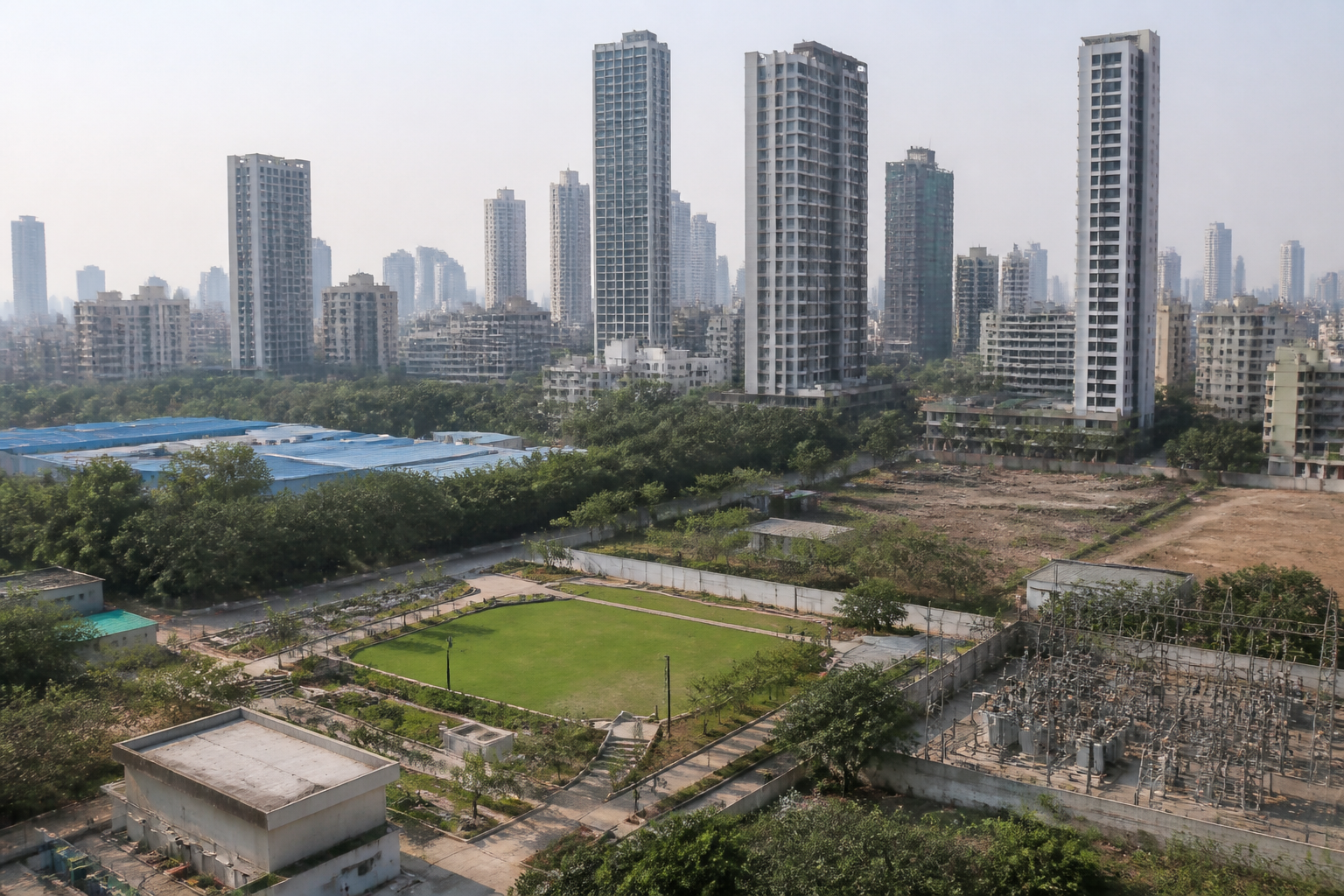
The proposed 30-year lease of the Century Mill land in Lower Parel has moved from committee-level consideration to Mumbai’s municipal corporation agenda. On the surface, the proposal concerns one land transaction: a 25,543-square-metre parcel that the Brihanmumbai Municipal Corporation (BMC) plans to lease for a premium of Rs 1,352 crore. But the dispute surrounding it is about more than the price of a single property. It raises questions about how Mumbai values public land, how recreational reservations are altered, and whether the city should lease strategically located land or retain greater control over its long-term development.
According to a report by Loksatta – Mumbai, the proposal was approved by the improvement committee and is scheduled to be placed before the municipal general body on Monday. The parcel includes a 10,929-square-metre recreation ground, a 1,265-square-metre playground and a 228-square-metre municipal school. The proposal also involves changing the reservation attached to the recreation ground.
These details make the case significant from an urban planning perspective. The parcel is not an undeveloped tract with no existing public use. It contains or is associated with public facilities and reserved open space. Any change to the reservation therefore has consequences beyond the lease arrangement itself. It can affect the distribution of open space in an already intensively developed part of Mumbai, as well as the future use of municipal land that has returned to public ownership after a prolonged legal dispute.
The land’s history is central to the present controversy. The report states that approximately six acres in Lower Parel were originally granted to Century Spinning and Manufacturing Limited from April 1, 1927, for 28 years for housing workers from economically weaker sections. A 1928 agreement covered 476 rooms, 10 shops and chawls constructed on the property. That agreement ended on March 31, 1955.
After the lease ended, the BMC claimed ownership of the land. Century Mill, however, filed a petition in the Bombay High Court seeking transfer of the property in its name, while the municipal corporation contested the claim. The report says the legal dispute ultimately ended with the land returning to BMC possession. It also records a statement that the Supreme Court ruled in the municipal corporation’s favour in the main ownership dispute in January 2025.
That sequence matters because the current proposal is not simply a fresh commercial transaction involving private land. It follows decades of litigation over whether the property belonged to the municipal corporation or the former mill company. Once the land came back into public possession, the city acquired not only an asset but also a responsibility: to explain how its use would serve public interests over the duration of a new lease.
The reported lease premium is Rs 1,352 crore. The source does not provide the complete valuation report, the ready reckoner basis, the detailed development conditions or the final contractual terms. Those omissions are important. A lease premium cannot be assessed only by comparing it with a speculative estimate of the property’s possible sale or development value. It also depends on the permitted use, development controls, floor space index, restrictions attached to reservations, construction obligations, payment structure and the rights retained by the public authority.
Congress group leader Ashraf Azmi has opposed the proposal and called for it to be put on hold. He has alleged that the municipal corporation could be giving a private developer development potential worth around Rs 13,000 crore in exchange for approximately Rs 1,300 crore, creating a loss of Rs 10,000 crore. The report attributes these figures to his assessment rather than establishing them as an independently verified valuation.
Azmi’s calculation is based on an assumption of at least five floor space index and a potential development area of about 1.3 million square feet. It also uses an estimated Lower Parel rate of approximately Rs 1 lakh per square foot. These assumptions illustrate the central difficulty in evaluating the proposal: land value and development value are not identical. The development potential of a site depends on planning permissions, the treatment of reserved land, permissible built-up area, infrastructure requirements and the terms under which construction may take place.
The difference between the proposed premium and the opposition’s estimate should therefore be treated as a question requiring documentation, not as a settled loss. A meaningful public assessment would require the BMC to publish the valuation methodology, the applicable ready reckoner rate, the development capacity considered, the reservation changes proposed and the obligations imposed on the lessee. It would also need to clarify whether the Rs 1,352 crore premium includes the value of development rights, and how the city has accounted for the public facilities currently located on the parcel.
The recreation ground is particularly important. Mumbai’s public open spaces are distributed unevenly, and land-use decisions in dense neighbourhoods can have long-term effects because replacement land is difficult to secure. In this case, the reported proposal would change the reservation of a 10,929-square-metre recreation ground. The source material does not specify the proposed new reservation or describe the precise future use of that portion. That information will be essential for assessing whether the change represents a reconfiguration of public amenities, a reduction in open-space protection or another planning arrangement.
The municipal school covering 228 square metres and the playground covering 1,265 square metres add another layer to the decision. The source does not state whether these facilities would remain in their current form, be relocated, be integrated into a new development or be subject to new operating conditions. Without those details, the public impact of the lease cannot be fully assessed. A transaction involving public land should make such consequences explicit before approval rather than leave them to later implementation decisions.
The proposal also raises the question of whether leasing is the most appropriate model for a strategically located municipal asset. A lease can provide the city with an immediate premium while allowing it to retain ultimate ownership. But the value received at the beginning of a 30-year term may not reflect the value created through future development, especially in a high-demand urban location. The answer depends on the contract’s escalation provisions, revenue-sharing arrangements, development obligations, reversion clauses and protections for public facilities. None of these terms is provided in the report.
Azmi has asked the BMC to examine whether it could develop the land itself and secure a longer-term benefit for Mumbai’s residents. He has also demanded that the ready reckoner rate, complete valuation, development potential and transaction conditions be made public before the land is given to a private developer. These demands identify the information gap at the centre of the controversy. The immediate disagreement is about the price, but the deeper issue is whether councillors and citizens have access to enough information to judge the transaction.
The proposal’s administrative path is also relevant. It has already received approval from the improvement committee and is now moving to the municipal general body. That progression places the next decision within the formal structure of municipal governance. The general body’s consideration will determine whether the proposal is approved, modified, deferred or rejected. The report does not state the outcome of that meeting, so the lease remains a proposal rather than a completed transaction.
The case demonstrates how Mumbai’s former mill lands continue to shape the city’s planning and property debates. Mill areas have become some of the city’s most valuable redevelopment locations, while their histories remain connected to worker housing, industrial employment and public land claims. The Century Mill parcel carries all of these layers at once: a historical worker-housing arrangement, a long ownership dispute, municipal possession, reserved open space and a proposed private lease.
The broader policy question is how a city should manage land that is both financially valuable and socially significant. If municipal land is leased, the public case cannot rest only on the receipt of a premium. It must also account for access to open space, continuity of civic amenities, the treatment of existing residents and workers’ families, and the value of retaining land for future public needs. Conversely, if the city develops land directly, it must demonstrate the financial and institutional capacity to do so effectively. The available report does not resolve that choice, but it shows why the choice requires more than a headline price.
For now, the evidence confirms that the BMC has proposed a 30-year lease for the 25,543-square-metre Century Mill parcel at a reported premium of Rs 1,352 crore, alongside a change to the reservation of a 10,929-square-metre recreation ground. It also confirms that the proposal has drawn political opposition and that competing claims about the land’s development value remain disputed. The next decisive information will be the municipal general body’s decision, the full lease and valuation documents, the treatment of public amenities and the final planning status of the recreation ground.
