


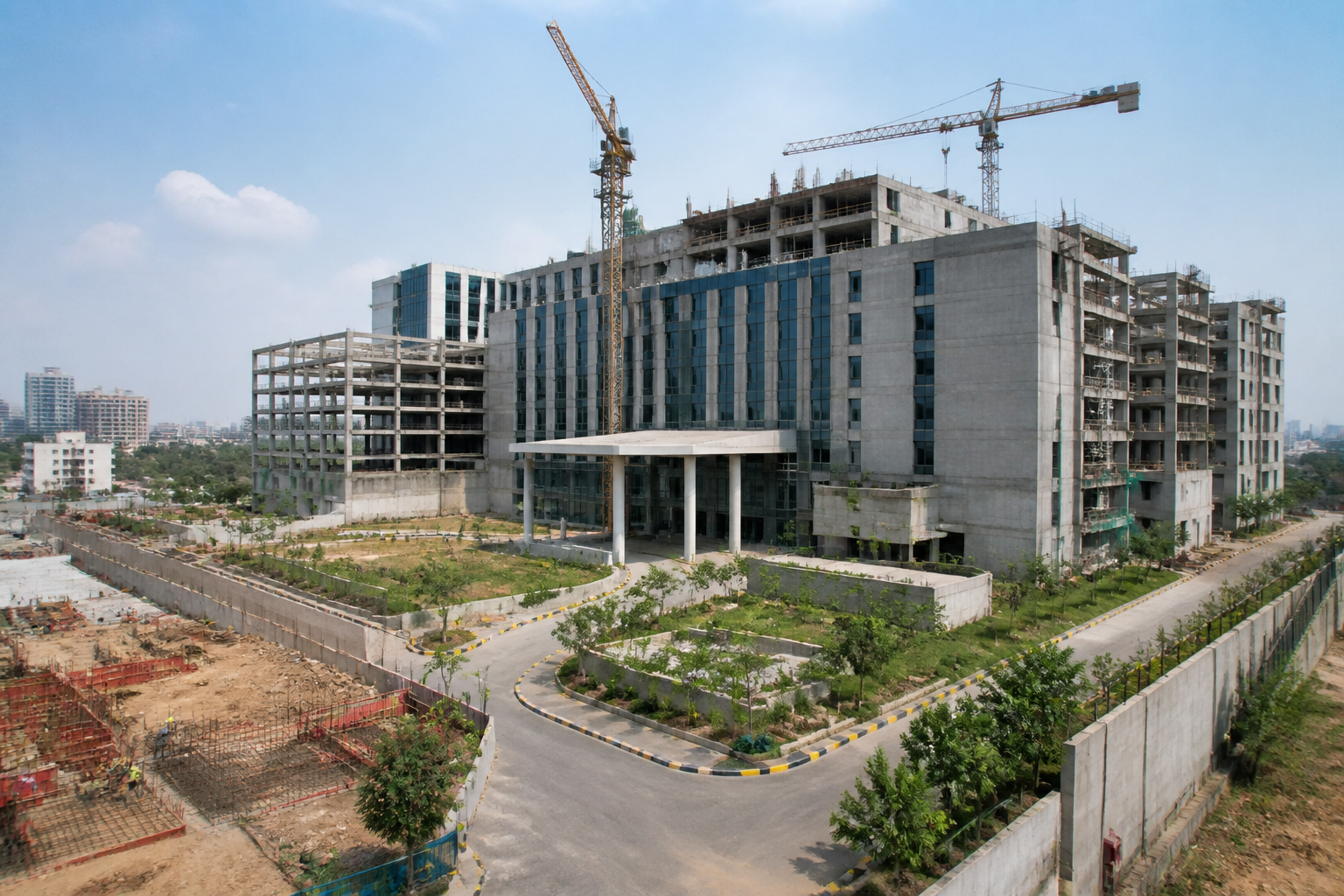
Manipal Hospitals’ plan to add 2,426 beds by 2030, with about 80 per cent coming from hospitals built from scratch, marks a shift in how one of India’s large hospital networks is approaching capacity expansion. The strategy follows several years of acquisition-led growth and places greater weight on land, construction, equipment and long-term utilisation rather than on the faster route of buying operating facilities.
The plan, disclosed in Manipal Health Enterprises’ first annual report after its public listing on August 5, covers approximately 1,943 greenfield beds and 483 brownfield beds. The company is focusing primarily on markets where it already operates, including Karnataka, Maharashtra, Goa and eastern India. It is also evaluating acquisitions in Delhi-NCR, Telangana, Kerala, Andhra Pradesh and Chhattisgarh, while identifying the Mumbai-Pune corridor as a key growth opportunity.
That combination of greenfield projects and selective acquisitions reveals two different approaches to building healthcare capacity. An acquisition can provide immediate access to hospitals, doctors, patients and established catchment areas. A greenfield project offers greater control over location, design, technology and service mix, but requires substantial upfront capital and takes time before beds begin generating revenue. For a hospital network, the choice is therefore not only about adding beds. It is also about deciding where future urban demand can support a new facility and how much financial pressure the business can carry during construction and ramp-up.
The available numbers show why the company is moving towards a more balanced model. Between FY21 and FY26, Manipal added 5,548 beds through the acquisitions of Columbia Asia, Vikram Hospitals, AMRI, Medica Synergie and Sahyadri Hospitals. The Sahyadri acquisition, completed in stages beginning in October 2025, added 10 hospitals and 1,606 licensed beds in Maharashtra. During FY26, Manipal paid around ₹5,255 crore for a stake of nearly 90 per cent and committed another ₹574 crore for a further tranche.
Those acquisitions rapidly expanded the network, but they also enlarged its financial and asset base. Consolidated revenue from operations increased 25.4 per cent to ₹10,335.75 crore in FY26 from ₹8,242.26 crore a year earlier, helped by the consolidation of Sahyadri and higher patient volumes. Earnings before interest, tax, depreciation and amortisation rose 22.1 per cent to ₹2,644 crore. Yet the Ebitda margin narrowed to 25.6 per cent from 26.3 per cent, while profit after tax fell 15.3 per cent to ₹916.59 crore.
The contrast between higher operating revenue and lower profit is central to understanding the next phase of expansion. Finance costs rose 68.9 per cent to ₹864.29 crore, primarily because of higher borrowings, including non-convertible debentures raised for acquisitions and expansion. Depreciation and amortisation increased 34.1 per cent to ₹679.55 crore as the asset base grew following the Sahyadri acquisition. Tax expense also rose, reaching ₹261.51 crore compared with ₹160.64 crore in the previous year.
Net debt, including lease liabilities, increased to 3.7 times Ebitda in FY26 from two times in FY25. Return on capital employed declined to 22 per cent from 27 per cent. These figures do not establish that greenfield expansion will weaken the company’s performance, but they do show the financial conditions under which the new beds will be created. The planned shift from acquisitions to construction is taking place after a period in which debt, depreciation and integration costs have already become more significant.
The indicative cost of the greenfield programme makes the scale clearer. Manipal Hospitals’ managing director and chief executive officer, Dilip Jose, previously told Business Standard that a greenfield hospital of around 250 beds typically requires an investment of ₹380 crore to ₹390 crore, excluding land and building costs. Medical equipment, technology, information technology and interiors account for around ₹1.5 crore per bed. Applying that per-bed benchmark to the planned 1,943 greenfield beds suggests an investment of approximately ₹2,915 crore for those components alone, excluding land and building costs.
This calculation is indicative rather than a disclosed project budget. It nevertheless illustrates the physical and financial demands of expanding hospital capacity in urban markets. A new hospital requires a site large enough for the facility and supporting services, access for patients and emergency vehicles, utility connections, medical equipment, specialised departments and staffing. The cost structure also means that the network must sustain a period during which the facility has been built but has not yet reached mature occupancy.
Existing utilisation provides the company’s stated basis for deciding when to add capacity. Manipal’s occupancy stood at 64.5 per cent in FY26, down from 67.1 per cent in the previous year, even as operational beds increased 20.2 per cent to 6,227 from 5,179. The company generally begins assessing additional capacity when a hospital approaches 70 per cent occupancy, allowing time for construction before existing facilities become constrained.
That threshold points to a planning problem that affects hospital infrastructure more broadly: capacity must be commissioned before demand becomes visible as overcrowding, but early construction can leave expensive assets underused. Manipal’s current occupancy figure remains below the stated assessment point, although the network is unevenly distributed across hospitals and markets. The supplied information does not establish the occupancy of individual facilities or the demand conditions in each proposed location. It does, however, show that the company is using network-level operating metrics as one input into expansion decisions.
The operating data also indicate that demand has continued to grow alongside capacity. Inpatient volumes increased 19.9 per cent to 527,227 in FY26, while outpatient volumes rose 16.2 per cent to 5.48 million. Average revenue per occupied bed increased 8.8 per cent to ₹68,900 per day from ₹63,300. Cardiac sciences, oncology, neurosciences, gastro sciences, orthopaedics and renal sciences together contributed 64.3 per cent of gross inpatient revenue, up from 62.6 per cent in FY25. Oncology recorded the strongest growth among these specialties.
These figures suggest that the expansion is not simply a numerical exercise in adding general beds. The company’s revenue mix is increasingly concentrated in complex clinical specialties, which require specialised equipment, trained staff and carefully planned layouts. A greenfield facility can be designed around such service lines from the beginning, whereas an acquired hospital may require retrofitting or reconfiguration. The source material does not specify the specialty mix of the planned 1,943 beds, so the extent to which new construction will address particular clinical shortages remains unclear.
Geography will be equally important. Manipal’s stated focus on Karnataka, Maharashtra, Goa and eastern India indicates a preference for extending its presence in existing markets rather than building an entirely new national footprint. The Mumbai-Pune corridor is being evaluated as a key growth opportunity, while acquisitions are being considered for Delhi-NCR and several other states. This creates a hybrid expansion map: greenfield projects may add capacity in established operating regions, while acquisitions could provide entry or consolidation in markets where the company sees strategic value.
The distinction matters for urban planning because hospital capacity is tied to the spatial structure of cities. A facility’s usefulness depends not only on its licensed beds but also on its access, catchment, referral network and connection to surrounding housing and transport systems. The supplied material does not provide site-level details, project approvals, construction schedules or land arrangements. As a result, it is not yet possible to assess how the planned facilities will affect particular neighbourhoods or whether they will be located close to the populations most in need.
For Manipal, the next phase therefore involves managing two forms of scale at once. The company must integrate the capacity acquired through Sahyadri and its earlier transactions while creating new facilities that require large upfront investments. Its FY26 performance shows stronger volumes and revenue, but also higher finance costs, depreciation and leverage. The greenfield programme will test whether those investments can be converted into sustainable utilisation without adding disproportionate financial pressure.
The broader urban question is how India’s expanding hospital networks will build capacity as cities grow and demand shifts towards specialised care. Manipal’s plan confirms the scale of private-sector investment being considered, but it does not by itself establish whether new beds will be distributed according to population need, affordability or gaps in public provision. What is clear is that the next stage of healthcare expansion will depend on more than acquisition size: it will require land, construction capital, operational readiness and evidence that the surrounding urban market can support the facilities being built.
The developments to monitor are the locations, approvals, construction timelines and funding arrangements for the planned greenfield beds, alongside occupancy and returns at the enlarged network. Those indicators will show whether Manipal’s move from acquisition-led growth to a predominantly greenfield pipeline becomes a durable model for adding hospital capacity in India’s urban markets.
