


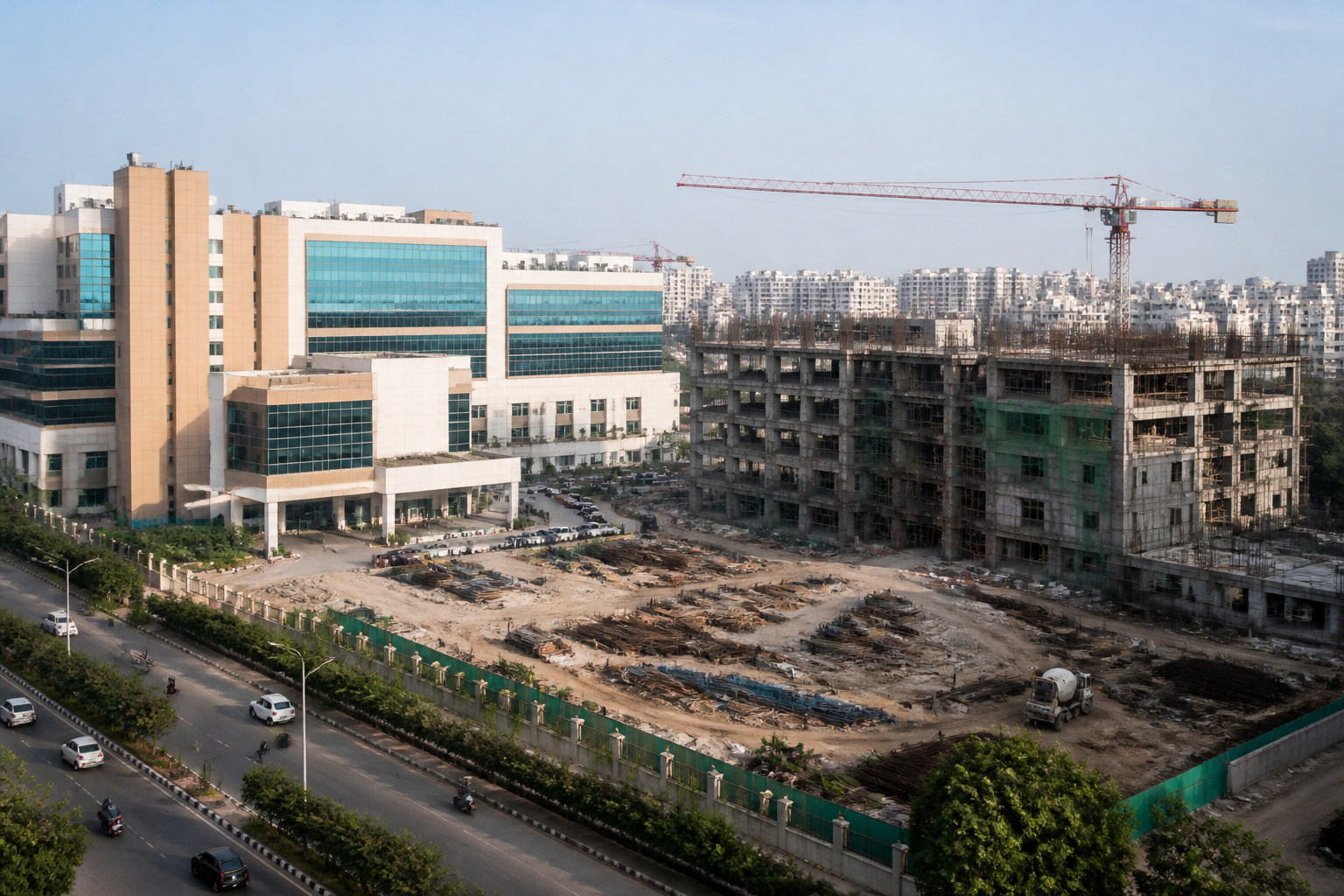
Manipal Hospitals is moving from an acquisition-heavy expansion model towards building more hospitals from scratch, a shift that places capacity creation, capital intensity and execution at the centre of its next phase of growth. The company plans to add 2,426 beds by 2030, of which about 1,943, or 80.1 per cent, are expected to come through greenfield projects.
The plan, disclosed in Manipal Health Enterprises’ first annual report after its public listing on August 5, offers a useful view of how a large private hospital chain is approaching expansion across India’s urban healthcare market. It also shows the trade-off embedded in the model: greenfield hospitals can create new capacity in markets where demand is rising, but they require substantial upfront investment and can add to debt, depreciation and execution risk before the facilities reach mature occupancy.
The company’s identified pipeline includes 483 beds through brownfield expansion at existing facilities and 1,943 beds through new hospitals. The expansion will focus primarily on markets where Manipal already operates, including Karnataka, Maharashtra, Goa and eastern India. It is also evaluating acquisitions in Delhi-NCR, Telangana, Kerala, Andhra Pradesh and Chhattisgarh. The Mumbai-Pune corridor has been identified as a key growth opportunity, while acquisitions are being considered to consolidate the company’s position in Delhi-NCR.
That combination of greenfield and inorganic growth suggests that Manipal is not abandoning acquisitions. Instead, it is adding construction-led capacity to a network that has expanded quickly through purchases of established hospital businesses. Between FY21 and FY26, the company added 5,548 beds through the acquisitions of Columbia Asia, Vikram Hospitals, AMRI, Medica Synergie and Sahyadri Hospitals.
The scale of the Sahyadri transaction illustrates the financial weight of that earlier strategy. The acquisition, completed in stages beginning in October 2025, added 10 hospitals and 1,606 licensed beds in Maharashtra. Manipal paid around ₹5,255 crore during FY26 for a stake of nearly 90 per cent and committed another ₹574 crore for a further tranche. The transaction significantly increased the company’s operating footprint in a major western Indian healthcare market.
The new pipeline is capital-intensive even before land and building costs are included. Dilip Jose, Manipal Hospitals’ managing director and chief executive officer, told Business Standard in an earlier interview that a greenfield hospital of around 250 beds typically requires an investment of ₹380 crore-₹390 crore, excluding land and the building. Medical equipment, technology, information technology and interiors account for around ₹1.5 crore per bed, according to the same benchmark.
Applied indicatively to the planned 1,943 greenfield beds, the equipment and related investment could amount to approximately ₹2,915 crore, excluding land and building costs. That calculation is not a disclosed project budget, and actual expenditure could vary by location, hospital format, specialty mix, construction cost and land arrangements. It nevertheless establishes the scale of funding required to create capacity rather than acquire it.
Greenfield development also changes the timing of returns. An acquired hospital comes with an operating base, existing clinical teams and patient volumes, although integration and improvement may still be required. A new hospital must establish those elements over time. The company’s occupancy figures show why the timing of new capacity matters to its planning process.
Manipal’s occupancy stood at 64.5 per cent in FY26, down from 67.1 per cent in the previous year, while operational beds increased 20.2 per cent to 6,227 from 5,179. The company generally begins assessing additional capacity when a hospital approaches 70 per cent occupancy, allowing time for construction before existing facilities become constrained.
The decline in occupancy, despite the increase in operational beds, indicates that capacity was added faster than it was filled across the network during the year. That does not by itself establish weak demand. It does show that the company’s expansion strategy has a material ramp-up component: new or acquired facilities can dilute average occupancy until patient volumes and clinical activity catch up.
The distinction matters for cities and urban regions where hospital demand is unevenly distributed. A large healthcare network may add beds nationally while still facing shortages in particular corridors, specialties or catchment areas. Manipal’s focus on existing markets and its identification of the Mumbai-Pune corridor point to an expansion model based on areas where the company sees a combination of demand, operating familiarity and opportunities to build or consolidate a network.
The company’s FY26 financial results show both the benefits and the costs of its recent growth. Consolidated revenue from operations increased 25.4 per cent to ₹10,335.75 crore from ₹8,242.26 crore a year earlier. Earnings before interest, tax, depreciation and amortisation rose 22.1 per cent to ₹2,644 crore. However, the Ebitda margin narrowed to 25.6 per cent from 26.3 per cent.
Profit after tax declined 15.3 per cent to ₹916.59 crore from ₹1,081.67 crore. Finance costs rose 68.9 per cent to ₹864.29 crore, primarily because of higher borrowings, including non-convertible debentures raised for acquisitions and expansion. Depreciation and amortisation increased 34.1 per cent to ₹679.55 crore, reflecting the larger asset base following the Sahyadri acquisition. Tax expense also rose to ₹261.51 crore from ₹160.64 crore.
These figures reveal why the greenfield plan is more than a construction programme. It is also a balance-sheet and operating-maturity decision. New hospitals require investment before they generate their full revenue potential, while acquired facilities can bring faster scale but may require substantial funding and integration. In FY26, Manipal’s net debt, including lease liabilities, rose to 3.7 times Ebitda from two times in FY25. Return on capital employed declined to 22 per cent from 27 per cent.
At the same time, operating indicators improved. Average revenue per occupied bed rose 8.8 per cent to ₹68,900 per day from ₹63,300. Inpatient volumes increased 19.9 per cent to 527,227, while outpatient volumes rose 16.2 per cent to 5.48 million. The figures suggest that the network was handling more activity and generating more revenue from occupied beds, even as the rapid addition of capacity and acquisition-related costs weighed on profitability measures.
The composition of clinical activity is also shifting. Cardiac sciences, oncology, neurosciences, gastro sciences, orthopaedics and renal sciences, classified by Manipal as CONGO-R, contributed 64.3 per cent of gross inpatient revenue, up from 62.6 per cent in FY25. Oncology recorded the strongest growth among these specialties. The data indicates that expansion is occurring alongside a concentration of revenue in complex and specialised care, rather than being limited to general inpatient capacity.
For urban healthcare planning, the central question is therefore not simply how many beds are added. It is where they are located, which specialties they support, how quickly they become operationally viable and whether the surrounding transport, workforce and referral systems can support them. The supplied information does not establish the affordability, public-private case mix or geographic accessibility of the planned hospitals. It does establish that Manipal is targeting capacity in selected regional markets while continuing to evaluate acquisitions in a wider set of states and urban corridors.
The policy and institutional environment is not detailed in the supplied material, so the specific approvals, land arrangements, public-health partnerships or state-level implementation frameworks for the planned projects are not yet established. Those factors will affect the pace and cost of greenfield delivery. The company’s stated preference for markets where it already has a presence may reduce some operational uncertainty, but it does not remove the need for site-level approvals, staffing, equipment procurement and patient acquisition.
The company’s public listing adds another layer to the expansion strategy. Manipal’s ₹9,275.21-crore initial public offering comprised a fresh issue of ₹8,000 crore and an offer for sale of ₹1,275.21 crore. Its shares listed at ₹652 on the National Stock Exchange, a 10.5 per cent premium to the issue price of ₹590, and closed at ₹725.20 on September 4, according to the report. The market data forms part of the company’s post-listing context, but it does not by itself determine whether the planned hospital capacity will be delivered or become profitable.
What the evidence confirms is a transition in the company’s growth mix. Manipal has used acquisitions to add thousands of beds and establish a broader operating network. It now intends for four-fifths of its identified pipeline to come from greenfield projects, which will require a different form of execution and a longer path from investment to mature operations.
The immediate indicators are mixed but clearly defined. Revenue, inpatient volumes, outpatient volumes and average revenue per occupied bed increased in FY26. Debt, finance costs, depreciation and taxes also rose, while profit after tax, return on capital employed and the Ebitda margin declined. Occupancy remained below the company’s stated threshold for assessing additional capacity, even after the network’s operational bed count expanded sharply.
The developments that deserve monitoring are the location and timing of the 1,943 greenfield beds, the balance between new construction and further acquisitions, the funding of projects excluding land and buildings, and the pace at which new capacity reaches sustainable occupancy. Until those details emerge, Manipal’s expansion plan is best understood as a large-scale capacity bet whose success will depend on converting financial investment into functioning hospitals, clinical activity and durable operating returns.
