


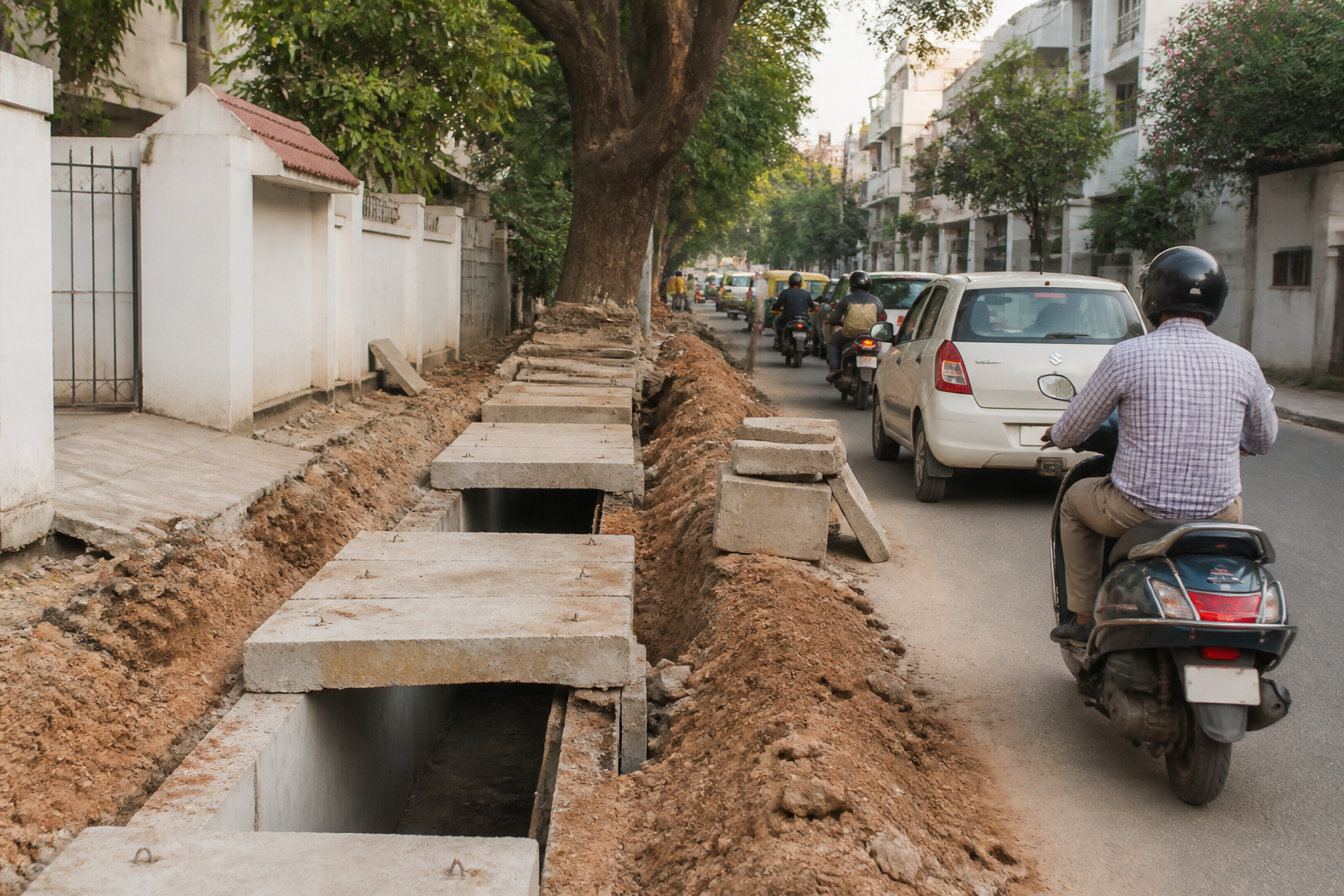
Cooke Town’s drain works were intended to improve roadside infrastructure. Instead, a project that has continued for about two months has become a test of how Bengaluru manages routine civic construction in occupied neighbourhoods. Residents have reported damaged compound walls, debris, elevated concrete slabs, traffic congestion and concerns about the design and quality of the work on Wheeler Road and Hutchins Road.
The immediate dispute is local, but the underlying issue is common across Indian cities: public works are often judged by whether a project is sanctioned and started, while residents experience them through access, safety, drainage performance and the condition in which the worksite is left each day. In Cooke Town, the supplied report shows a gap between the existence of a civic project and the arrangements required to make that project workable for the people living alongside it.
Bangalore Mirror reported on September 5, 2026, that residents had been dealing with the consequences of the ongoing drain development work for two months. The report said work had affected busy neighbourhood roads and that residents questioned the construction methods, supervision and use of concrete covers. A previous Bangalore Mirror report, published on August 18, had already highlighted complaints about delayed and substandard drain development work in Cooke Town. The latest account therefore describes a continuing problem rather than a single-day disruption.
The most direct evidence concerns the interface between construction and private property. Constantine Pereira, a resident, said an earth-moving machine damaged his compound wall while the existing drain was being dismantled. He also said the wall had not been repaired after two months and that a concrete slab placed over the drain was higher than the ground level, making it difficult to close his gate. These details point to a basic site-management question: how is a contractor expected to protect adjoining properties, maintain access and restore damage as work progresses?
The contractor-appointed supervisor, identified as Manoj, said debris would be cleared and that he would repair the damaged compound walls. The statement is significant because it identifies a possible remedy, but the supplied report does not establish when the repairs would be completed, how many properties were affected or whether the work had been inspected after the reported damage. Those missing details matter because residents experience accountability through completed repairs, not assurances alone.
The report also records criticism of municipal oversight. Albert R, founder-president of the Cooke Town Nivasigala Sangha, said Bengaluru North City Corporation engineers had not adequately supervised or inspected the quality of the drain development work. He argued that the contractor should clear debris daily so that residents and motorists are not inconvenienced, particularly during peak hours. The association’s position was not opposition to development works; it was a demand that construction should not become a continuing obstacle to movement.
This distinction is important for urban governance. A drain project does not operate in isolation from the road above it. It occupies carriageway or roadside space, changes pedestrian and vehicle access, affects property entrances and can create temporary hazards. If debris clearance and access management are treated as secondary tasks, the project can transfer its costs to residents and road users. In this case, those costs reportedly include damaged walls, blocked stretches and recurring congestion.
The traffic impact has been quantified only through the residents’ account. More than 600 residents of Wheeler Road and Hutchins Road signed a petition seeking intervention to ensure hassle-free commuting. Pamela Parashar, a resident, said traffic jams had become routine during peak hours on Wheeler Road and called for action by the authorities, including the traffic police. The report does not provide traffic counts, lane-closure details or a formal traffic-management plan, so it cannot establish the precise scale of delay. It does, however, show that the project has generated a collective demand for intervention across two roads.
That petition also illustrates how a small-area infrastructure project can become a governance issue. Residents who may have little influence over technical design or contractor management can still document disruption collectively. A petition does not by itself confirm that construction has breached a specification, but it is evidence of perceived and shared impact. It also creates a public record against which the authorities’ response can be assessed.
The design of the drain covers has raised a separate concern. Some residents described the concrete slabs as inferior or substandard. Another resident questioned the decision to concretise the drain, arguing that it left no provision for rainwater percolation and could affect trees along the road. The supplied material does not include a technical drawing, soil assessment, stormwater standard or engineering inspection, so it cannot determine whether the design is defective. The concern nevertheless identifies a larger planning question: whether roadside drainage is being treated only as a covered channel or as part of a wider system involving runoff, groundwater, trees, access and road safety.
The distinction between a covered drain and a functioning stormwater system is consequential. A concrete cover may improve access or reduce exposure to an open channel, but the report’s account suggests that the way covers are installed can create new problems when they sit above adjoining ground levels. Drainage infrastructure has to connect with the road edge and property entrances at usable levels. It also has to be maintained after construction. Without technical information, the performance of the Cooke Town design cannot be judged, but the residents’ concerns show that visible construction does not necessarily resolve the drainage problem as experienced at street level.
The institutional chain described in the report is relatively short: residents raised concerns; a contractor-appointed supervisor addressed debris and repairs; and a BNCC assistant engineer responded to the complaint about damaged walls. BNCC Assistant Engineer Sandeep said no one had complained to him about the damage and that he would attend to the problem if it was brought to his notice. This response exposes a familiar administrative weakness: a complaint may exist in the neighbourhood without reaching the officer responsible for acting on it through a recognised channel.
That gap is not merely procedural. When responsibility is divided between residents, contractors and municipal engineers, unresolved issues can persist because each party may assume that another has recorded them. The report does not establish whether a formal complaint was filed, whether a site inspection took place or whether the contractor was issued a written direction. Those are key facts for evaluating supervision, and their absence means the current evidence supports concern but not a final finding of negligence.
The episode also shows why construction quality cannot be separated from construction sequencing. Dismantling an existing drain, managing excavated material, installing a new structure, placing covers and restoring edges are connected steps. If one stage remains incomplete, the effects spread: debris narrows the road, an unfinished edge affects access, an incorrectly placed slab creates a level difference and delayed restoration leaves residents bearing the inconvenience. The report indicates that residents have experienced these problems over approximately two months, but it does not state the project’s approved duration or completion deadline.
That missing timeline is central to understanding whether the work is delayed, proceeding within schedule or affected by an undisclosed technical issue. A credible public account would need the work order, planned completion date, contractor details, scope of work and inspection records. It would also need clarity on whether the drains are part of a larger road or stormwater project and how traffic movement is meant to be managed while the work continues. None of those documents is included in the supplied report.
The available evidence therefore supports a measured conclusion. Cooke Town’s drain works have created a sustained conflict between infrastructure improvement and everyday urban functioning. Residents have reported property damage, debris, access problems, congestion and concerns about concrete covers. The contractor’s supervisor has promised debris clearance and repairs, while a BNCC assistant engineer has said he will respond if the damage is brought to his notice. These statements establish the competing accounts, but not whether corrective action has been completed.
What happens next should be assessed through verifiable milestones: clearance of debris, repair of damaged walls, correction of unsafe or inconvenient level differences, a response to the petition, and an inspection of the completed drain and covers. The authorities’ ability to provide the project schedule, technical rationale and inspection record will determine whether the Cooke Town dispute remains a neighbourhood grievance or becomes a documented example of how Bengaluru manages civic works on lived-in streets.
