


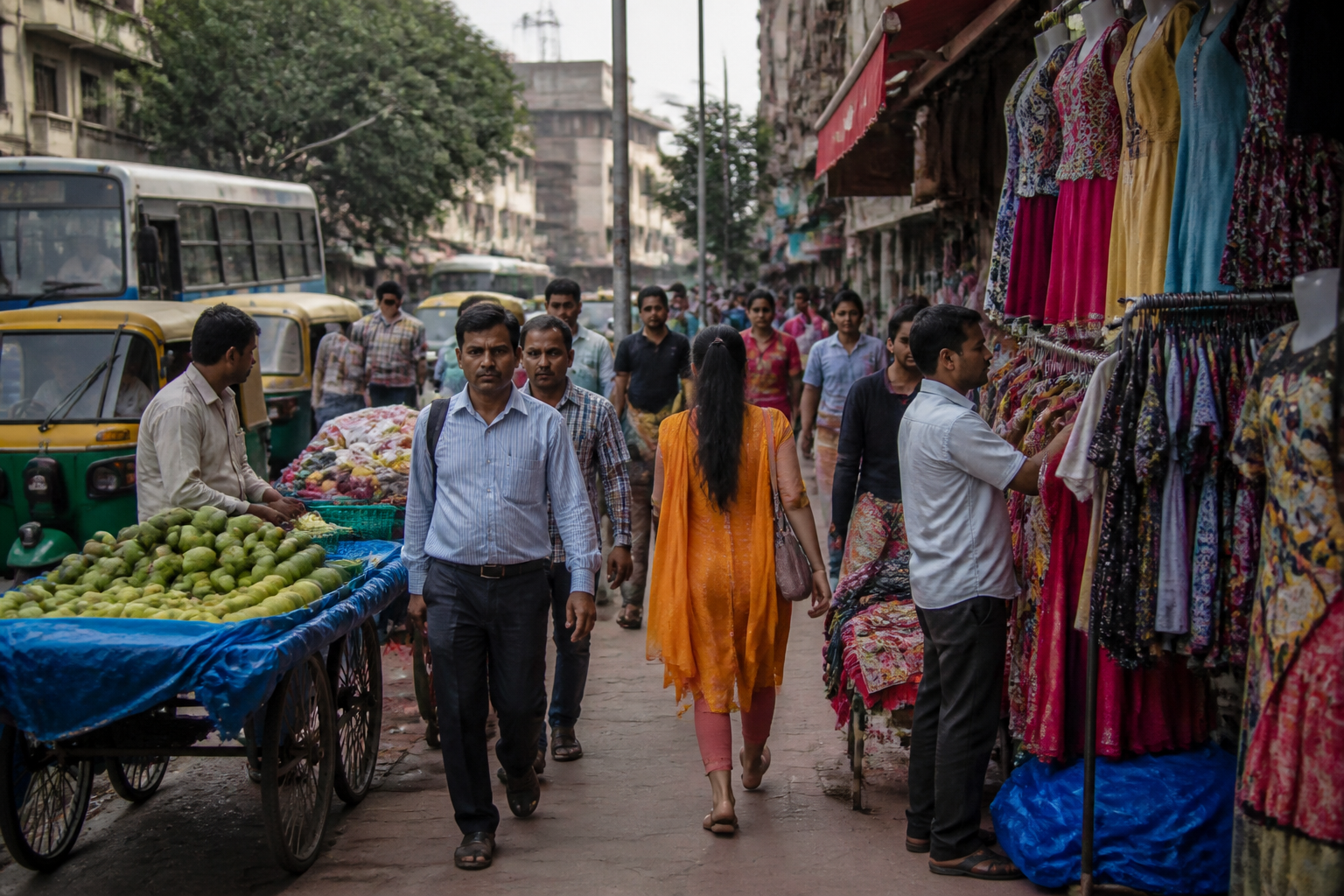
Bengaluru’s recurring footpath encroachments are not simply a story of vendors returning after eviction drives. On Church Street and Commercial Street, the pattern described by residents and shoppers points to a larger administrative problem: public space is cleared temporarily, but the system does not keep it clear or provide a stable arrangement for those who depend on it for trade.
The report published by Bangalore Mirror on September 3, 2026, describes vendors returning to Church Street within days of enforcement drives. Residents say carts, stalls, shop displays and other goods again occupy pedestrian space, forcing people to share narrow stretches with vehicles. Similar conditions are reported on Commercial Street and connecting roads such as Ibrahim Sub Street.
That recurrence changes the character of the problem. A single encroachment drive can be measured by the number of carts removed or the length of pavement cleared. But repeated return raises a different question: what happens after the enforcement team leaves? In the accounts supplied to the report, the answer is that the occupation resumes quickly, sometimes the next day. The result is a cycle in which enforcement produces a brief visible change without resolving the underlying conflict over street space.
The immediate cost is borne by pedestrians. Church Street attracts shoppers and visitors, while Commercial Street is a busy retail destination. Residents and shoppers quoted in the report describe footpaths that are difficult to use when vendors, shopkeepers’ goods, stands, carts and billboards extend into the pedestrian corridor. On smaller connecting roads, the pressure is compounded when vehicles pass through, leaving people with little room to move.
One frequent shopper said clear footpaths had made it possible to walk comfortably and view shops without repeatedly stepping aside for carts or vehicles. After vendors returned, the shopper said there was hardly any space. Autos and cabs were also described as being reluctant to enter smaller roads, sometimes dropping passengers farther away. These accounts connect footpath encroachment to more than inconvenience: it affects how people reach shops, move between streets and access local transport.
Yet the report also makes clear that the conflict cannot be reduced to vendors alone. A resident of Infantry Road said shopkeepers were placing goods, stands, carts and billboards outside their establishments. That distinction matters for enforcement. If public space is occupied by different types of commercial activity, action focused only on mobile hawkers may leave a substantial part of the problem untouched.
The evidence in the report therefore describes a mixed-use enforcement challenge. Pushcarts, clothing, merchandise and food-related activity are visible on the street, but fixed shops can also expand into the public realm. Jewellery, clothing and cap shops, along with eateries, are identified as occupying parts of Church Street’s footpaths. The administrative response needs to account for the full range of activity described by residents rather than treating the street as a problem created by one category of user.
The role of monitoring is central to the breakdown described. Sanjay Kumar, president of the Church Street Residents Welfare Association, wrote to Bengaluru Development Minister Krishna Byre Gowda and the Greater Bengaluru Authority, or GBA, about the encroachments. He said evictions initially cleared the area, but vendors returned in two days. According to Kumar, residents complain to the GBA, action is taken and vendors are asked to free the footpath, but they return the following day.
Kumar also called for an inquiry into alleged leaks about enforcement drives. The association’s claim is that vendors remove their carts before officials arrive and return after enforcement teams leave. The supplied report does not establish whether such leaks occurred. It does, however, show why residents view the current process as ineffective: the timing of clearance and reoccupation appears to produce a repeated loop, while responsibility for sustained enforcement remains unclear.
The report refers to both the GBA and traffic police. Residents have asked the traffic police to ensure that enforcement is strict and monitored. This indicates that footpath encroachment is not confined to one administrative function. The issue involves the management of pedestrian space, regulation of commercial activity and the movement of vehicles on adjoining streets. When these responsibilities are separated without visible coordination, a cleared footpath can quickly become unusable again.
The institutional question is particularly important because the report records complaints being directed to the GBA, while residents also expect traffic police involvement. The available material does not specify the precise legal or operational division between the agencies, nor does it identify the enforcement schedule, penalties imposed or number of establishments penalised. Those gaps limit what can be concluded about the effectiveness of the current system. They also point to the information that residents would need in order to judge whether enforcement is continuous, targeted and accountable.
The demand for designated vending zones offers a different approach to the recurring cycle. The shopper quoted in the report said vendors need to earn a livelihood and should be given specific areas where they can sell without occupying footpaths. This proposal seeks to separate two objectives that are currently colliding on the same narrow public space: maintaining a continuous pedestrian route and preserving access to street-based livelihoods.
Designated vending zones, however, would only address part of the issue described. They would need to be accompanied by a clear treatment of shopfront extensions and other commercial obstructions. The Infantry Road resident called for confiscation of goods, penalties and, in cases of repeated non-compliance, sealing establishments. These demands represent a stricter enforcement position, particularly towards shopkeepers who place merchandise and advertising material outside their premises.
The contrast between these positions shows why the city’s response cannot rely on a single measure. Repeated eviction without an alternative arrangement leaves the livelihood question unresolved. Designated zones without rules for shopfront encroachment could leave pedestrians facing the same obstruction from another source. Penalties without consistent monitoring may produce another temporary clearance rather than a durable result.
The supplied report does not provide data on the total length of encroached footpaths, the number of vendors affected, the number of drives conducted or the duration of each clearance. It also does not state how many vending zones exist, whether any have been proposed for Church Street or Commercial Street, or how many penalties or confiscations have taken place. Without those figures, it is not possible to quantify the scale of the problem or compare enforcement performance across locations.
What can be established is the repeated nature of the local experience. Church Street residents report a return within two days. A shopper describes vendors returning to Commercial Street after clearance. Ibrahim Sub Street is identified as a connecting stretch where pedestrians struggle when vehicles pass. These specific accounts show a system under pressure at multiple points around busy shopping areas, even though the wider extent of the problem is not established by the material available.
The larger urban question is who gets priority when commercial activity, traffic and pedestrian movement compete for limited street space. Footpaths are intended to provide a safe route for walking, but in the locations described they also function as places for selling, displaying goods, waiting and accessing shops. The conflict is therefore built into the way the space is being used and regulated.
For Bengaluru, the significance lies in the gap between an enforcement event and an enforceable public-space arrangement. Clearing a footpath is a visible action. Keeping it available requires follow-up, monitoring, clarity about agency responsibility and rules that apply to both mobile vendors and established businesses. The report does not establish which of these mechanisms is missing or failing, but residents’ accounts show that the present cycle is not delivering lasting access.
The next stage of scrutiny should focus on what the GBA and traffic police do after each drive, whether the allegations about leaked schedules are investigated, how shopkeepers are treated alongside vendors, and whether designated vending areas are being considered. Until those details are available, the evidence confirms a recurring pattern rather than a complete explanation. Bengaluru’s footpath problem is visible on the street; its resolution depends on whether enforcement can become continuous governance rather than an occasional clearance exercise.
