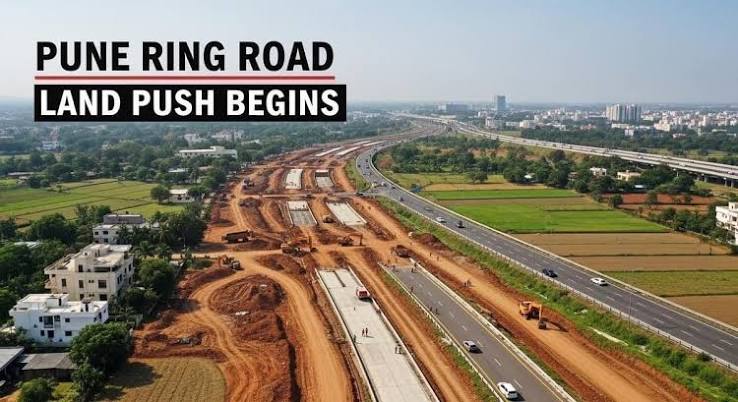
Pune Inner Ring Road Spurs Demand For Clear Planning
Pune: Work on land acquisition for Pune’s proposed Inner Ring Road is moving ahead, but uncertainty over land-use planning in parts of East Haveli is emerging as a key concern. Residents and local businesses want development plans settled before acquisition advances, arguing that unclear road alignment and future reservations could affect property rights, construction permissions and investment decisions across rapidly urbanising areas.
The 83.12-km project is planned as a 65-metre-wide corridor intended to divert heavy traffic away from central Pune and improve connections between major employment, industrial and transport hubs. PMRDA lists an administrative approval of ₹14,200 crore, while its current project data puts the land requirement at 720.78 hectares. The immediate implementation push is focused on the first stretch between Solu and Vadgaon Shinde. PMRDA says joint land measurement and valuation have been completed in Solu, Nirgudi and Vadgaon Shinde. The authority has also submitted acquisition proposals covering nine additional Haveli villages, including Kadamwakvasti, Wadachiwadi, Pisoli and Yewalewadi. The issue is not only about compensation. In fast-growing peripheral areas, a major road can reshape land values, building patterns, commercial activity and access to public infrastructure. Without a clear development framework, landowners may face uncertainty over where construction is permitted, while future development could emerge in ways that increase traffic pressure rather than reduce it.
That concern is particularly relevant because the corridor crosses multiple administrative areas. Maharashtra’s urban development department identifies different implementation responsibilities for the wider project, while PMRDA’s own planning documents show that portions are linked to town-planning schemes and other development mechanisms. For residents, the timing of planning decisions matters as much as the road itself. A development plan can establish land-use reservations, road networks and infrastructure priorities before large-scale construction begins. Urban planners say this can reduce the risk of fragmented growth, particularly around interchanges where commercial and residential development tends to accelerate. The project also carries a wider environmental implication. PMRDA says the Inner Ring Road is intended to reduce congestion and urban pollution by rerouting heavy vehicles. But those gains will depend on how effectively surrounding growth is managed. A road designed to improve mobility can generate additional private-vehicle traffic if housing, workplaces and services remain poorly connected to public transport and walking networks.
With land acquisition now advancing, the next stage should therefore align compensation, road design and development planning. For Pune’s expanding metropolitan edge, the success of the Inner Ring Road will ultimately depend not just on completing the carriageway, but on ensuring that the growth around it remains predictable, accessible and infrastructure-ready.