


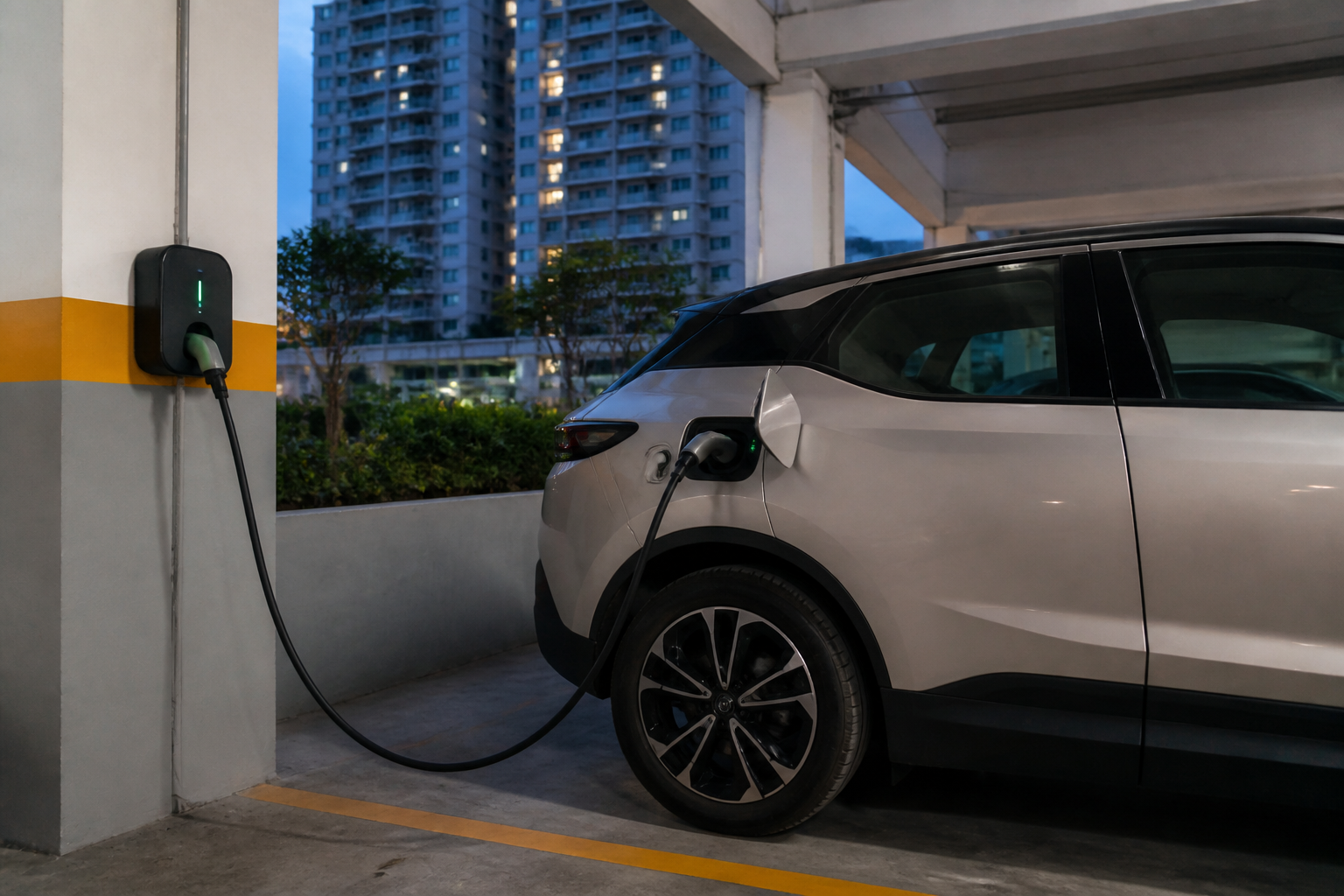
For many electric-vehicle buyers, the first question about charging is where to find a public station. In apartment buildings, however, the more consequential question may be whether the building’s electrical system can support the vehicle at all. A report published by NDTV Business on September 2, 2026, highlights the gap between buying an EV and creating the electrical infrastructure needed to charge it at home.
The issue is not limited to the charger installed beside a parking slot. It involves the sanctioned load of an individual home, the wiring connecting the parking area, the availability of a dedicated circuit or meter, the capacity of the housing society’s transformer and the approvals required from the residents’ association, facility manager and local electricity distributor. Together, these determine whether home charging is technically possible, safe and affordable.
The distinction between an independent house and an apartment is central. In an independent home, the owner may have more control over the connection between the electricity supply, the charger and the parking area. In a multi-storey building, the charging point usually sits within a shared electrical and administrative system. That means one resident’s decision to install a charger can eventually become a capacity and governance question for the entire housing society.
The first constraint is sanctioned load. The NDTV report says most homes have a sanctioned load of around 3-4 kilowatts, while an EV charger can add 7.5 kW or more, depending on the vehicle and charger. Anil Kumar, founder and chief executive officer of Charger On Wheels, told NDTV that charging one car over eight to 10 hours requires a minimum additional 7.5 kW. Faster chargers can require as much as 22 kW.
These figures change the way a household’s electricity connection has to be understood. An EV charger is not simply another small appliance added to an existing circuit. It can operate for several hours and draw substantial power, potentially taking a household beyond the capacity for which its connection was designed. If the sanctioned load is insufficient, the owner may need to seek an upgrade through the local distribution company, or DISCOM.
For apartment residents, an individual load upgrade may still leave the larger problem unresolved. A society may contain dozens or hundreds of flats, each with existing demand from lifts, water pumps, air conditioners and household appliances. If several residents begin charging vehicles during the same period, the combined demand can put pressure on the building’s transformer and distribution network.
Kumar told NDTV that this issue is increasingly appearing in residents’ welfare association meetings because many residential buildings were not designed around widespread EV charging. The immediate concern is simultaneous charging. A transformer with limited spare capacity may be able to support one additional charger, but the same assumption cannot automatically be extended to every parking space in the building.
The report does not establish how many housing societies currently face transformer constraints or how much additional capacity would be required across Indian apartment buildings. It does, however, identify the infrastructure layers that must be checked before a buyer commits to a vehicle. The problem is therefore less about a single device and more about the capacity of a shared urban system.
Parking arrangements add another layer of complexity. A buyer needs to know how the parking space will be connected, whether a dedicated meter or circuit is possible and whether the supply will come from the flat’s existing connection or require a separate arrangement. In a building where parking is physically distant from individual meters, the wiring route and ownership of the connection can become as important as the charger itself.
Hari Krishna, founder and chief executive officer of Green Drive Mobility, told NDTV that buyers should understand whether the parking space can be connected to a dedicated meter or circuit and whether the society’s transformer and distribution system have enough capacity. He also said that modifying the electrical network underneath the charger may cost more and take more time than installing the charger itself.
This distinction is significant for the economics of EV ownership. The visible equipment may be the charger, but the less visible expenses can include additional wiring, a load upgrade, separate metering, approvals and wider infrastructure improvements. The report does not provide cost estimates for these interventions, and the actual requirement will depend on the building, its electrical design, the charger and the procedures followed by the relevant DISCOM and housing society.
The administrative process can also affect the practicality of home charging. Prospective buyers are advised to speak to the RWA, facility management and local DISCOM before purchasing the vehicle. The report notes that rules and procedures can differ across states and electricity distribution areas. In an apartment, the ability to charge at home may therefore depend on an institutional decision as much as on the buyer’s personal electricity connection.
Once capacity and approvals are addressed, the installation still requires an appropriate circuit. Kumar recommends dedicated wiring, proper miniature circuit breaker and residual-current circuit-breaker protection, a separate meter or segregated connection and a safe, ventilated location. The charger should be certified and installed by a qualified professional.
The safety point is particularly important because charging is a sustained electrical load rather than a brief, occasional use of power. The report warns against treating a temporary extension cable or improvised connection as a substitute for a properly designed circuit. This places responsibility on several actors: the vehicle owner, the installer, the housing society and the electricity distributor.
One possible way to manage shared capacity is smart charging. Instead of every vehicle charging at full power at the same time, charging can be staggered or managed according to the electricity available in the building. Krishna told NDTV that regular load checks, suitable cables, smart charging and clear society rules could help housing associations manage rising EV demand.
Smart charging does not remove the need for adequate infrastructure. It changes how available capacity is allocated. A society may be able to reduce simultaneous demand by scheduling charging at different times, but it would still need to understand the capacity of its transformer, internal wiring and distribution system. The report provides no evidence on how widely such systems are currently used in Indian housing societies, so their practical adoption remains an open question.
The discussion points to a broader challenge in the transition to electric mobility. Vehicle adoption and urban infrastructure do not always expand at the same pace. A car can be purchased immediately, while the electrical network that supports repeated charging may require permissions, technical assessment and investment. In apartment-heavy cities, the charging question therefore sits at the intersection of transport, housing governance, electricity distribution and building management.
It also complicates the idea that home charging is automatically the simplest or cheapest option for every EV owner. For some residents, the necessary connection may be straightforward. For others, the building’s shared system, parking layout or approval process may become the determining factor. The difference cannot be inferred merely from whether a neighbouring resident has already installed a charger, because one existing connection does not prove that the building has sufficient capacity for many more.
The evidence supplied in the report confirms the main technical and administrative checks buyers should make: sanctioned load, transformer capacity, parking-space connectivity, metering, society approvals, protective equipment and professional installation. It does not establish a national measure of the scale of the problem, a uniform regulatory framework or the costs of upgrading apartment infrastructure. Those gaps matter because requirements may vary across buildings, states and distribution areas.
For now, the most immediate implication is procedural. EV buyers living in apartments need to assess the building’s electrical readiness before booking the vehicle, rather than treating charging as an installation decision to be made later. Housing societies, meanwhile, are being pushed to consider whether their common infrastructure can accommodate multiple private charging connections.
The next stage will depend on how individual residents, RWAs, facility managers and DISCOMs handle these requests, and whether societies adopt clear rules for metering, approvals, safety and charging schedules. Until those systems are examined, the availability of a parking space does not by itself guarantee the availability of a reliable home-charging connection.
