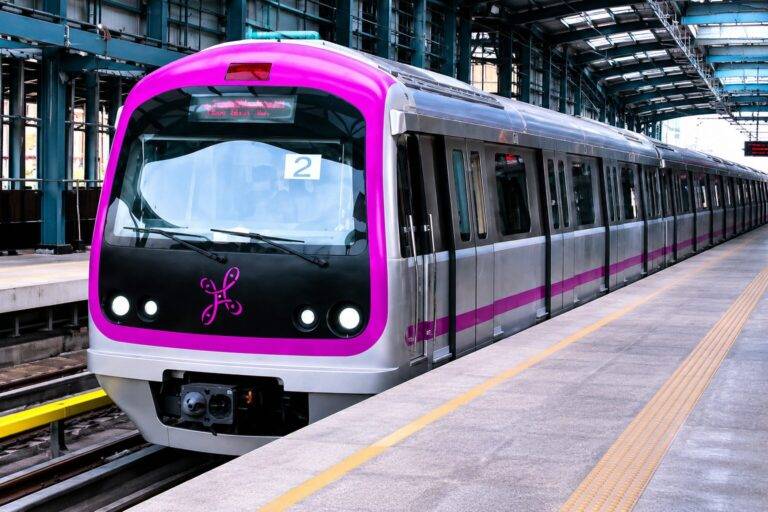
Bengaluru’s long-awaited Pink Line is nearing another opening window, but repeated deadline shifts have raised questions about project execution and the city’s ability to deliver major public transport infrastructure on schedule. The 7-km elevated section between Kalena Agrahara and Tavarekere is now being targeted for a September 2026 launch, after the earlier August 15 deadline was missed.
The immediate hurdle is not construction of the elevated corridor but the final safety and signalling clearances required before passenger operations can begin. Train testing has progressed, including oscillation and emergency braking trials, while statutory approvals remain part of the final commissioning process. The Bengaluru Pink Line is important because even its first operational section can add a new rapid-transit option along the heavily used Bannerghatta Road corridor. The six-station elevated stretch includes Jayadeva, where passengers will eventually be able to interchange with the Yellow Line. That connection could make the corridor more useful than a standalone suburban route by allowing passengers to transfer across Bengaluru’s expanding Metro network.
However, the delay also highlights a wider weakness in Bengaluru’s Metro expansion: infrastructure commissioning is often treated separately from the conditions required for commuters to reach stations. On parts of Bannerghatta Road, pedestrian paths remain incomplete or obstructed, while open drains, roadside waste and inadequate bus-stop infrastructure can make station access difficult. This matters because Metro ridership depends heavily on the quality of the journey before and after the train ride. A station surrounded by unsafe walking routes or weak feeder connections can reduce the practical benefit of a new corridor, particularly for residents who do not own private vehicles.
The Pink Line’s larger 21-km corridor will eventually connect Kalena Agrahara with Nagawara, including a 13.76-km underground section between Dairy Circle and Nagawara. That underground portion, which includes central locations such as MG Road and Shivajinagar, is on a separate construction and commissioning timeline and has faced its own schedule pressures.
For Bengaluru, the Bengaluru Pink Line therefore represents both a transport opportunity and a test of delivery discipline. Opening the elevated section safely is the immediate priority, but authorities will also need to improve pedestrian access, feeder connectivity and station-area infrastructure. A reliable commissioning process combined with strong last-mile planning would give commuters far more value from the investment than simply putting trains into service.