


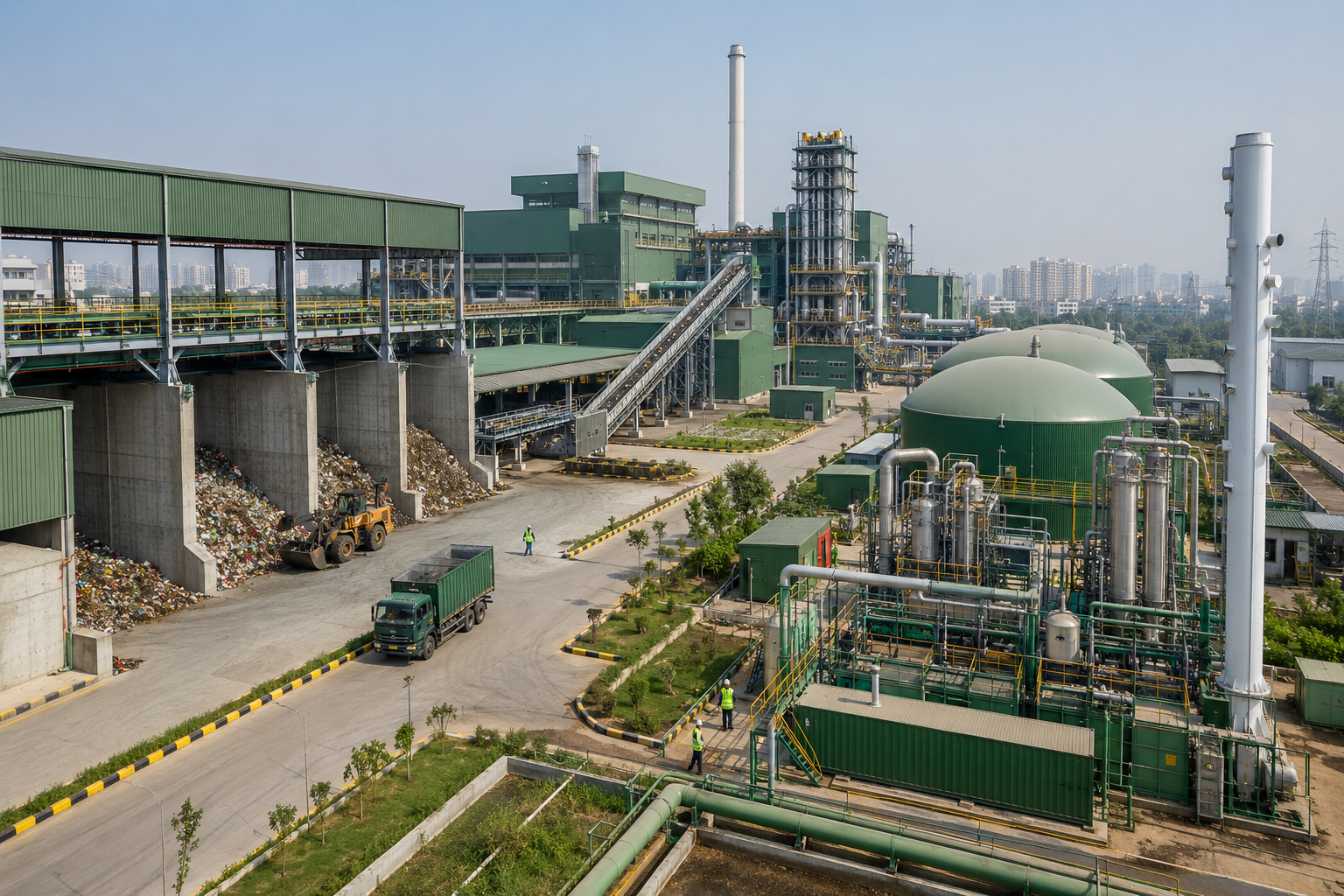
OIL Green Energy has signed Memoranda of Understanding with four municipalities in Haryana to develop integrated compressed biogas and waste-to-energy projects capable of processing 5,000 tonnes of municipal solid waste per day.
The projects will be established in Gurugram, Faridabad, Hisar and Ambala, according to a report by The Hindu BusinessLine published on August 31. OIL Green Energy is the renewables arm of Oil India, the exploration and production company.
The proposed facilities will be developed across four municipal clusters. The Hisar project is planned with a capacity of 500 tonnes per day, while the Ambala project is designed to process 900 tonnes per day. The proposed capacity is 1,600 tonnes per day in Faridabad and 2,000 tonnes per day in Gurugram.
Together, the projects are expected to produce between 70 and 75 tonnes per day of compressed biogas, or CBG, as well as 50 megawatts of green power. The source report did not provide project costs, construction schedules, land details or commissioning timelines.
Under the proposed integrated waste-processing model, municipal solid waste will first undergo scientific pre-processing and segregation. Recyclable materials will be recovered, while wet and biodegradable waste will be used to produce CBG. The non-recyclable dry fraction will be directed to waste-to-energy facilities for electricity generation.
The arrangement is intended to recover value from different waste streams rather than sending the entire municipal waste load to landfill. According to the report, the approach is also expected to optimise energy recovery from non-recyclable waste and reduce dependence on landfilling.
The four municipalities covered by the MoUs are among Haryana’s major urban centres. Gurugram and Faridabad account for the largest proposed processing capacities, together representing 3,600 tonnes per day of the planned total. Hisar and Ambala together account for the remaining 1,400 tonnes per day.
The initiative forms part of OIL’s expansion of its low-carbon energy portfolio through OIL Green Energy. The company said the collaboration would advance integrated waste-to-clean-energy solutions at scale, as described in the report.
The projects are also aligned with the Government of India’s GOBARdhan – National Circular Bioenergy Scheme 2026, which seeks to promote scientific waste management and the conversion of organic waste into CBG and other clean-energy forms. The report did not disclose the specific approvals, financing arrangements or implementation responsibilities attached to the Haryana projects.
The MoUs mark the formal announcement of the proposed municipal collaborations. Further details on project execution, including site selection, construction milestones and operating arrangements, were not available in the source material.
