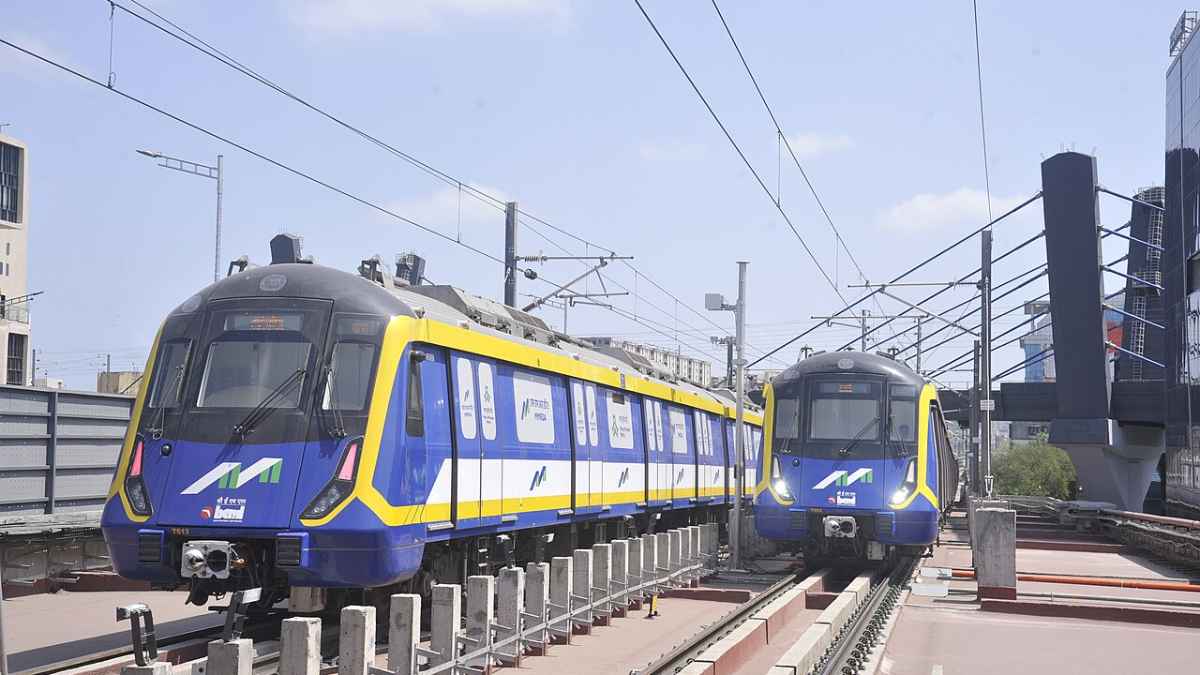
Mumbai Metro Line 7A has encountered a potentially expensive design problem near Airport Colony in Vile Parle East, where part of the elevated structure does not meet aviation-related height requirements. The issue has emerged after substantial construction was completed, leaving the Mumbai Metropolitan Region Development Authority (MMRDA) dependent on a decision from the Airports Authority of India (AAI). If no technical solution or relaxation is secured, around ₹250 crore of work could require reconstruction. The 3.42-km corridor is planned to connect Andheri East with Chhatrapati Shivaji Maharaj International Airport, providing an interchange with Mumbai’s wider Metro system. MMRDA’s project information confirms that the Airport Colony station is elevated while the airport station is underground.
The difficulty relates to the overhead equipment required to power metro trains. The structure falls within the airport’s regulated flight-path zone, where height restrictions are critical to aviation safety. According to project information reported by officials, the clearance available from the aviation authority did not accommodate the additional height required for the electrical equipment. The problem is particularly significant because the civil works had already advanced substantially before the discrepancy was addressed. MMRDA’s February 2026 project status recorded the elevated viaduct works as complete, with the elevated ramp also substantially progressed. A technical redesign is difficult because lowering the alignment could affect the gradient needed for trains to move between elevated and underground sections. MMRDA has therefore sought additional clearance from the aviation authority rather than immediately dismantling completed infrastructure. The final outcome remains dependent on the technical assessment and approval process.
For a public transport project, the financial exposure is only one part of the concern. Rebuilding completed infrastructure consumes construction materials, labour and public capital that could otherwise support new transport capacity. It can also extend disruption around an already constrained urban corridor. The episode highlights a broader challenge in Mumbai’s infrastructure pipeline: complex projects increasingly operate at the intersection of transport, aviation, land-use and engineering regulations. Early coordination between these systems is essential, particularly where a small change in vertical clearance can affect an entire viaduct section. The Mumbai Metro 7A delay also matters because airport connectivity is increasingly being built around integrated public transport. A reliable link between the airport and the wider metro network could reduce dependence on road-based journeys and improve access for passengers and airport workers.
For now, the immediate priority is to establish whether the existing structure can be made compliant without reconstruction. The longer-term lesson for Mumbai Metro 7A is equally important: major infrastructure should resolve regulatory and engineering interfaces before construction reaches the point where correcting an error becomes a major public expense.