


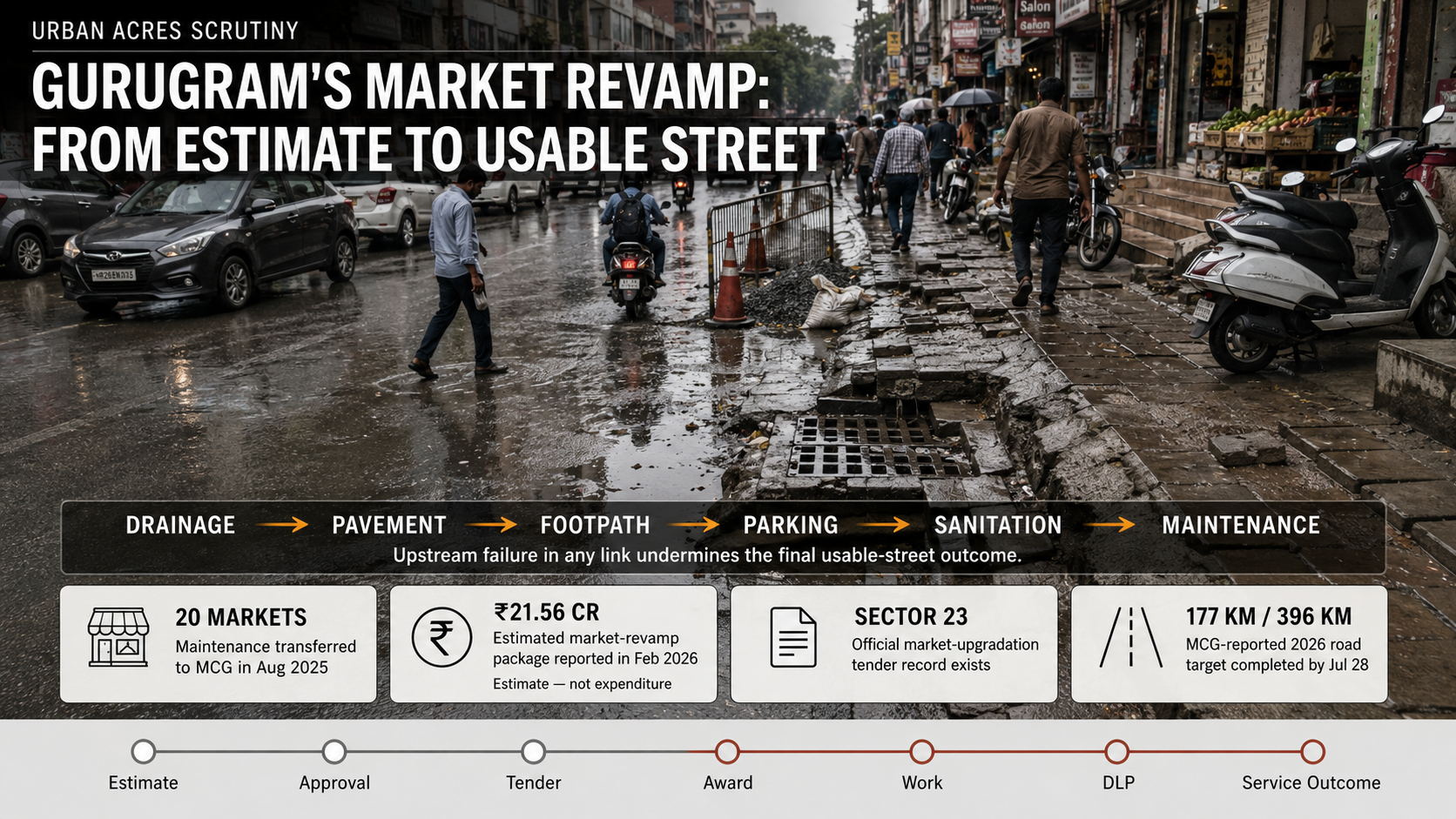
MCG took over maintenance of 20 developed sector markets from HSVP last year and began preparing redevelopment works months ago. Fresh complaints from Sectors 10, 14, 22A, 23 and 46 show why the issue is no longer whether markets have been promised upgrades, but whether drainage, roads, sanitation and pedestrian access are being delivered as one dependable public service.
Gurugram’s monsoon has exposed more than deteriorating asphalt.
Residents across several sector markets are reporting potholes, waterlogging, stagnant water, poor sanitation, damaged or encroached pedestrian areas and inadequate parking. In Sector 46, a resident told Hindustan Times that water remained stagnant for as long as 48 hours after rain. In Sector 23, a resident said a road built only six to eight months earlier had already developed potholes and waterlogging.
Taken alone, these could look like another seasonal road-damage story. The institutional history makes them more significant.
In August 2025, HSVP formally handed responsibility for maintaining and servicing 20 developed sector markets to the Municipal Corporation of Gurugram. The transfer included markets in Sectors 10A, 14, 22, 23 and 46, among others, and was intended to clarify civic responsibility for their upkeep.
By February 2026, MCG was already preparing redevelopment projects for the transferred markets. Reporting at the time showed that most remained at preliminary stages such as estimate preparation and administrative approval. Sector 56 was reported as the only market then to have reached execution, while estimates for Sector 10A and Sector 46 were stated at ₹2 crore and ₹8.3 crore respectively.
A separate February 28 report described an estimated ₹21.56-crore programme for identified sector markets, including works aimed at parking, footpaths and pothole-free roads. That figure needs careful treatment: it represented an estimated package, not evidence that ₹21.56 crore had been spent or that all the projects had reached construction.
Six months later, therefore, the useful question is not whether MCG has plans. It is how far each market has progressed from estimate to usable infrastructure.
Sector 23 exposes a project-stage problem
The most important discrepancy is in Sector 23.
The August 30 report quotes the ward councillor as saying an estimate has been prepared and will require Finance and Contracts Committee approval before a tender is floated for the road. That may accurately describe a new or separate repair package.
But Haryana’s official e-procurement system already contains a recalled tender titled “Upgradation of Sector-23 Market area, Ward No. 4, Division 3A under MCG,” with tender ID 2026_HRY_523456_1. Its status page lists technical and financial bid stages.
Those two records cannot simply be merged.
The existing procurement could cover the market generally while the fresh estimate concerns an approach road, reconstruction necessitated by drainage failure or an amended scope. Alternatively, project requirements may have changed after the earlier tender. The material reviewed by Urban Acres does not establish which explanation is correct.
MCG should therefore disclose the current scope, estimate, earlier tender status and relationship between the two works.
That is project-stage discipline in practice: an estimate is not a tender, a tender is not a contract award, and a tender relating to a market does not automatically cover every road or drainage asset around it.
Rain can damage a road. It cannot explain the entire market failure
There is a legitimate engineering argument for delaying some permanent bituminous resurfacing until sustained monsoon rainfall subsides. Laying certain pavement treatments in persistently wet conditions can compromise execution quality.
But that qualification does not turn the monsoon into a complete explanation.
The current complaints span drainage, stagnant water, waste collection, pedestrian access, encroachment and road condition. In Sector 23 itself, the councillor linked persistent drainage problems and water accumulation with deterioration of the repaired road.
That creates a basic infrastructure sequencing problem.
If drainage continues to leave water standing against or over the pavement, simply resurfacing the road can treat the visible defect while leaving one of the mechanisms of recurrence intact. Likewise, a reconstructed carriageway does not create a usable market if pedestrians are still pushed into traffic because footpaths are damaged or occupied.
The relevant service chain is therefore:
drainage → pavement → pedestrian space → parking/loading → sanitation → maintenance response.
Residents experience that chain as one place, even when MCG administers it through separate engineering, sanitation, enforcement and procurement processes.
Maintenance procurement already exists
MCG also has broader road-maintenance procurement outside the market-specific programme.
In May, the corporation invited separate tenders for pothole repair, patchwork and day-to-day road grievances in Old Gurugram and New Gurugram. Their stated tender values were approximately ₹7.55 crore each, with 280-day work periods.
Those figures should not be added to the ₹21.56-crore market-redevelopment estimate. They are different procurement categories and the extent of any geographical or BOQ overlap has not been established.
Their existence does, however, sharpen another question: when a market road develops a dangerous pothole, which mechanism is supposed to respond—the market redevelopment contract, a routine road-maintenance contract, the original contractor’s defect-liability obligation or another divisional work?
Without a public asset and contract ledger, residents cannot easily know.
Gurugram’s wider road backlog matters
The market conditions are also occurring against a larger municipal road-repair backlog.
On July 28, MCG figures reported by Hindustan Times said the corporation had completed 177 km of the 396 km of roads targeted for repair and upgradation during 2026, leaving more than 219 km requiring work. The remaining portion was expected to be addressed after the monsoon.
That context makes prioritisation important.
Post-monsoon resurfacing may be necessary, but the corporation also needs a method for distinguishing cosmetic deterioration from failures driven by drainage, sewer leakage, utility cuts, pavement structure or repeated reinstatement.
Otherwise kilometres completed can become a misleading performance indicator: a road can be counted as repaired while the underlying service chain remains vulnerable to the next intense rainfall.
The recently repaired road needs a contract-level audit
Sector 23 offers a particularly useful accountability test because a resident says the approach road was constructed only six to eight months ago before deteriorating again.
That observation alone does not establish poor construction.
Urban Acres has not verified the road’s contractor, pavement specification, completion date, drainage scope, quality tests or defect-liability terms. Utility work or abnormal water accumulation could also contribute to deterioration.
The appropriate response is therefore not to assign blame prematurely but to publish the contract record.
MCG should identify the project and contractor, state whether the road remains under a defect-liability period, publish the relevant completion and quality-control records, and explain whether the present repair will be paid for as a new municipal work or rectified under an existing contractual obligation.
That distinction matters financially. Residents should not have to fund repeated reconstruction of the same defect without knowing why the earlier asset failed.
What a genuine market revamp should be measured against
The current programme has been described through inputs—estimated costs, tenders and proposed works.
The next phase of disclosure should focus on outcomes.
For each transferred market, MCG should publish the road and drainage assets under its control; approved estimate and funding source; F&CC approval date where applicable; tender and contract number; contractor; start and completion dates; defect-liability period; drainage and sewer scope; footpath scope; parking provision; waste-management arrangement; and current project status.
It should then attach service indicators: recurrence of potholes after repair, time taken to remove standing water after rainfall, obstruction-free pedestrian space, sanitation complaints and closure rates, toilet functionality, road-defect complaints and rectification under DLP.
No new numerical service standard should be invented for this purpose. MCG should publish the standards already contained in its contracts, engineering manuals and service commitments and report performance against them.
The next monsoon is the real completion certificate
Gurugram’s sector markets do not need separate success stories for asphalt, drains, parking, toilets and sanitation.
They need streets that continue to work when the weather places those systems under stress.
The reasonable defence that permanent road work may be sequenced after the monsoon should therefore be judged against what happens next: whether drainage is corrected before resurfacing, whether recently completed roads survive, whether pedestrian space is restored, whether maintenance obligations are traceable and whether residents can see the status of each project.
The real measure of the market-redevelopment programme will not be how many estimates are approved or tenders floated after the rains.
It will be whether the same streets remain usable when the rains return.
