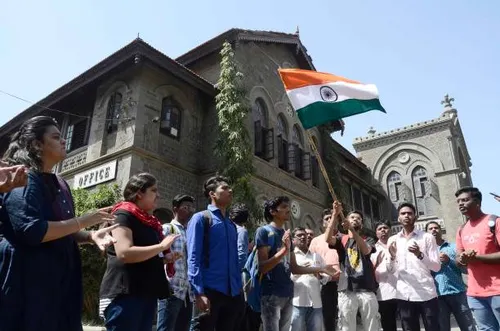
Pune Students Push Education Access Into Campus Debate
Pune’s student community is widening its focus from examination irregularities to the affordability, accessibility and governance of higher education. At a student dialogue held at Savitribai Phule Pune University on Wednesday, student groups raised concerns over rising fees, unemployment, hostel conditions, scholarships and democratic rights, placing the city’s role as an education centre under renewed scrutiny.
The discussion comes as Pune student issues increasingly intersect with wider questions of social mobility. For thousands of students arriving from smaller towns and lower-income households, access to affordable universities, accommodation and competitive examinations can determine whether higher education becomes a pathway to better employment or another financial burden. A central concern at the meeting was the credibility of competitive examinations. Student representatives argued that alleged irregularities in examinations conducted by national and state recruitment bodies can impose costs far beyond a single disrupted test. Candidates may spend several years preparing, often alongside significant expenditure on coaching, accommodation and study materials. That concern has particular relevance in Pune, where a large student population supports an extensive education economy. The city’s colleges, coaching centres, rental housing and student services form an important part of the local economy. Any decline in confidence in examination systems can therefore affect both students and the institutions and businesses built around them.
The dialogue also brought education affordability into the conversation. Rising fees and the cost of living can create a barrier even after admission has been secured. Hostel availability, scholarship access and reliable public transport can influence whether students are able to remain in education, particularly those travelling from outside the city. The debate over Pune student issues also reflects a broader question about how education systems distribute opportunity. Speakers at the programme highlighted the historical expansion of educational access for communities that faced exclusion in earlier periods. They argued that reservation policies and other measures aimed at widening participation remain important to students from disadvantaged backgrounds. For urban planners and policymakers, the discussion has implications beyond university campuses. A city that attracts students but lacks affordable housing, dependable transport and accessible public services can transfer much of the cost of education onto households. Better coordination between education planning and urban infrastructure could reduce that pressure.
Employment is another part of the equation. A degree alone does not guarantee economic security, making the connection between universities, skills, apprenticeships and local employment increasingly important. For Pune, which combines education, manufacturing and technology sectors, stronger pathways from classrooms into decent work could improve the city’s ability to retain young talent. The student mobilisation now places these concerns within a broader civic conversation. Whether that translates into policy change will depend on how universities and public authorities respond to specific issues such as fees, accommodation, examination administration and employment opportunities. For Pune, the test is whether its reputation as an education hub is matched by an education system that remains affordable, accessible and resilient for the students who sustain it.