


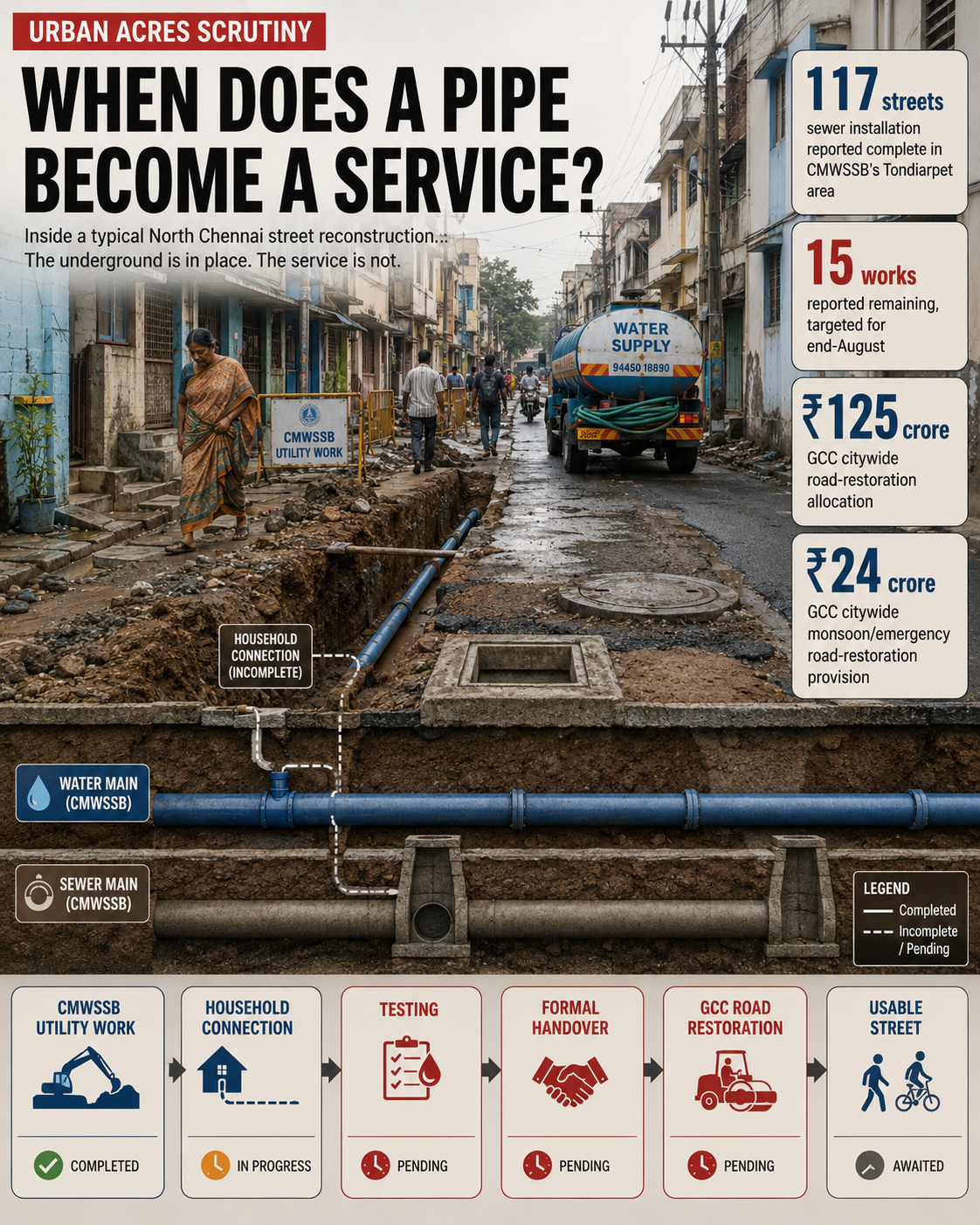
Across Vyasarpadi and adjoining parts of the Perambur Assembly constituency, sewer and water upgrades remain separated from the outcomes residents actually need: functioning household connections, contained sewage and safely restored streets. The immediate accountability test is whether Chennai Metro Water and Greater Chennai Corporation can close that delivery chain before the northeast monsoon.
CHENNAI — A road can contain a newly laid pipe and still function badly as urban infrastructure.
That distinction has become increasingly visible across parts of Vyasarpadi and adjoining North Chennai neighbourhoods, where residents are entering the final pre-northeast-monsoon months with sewer works unfinished, road surfaces damaged, household drinking-water connections incomplete and several public-space and safety problems unresolved.
DT Next reported on August 27 that sewer replacement remains under way on Jagjivan Ram Nagar Main Road in Sathya Murthy Nagar after residents sought intervention following three road cave-ins. Nearby residents have also reported sewage spilling onto Jagjivan Ram Nagar 3rd Street. CMWSSB says sewer installation has been completed on 117 streets in its Tondiarpet area and expects 15 remaining works to be finished by the end of August.
That completion figure is important, but it is not enough to judge the service outcome.
The same street was already signalling failure in 2025
The problems at Jagjivan Ram Nagar are not new.
On June 15, 2025, DT Next reported recurring road cave-ins, sewage overflow and stagnant water on Jaga Jeeva Ram Nagar Main Road. At the time, a CMWSSB official said works under the Vada Chennai Valarchi Thittam would begin within a week to address the area’s problems.
The current report says pipeline replacement began in July 2026 following repeated cave-ins.
That chronology changes the journalistic question. The issue is no longer simply whether new infrastructure has been sanctioned. It is whether a known network defect moved through diagnosis, procurement, construction and permanent service restoration quickly enough.
Urban Acres cannot establish from the public material reviewed why the intervention took this long, and should not attribute the elapsed time to a particular contractor or agency failure without the corresponding work order and contract schedule.
But the absence of that information is itself significant.
A main pipeline is not a household water service
The strongest example comes from Gandhi Nagar.
Residents say the main sewage and drinking-water pipelines there have been completed, but household connections have not. They therefore continue to depend on tanker water.
That exposes a common infrastructure-reporting error.
A water project is not complete from the resident’s perspective when only the main network exists.
The relevant chain is:
Bulk/main network → local distribution → household connection → actual supply → reliability
Until the connection stage is finished and water reaches homes dependably, construction output and service outcome remain different things.
The same applies to sewerage. Installing or replacing a sewer pipe is not sufficient if sewage continues reaching the street during construction or if property connections and downstream conveyance are not functioning properly.
The road is the interface where fragmented agencies become one city
The second unresolved chain concerns road restoration.
GCC Commissioner GS Sameeran told DT Next that CMWSSB carried out the utility cuts and that the Corporation would begin restoration once the utility agency completed its work and formally handed over the streets. GCC has also set aside ₹125 crore for restoration of 2,000 interior roads and 97 bus-route roads across Chennai, with another ₹24 crore for monsoon patching and emergency road restoration citywide.
Those are citywide allocations, not Perambur-specific commitments.
But the handover mechanism deserves much closer scrutiny.
From a resident’s perspective there is no meaningful distinction between a CMWSSB trench and a GCC road. The same street must ultimately provide water, carry sewage safely, drain rainwater, support pedestrians and vehicles, and remain usable during rainfall.
The institutional sequence is therefore:
Utility excavation → pipeline completion → testing/reconnection → backfilling → formal handover → road restoration → safe public street
If any handoff stalls, the resident experiences a single failed street even though multiple departments can each describe their own portion of the project as incomplete or awaiting another agency.
Current Tamil Nadu tender records reinforce that this interface is active. GCC had live August 2026 tenders for monsoon patching in Zones 4 and 6, while Zone 4 listings include individual packages specifically described as restoration of CMWSSB road cuts.
The question Urban Acres should now track is not simply whether funds exist. It is which exact roads have been handed over and on what date.
North Chennai’s development programme has grown far beyond its original headline number
The works sit within the broader Vada Chennai Valarchi Thittam.
When the programme was announced in Tamil Nadu’s 2023-24 Budget, the government described a ₹1,000-crore initiative over three years. By the 2025 Budget, it said the programme covered 252 works at an estimated ₹6,309 crore across infrastructure and social sectors.
That expansion makes programme-level dashboards more, not less, necessary.
CMWSSB procurement records show major water and sewer packages spanning multiple operational areas, with contract periods measured in months or years. One VCVT water package was awarded in March 2025 for ₹80.98 crore inclusive of GST with a 12-month contract period. A major sewer-strengthening tender published in March 2025 carried a 540-day period before being cancelled and subsequently retendered.
Those records show that the scheme is a portfolio of contracts, not one monolithic project.
What remains missing for residents is the translation from that portfolio into street-level accountability.
The monsoon test should begin before extreme rainfall
As of August 27, Chennai is not facing an exceptional northeast-monsoon rainfall emergency. IMD’s August 25 outlook expected subdued rainfall over Peninsular India during the following week and showed no Tamil Nadu warning for August 27.
That makes the current conditions more revealing, not less.
If relatively ordinary rainfall leaves excavated roads slushy, exposes sewage on streets or makes access difficult, agencies still have time to resolve those defects before the northeast monsoon becomes the dominant weather system.
Preparedness should therefore be measured before the first major inundation.
What should CMWSSB and GCC disclose now?
Before the northeast monsoon, the agencies should publish a joint street-level completion register for affected North Chennai neighbourhoods.
For every road cut, it should show the utility work, contractor, work-order date, contractual completion date, current construction status, number of household connections pending, testing status, handover date to GCC, road-restoration package, restoration deadline and final completion date.
For sewage works, it should additionally disclose whether existing lines remain temporarily blocked or diverted during construction and what measures prevent overflow onto streets.
For drinking-water projects, it should distinguish main-line completion from active household connections.
And for road restoration, the public should be able to see precisely how long each street remains between utility completion and final resurfacing.
North Chennai does not need another percentage claiming that infrastructure is “mostly complete.”
It needs evidence that the entire chain works.
