


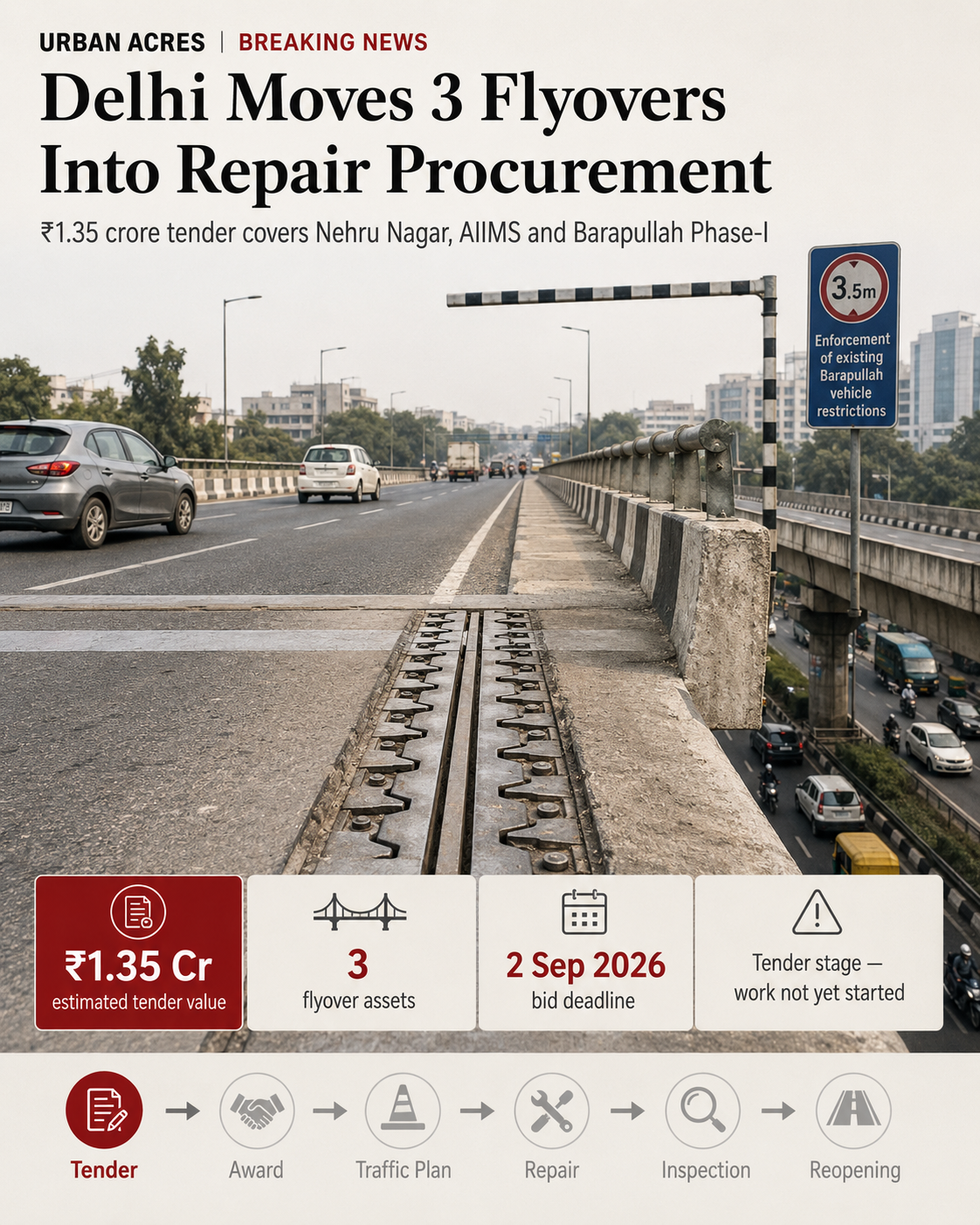
The South Delhi structures are not yet under repair. PWD has moved expansion-joint and height-barrier works into procurement, with bids due September 2 and traffic coordination still required before work can begin.
NEW DELHI — Delhi’s Public Works Department has opened procurement for repair and rehabilitation work across the Nehru Nagar, AIIMS and Barapullah Phase-I flyover system, marking a fresh maintenance intervention on a set of heavily used elevated roads connecting South and South-East Delhi.
The tender, published on August 25, carries an estimated value of ₹1,35,31,048 and closes on September 2. It is an open works tender; no contract award or physical commencement has yet been established.
That project-stage distinction is central to understanding the development. PWD has invited bids. It has not yet selected a contractor, issued a work order or begun the repair programme.
Expansion joints form the verified core of the package
The procurement title identifies replacement of expansion joints and installation of a height barrier as the principal works.
Expansion joints sit between structural sections of a bridge and accommodate movement caused by temperature changes, loading and structural behaviour. Their deterioration can affect riding quality and, depending on condition, allow water ingress or impose unwanted stresses elsewhere in the structure.
PWD’s own repair-and-rehabilitation manual treats them as lifecycle components rather than permanent installations. It gives 10–15 years as a general indicative replacement interval, while emphasising that traffic loads, weather and maintenance can change that interval substantially.
TOI reports that bearings will also be rectified. Urban Acres has not independently located that item in the publicly retrievable tender metadata, so bearing work should remain qualified until the full BOQ is checked.
₹1.35 crore is not money already spent
The ₹1.35 crore figure represents the estimated tender value.
The final price becomes clearer only after bidding, evaluation and contract award. The tender documentation currently visible also records an EMD of ₹2,70,621, a two-cover bidding process and 75-day bid validity.
PWD officials have said the work is expected to take around four months after award. That makes the eventual contract-award date—not August 25—the meaningful starting point for measuring the execution period.
Nehru Nagar’s maintenance history deserves closer tracking
The Nehru Nagar structure is not a simple, recently built flyover.
PWD’s technical history says it was constructed in 1969 and widened substantially in 2003. The original and widened portions use different structural arrangements, including brick-masonry piers in the older structure and RCC piers with elastomeric bearings in the additions.
It has also undergone major rehabilitation before.
PWD records identify a rehabilitation-and-strengthening project awarded to The Freyssinet Prestressed Concrete Co. Ltd., with an estimated cost of ₹13.92 crore and tendered cost of ₹11.27 crore. Work began in September 2021. Delhi’s 2022-23 planning material later showed a December 2022 target, while PWD’s technical documentation subsequently listed Nehru Nagar among structures being repaired during FY2024-25.
That history does not establish that the earlier contract failed.
The current joints may be different components, may not have been replaced during the earlier package, or may have developed condition-specific requirements. What it does establish is a need for better lifecycle disclosure: residents should be able to see which components were repaired, when they were installed, their warranty or defect-liability period and why another intervention is required.
The height barrier addresses an existing enforcement problem
The Nehru Nagar-side height barrier has a different purpose from the structural repairs.
Traffic restrictions already apply to the Barapullah corridor. A Delhi Traffic Police notification prohibits multiple categories of buses and goods vehicles on Barapullah Road on a 24-hour basis.
PWD officials say heavy vehicles nevertheless continue to enter the corridor and that the new barrier is intended to physically restrict that movement.
There is history here too.
Height barriers were proposed at Barapullah entry points in 2023 after Delhi Traffic Police complained about heavy vehicles entering the corridor. One barrier installed near Sarai Kale Khan was subsequently damaged by a bus within days.
Officials also previously flagged a design complication: conventional 3.5-metre barriers could interfere with some emergency vehicles, requiring coordination with fire and emergency agencies.
The relevant test for the 2026 installation is therefore not simply whether a steel barrier appears on site. It is whether the barrier is durable, enforces the legal restriction, preserves emergency access and avoids creating a new road-safety hazard.
Traffic management is part of the repair, not an afterthought
These structures sit on interconnected routes serving Ring Road, Mathura Road, South Extension, Lajpat Nagar, Sarai Kale Khan, the DND corridor and the AIIMS area.
PWD officials have said physical work will begin only after consultations with Delhi Traffic Police because lane occupation or closures could affect major traffic flows.
That coordination should be treated as an explicit delivery stage:
Tender → Award → Traffic Plan → Mobilisation → Joint Replacement → Inspection → Reopening → Performance Monitoring
A four-month contract is not useful to commuters if closures are poorly sequenced or adjoining junctions become gridlocked. Conversely, traffic disruption alone would not indicate poor project management: expansion-joint replacement can require controlled lane closures to execute safely.
The test is whether disruption is planned, communicated and limited to what the engineering work actually requires.
One tender inside a much larger maintenance challenge
Delhi’s issue is no longer simply building new flyovers.
PWD is simultaneously dealing with an ageing stock of elevated structures. Earlier this year, officials identified 44 flyovers more than 15 years old for structural audits, with the AIIMS/Safdarjung flyover among the first structures shortlisted.
That programme is important because repair tenders are only the visible output of asset management. The deeper question is whether Delhi maintains a transparent condition register capable of showing when every flyover was last inspected, which components are approaching end-of-life, what defects were detected, what repairs were ordered and whether they performed as expected.
For Nehru Nagar, AIIMS and Barapullah, the immediate milestone is now clear: bids close September 2.
After that, public scrutiny should move to the award, final scope, traffic plan and completion—not simply the announcement that repairs are planned.
