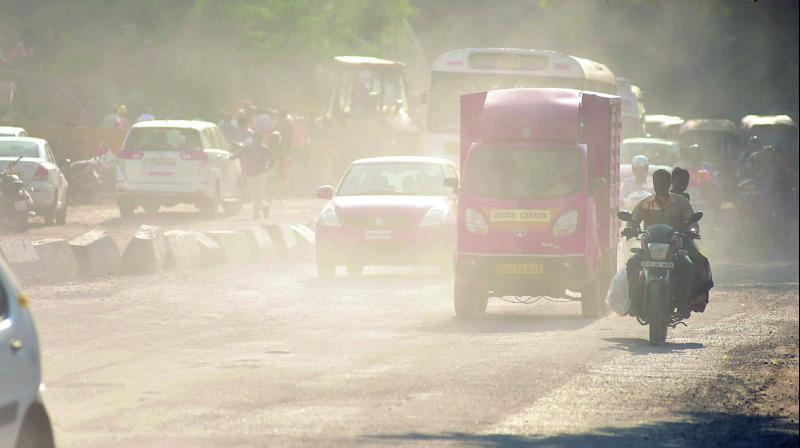
HYDERABAD: Road dust is emerging as a significant contributor to Hyderabad’s particulate pollution, according to a study conducted by the Telangana Pollution Control Board (TGPCB) in collaboration with IIT Hyderabad. The findings point to a largely preventable source of urban pollution and place greater focus on road maintenance, street-cleaning practices and the efficiency of mechanical sweepers.
The study found that road dust contributes about 32% of PM10 and 26% of PM2.5 pollution. PM10 refers to larger airborne particles, while PM2.5 consists of finer particles that can penetrate deeper into the respiratory system. Their presence makes controlling dust on heavily used urban roads an important part of improving air quality. Researchers also recorded silt deposition of between 5 and 15 grams per square metre on roads. The study indicates that the preferred level is below 3 grams per square metre. The gap suggests that substantial quantities of loose material remain available to be lifted into the air by passing traffic, wind and road activity. The findings were discussed at a workshop focused on improving the effectiveness of mechanical road sweepers. The event brought together researchers and representatives from pollution-control and civic agencies to examine how road-cleaning operations could be strengthened.
For a rapidly expanding metropolitan region, the issue has implications beyond air pollution. Dust accumulation can affect roadside cleanliness, reduce visibility in heavily trafficked areas and increase the environmental burden of construction and transport activity. The challenge becomes more pronounced where road shoulders, unpaved edges and poorly maintained surfaces allow fine material to accumulate. Urban planners and environmental specialists have increasingly emphasised that air-quality management cannot depend solely on controlling industrial emissions or vehicle exhaust. Non-exhaust sources, including road dust and particles generated through tyre and brake wear, also require targeted interventions. Improving mechanical sweeping could therefore provide a relatively direct avenue for reducing one part of the particulate load. But the effectiveness of such programmes will depend on how frequently roads are cleaned, whether machines collect fine material efficiently and how quickly dust returns after sweeping.
Road design and maintenance also matter. Sealed shoulders, better drainage, construction-site controls and timely removal of deposited material can reduce the amount of loose silt available to become airborne. Such measures can complement sweeping rather than treating it as a standalone solution. The study’s findings provide a useful benchmark for Hyderabad’s broader clean-air efforts. Monitoring silt levels across different road categories and measuring the actual reduction in particulate pollution after cleaning could help civic agencies identify where resources deliver the greatest benefit. For a city seeking more resilient and liveable growth, controlling road dust is ultimately an everyday infrastructure task. Cleaner streets, better-maintained road edges and more effective sweeping could help address an overlooked contributor to Hyderabad’s air-quality challenge.