


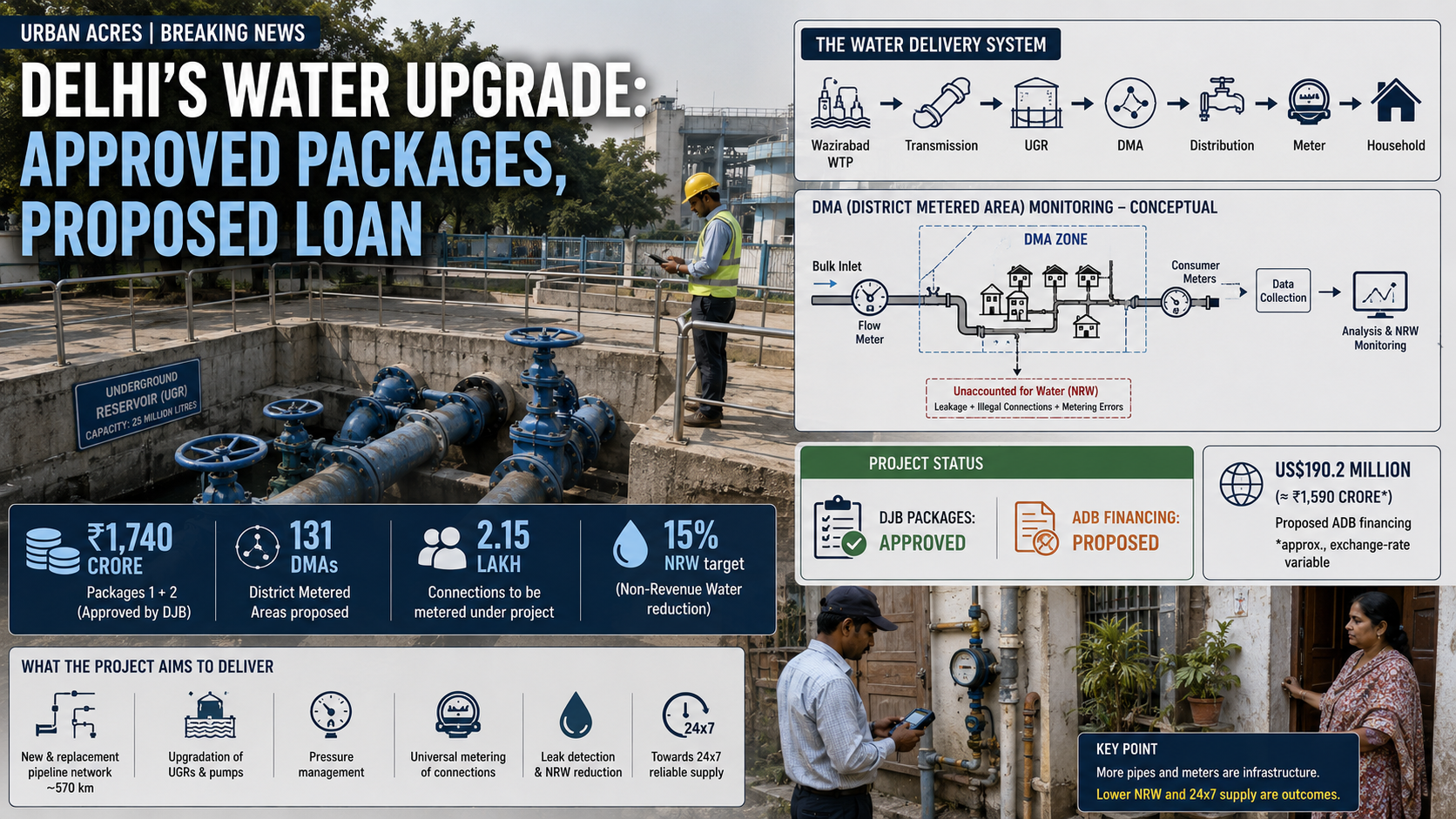
Delhi Jal Board has approved two packages worth about ₹1,740 crore to overhaul parts of the Wazirabad water-treatment-plant command area, setting ambitious targets for 24×7 pressurised supply, universal metering and sharply lower water losses. But the external financing behind the programme has not yet reached the stage implied by some headlines: the Asian Development Bank still lists its US$190.2 million financing for the Delhi Water Supply Improvement Project as proposed, with no approval date recorded.
Chief Minister Rekha Gupta announced the programme on August 25, saying ADB would finance 70% while Delhi would provide the remaining 30%. DJB has approved Package 1 at ₹805 crore and Package 2 at ₹935 crore for the Wazirabad command area.
Those approvals are significant, but three separate financial numbers must not be conflated.
The first is the roughly ₹2,500 crore referred to in the government’s announcement and subsequent media reporting. The second is the ₹1,740 crore combined value of the two newly announced packages. The third is the US$190.2 million loan currently shown by ADB against Project 60139-001.
Public documentation reviewed by Urban Acres does not yet reconcile those three figures sufficiently to describe ₹2,500 crore as a final, approved ADB loan.
A water network built around measurement
The physical programme is substantial.
Around 43.96 sq km covering nine underground-reservoir command areas and eight Assembly constituencies is proposed to come under the upgraded distribution system. Approximately 836 km of network is involved, including nearly 570 km of new or replacement pipelines. About 2.15 lakh household service connections are expected to be covered.
The most important operational intervention may not be the pipeline length, however. It is the proposed creation of 131 District Metered Areas.
A DMA divides a distribution network into measurable zones. With properly calibrated bulk and consumer meters, utilities can compare water entering a zone with legitimate consumption and identify areas where leakage, unauthorised consumption or measurement failures are producing abnormal losses.
Delhi’s stated objective is to combine DMAs with network rehabilitation, metering, instrumentation and leakage control to reduce non-revenue water to 15%.
That makes this fundamentally a service-management project, not merely a pipe-laying programme.
The outcome should therefore not be measured by kilometres installed. It should be measured through pressure, duration of supply, continuity, water-quality compliance, leakage reduction and the difference between bulk water entering each DMA and properly accounted household consumption.
The project has a decade-old predecessor
The August announcement should also not be presented as the beginning of Delhi’s effort to modernise the Wazirabad system.
DJB approved an earlier Delhi Water Supply Improvement Investment Programme in March 2014 with a tentative cost of ₹2,243 crore. The programme was also intended to rely on ADB financing.
What happened next is directly relevant to the new project.
According to the Comptroller and Auditor General, ADB required sufficient project readiness before loan negotiations. DJB was expected to bring contracts representing at least 30% of project cost to the award stage. Problems followed the tendering process.
The CAG records that ADB gave a no-objection for two proposed awards in December 2019, but DJB subsequently rejected the awards in June 2020. After the Board later sought another round of tendering, ADB informed DJB that the project had been withdrawn from its financing pipeline.
That history changes the accountability test for the 2026 revival.
This time, the question is not simply whether ADB is willing to finance Delhi’s water network. It is whether DJB can maintain project readiness, complete procurement, execute packages and sustain the operating model after the capital works are built.
DJB had already begun reviving the programme before this week’s announcement. It issued an EOI in January for project-management consultancy for an ADB-assisted Wazirabad project, followed by a consultancy tender in April.
ADB’s new project record was subsequently established as Project 60139-001, with concept clearance dated May 26.
A better network will not create raw water
The government’s 24×7 ambition also needs a second qualification.
Reducing losses can make existing water substantially more useful. Pressure management can improve household service. Metering can reveal where water disappears. Distribution rehabilitation can reduce contamination risks caused by low pressure and damaged pipelines.
But none of those measures substitutes for dependable raw-water availability.
The CAG’s audit of DJB, covering 2017-18 to 2021-22, found both supply deficits and very high NRW. It reported NRW in the range of roughly 51%-53% in most of the years examined, while also identifying inadequacy of raw-water sources and treatment capacity as part of Delhi’s wider supply problem. Those numbers are historical and should not be presented as Delhi’s 2026 baseline, but they show why both source security and distribution efficiency matter.
A credible 24×7 programme therefore requires the entire chain to work:
Source → treatment → transmission → reservoir → DMA → distribution → household meter → sustained pressure and quality.
The dashboard Delhi should publish before construction
The strongest protection against repeating the history of the earlier programme would be radical project-level transparency.
For every one of the proposed 131 DMAs, DJB should disclose a baseline before physical works begin:
- population and number of active connections;
- average daily water entering the DMA;
- current supply hours;
- minimum and average network pressure;
- bulk-meter coverage;
- functioning household meters;
- baseline NRW;
- water-quality compliance;
- tanker dependence;
- planned capital works;
- contractor and contract value;
- start and completion dates;
- target NRW;
- target pressure and supply duration.
The same indicators should be published after commissioning.
That would allow Delhi residents to distinguish ₹1,740 crore of approved packages from kilometres of completed infrastructure — and ultimately from the only result that matters: water arriving reliably at the household tap.
