


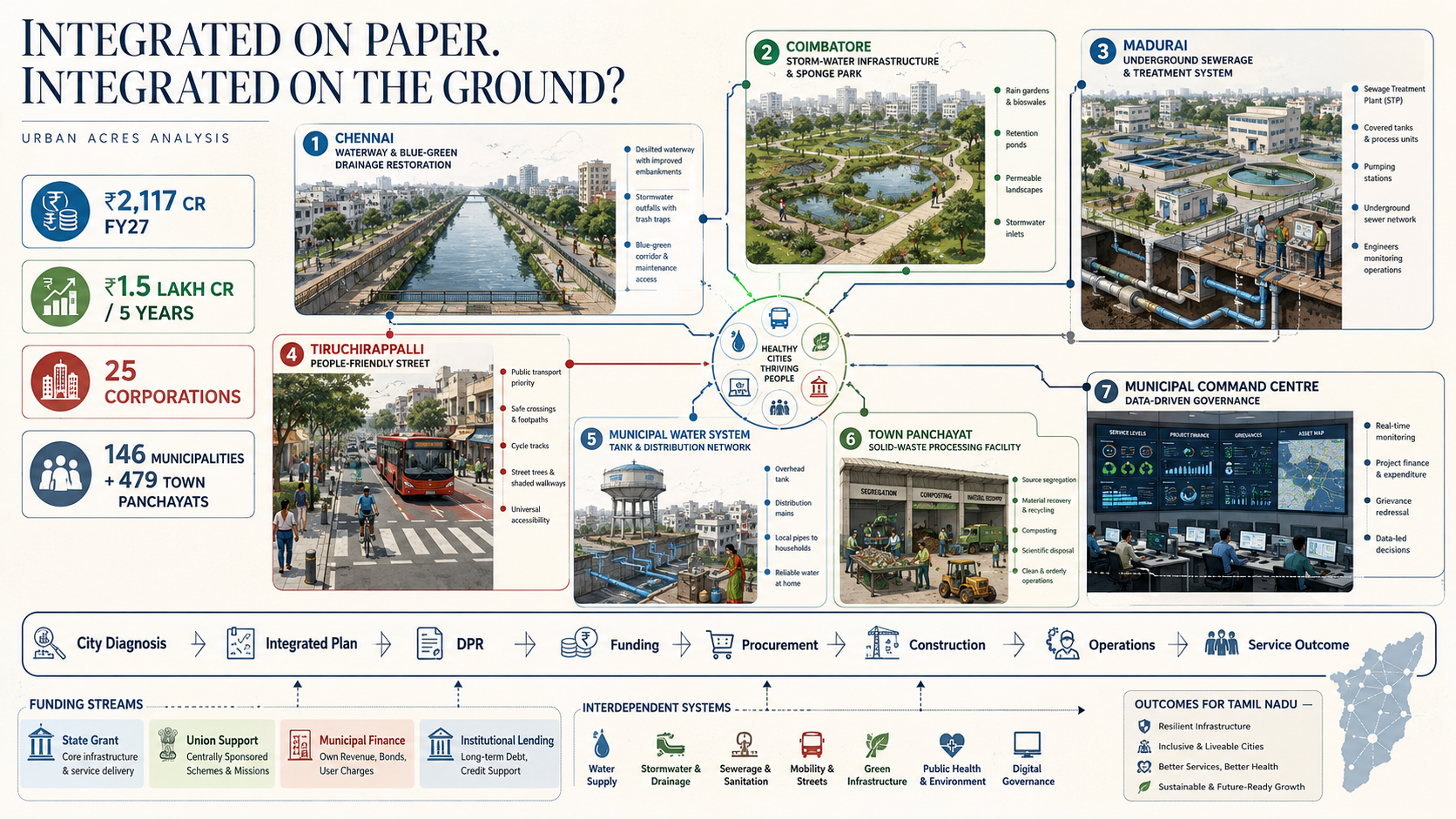
Tamil Nadu has launched an ambitious integrated urban programme covering water, sewerage, roads, transport, public health, waterways, green infrastructure and digital governance. The first Budget allocation is substantial, but the mission’s success will depend on whether separately administered projects actually become one functioning urban system.
The Tamil Nadu Integrated Urban Transformation Mission begins with ₹2,117 crore in the revised 2026–27 Budget.
The formal programme—identified in the official Budget book as the Chief Minister Integrated Urban Transformation Mission—has a much wider horizon. Tamil Nadu estimates that transforming its corporations, municipalities and town panchayats between 2026 and 2031 will require approximately ₹1.5 lakh crore.
The difference between these figures is not automatically evidence of underfunding.
The ₹2,117 crore is one year’s State Budget allocation. The five-year programme is expected to combine State funds with Union schemes, Finance Commission grants, municipal borrowing, bonds, PPPs, bank finance and international development finance.
It does, however, reveal the mission’s central vulnerability.
Tamil Nadu has announced the urban outcomes it wants. The financing, project sequencing and institutional architecture required to reach those outcomes remain only partly visible.
Integration must happen before projects are tendered
Urban infrastructure frequently fails at the interfaces between departments.
A new road is laid and then excavated for a sewer.
A storm-water drain is built without resolving where the water will discharge.
A treatment plant is commissioned while household connections remain incomplete.
A lake is beautified without stopping sewage inflow.
A smart-parking system is introduced without integrating bus stops, footpaths or traffic enforcement.
CMIUTM can correct these failures only if every participating city begins with one integrated infrastructure plan.
The sequence should be:
urban system diagnosis → city investment plan → sector coordination → project prioritisation → DPRs → financing → procurement → construction → operations → outcome verification
If water agencies, municipal engineering divisions, transport authorities and urban-development bodies continue preparing separate DPRs, placing them beneath one mission name will not create integration.
The mission’s water promise is operationally demanding
Tamil Nadu aims to deliver 24×7 water in all municipal corporations and at least three hours of daily supply in municipalities and town panchayats by 2031.
Achieving this requires more than additional treatment plants and pipelines.
Continuous or extended supply depends on:
- reliable water sources;
- treatment capacity;
- functioning pumping systems;
- pressure-zoned distribution;
- active household connections;
- accurate metering;
- low leakage;
- electricity security;
- financially sustainable tariffs;
- and rapid repair.
Intermittent systems cannot simply be operated for more hours without examining pipe condition. Higher and longer pressure can initially expose leakage and increase bursts.
The Budget’s ₹25-crore allocation for IoT smart-water meters may support measurement, while ₹600 crore for clean drinking water and substantial TWAD allocations can address source and network infrastructure.
But smart meters are not an outcome by themselves. The public needs to know whether water reaches every zone at the promised pressure, whether billing is accurate and whether lower-income households retain affordable access.
Sewerage performance must be measured at the household and outfall
The official Budget contains approximately ₹377.18 crore for underground sewerage schemes.
The relevant result is not only kilometres of sewer laid or treatment capacity built.
A functioning sewerage project requires:
- household connection;
- functioning lateral and trunk sewers;
- pumping-station reliability;
- sewage reaching the treatment plant;
- the plant operating at compliant quality;
- treated water being safely discharged or reused;
- illegal and untreated outfalls being eliminated.
Cities frequently build treatment capacity that remains partly unused because household connections or interceptors are incomplete. CMIUTM should publish both installed capacity and actual daily flow treated.
River restoration cannot be separated from sewerage
The Budget proposes further studies and DPR preparation for the Cooum and Adyar, while Buckingham Canal and other waterways remain within the broader urban-transformation agenda. Chennai is also pursuing blue-green infrastructure and a ₹3,108-crore Ring Main Pipeline targeted towards 2031.
River restoration must begin upstream of the visible riverfront.
The sequence is:
identify every sewage outfall → provide sewer connectivity → intercept residual flows → restore hydraulic capacity → manage solid waste → protect floodplain → improve public access where appropriate
Beautification conducted before pollution control produces landscaped edges around a contaminated water system.
Restoration programmes also require social safeguards. Settlements located along waterways may face relocation. The mission must publish tenure assessments, rehabilitation sites, transport access, livelihood impacts and grievance procedures before displacement begins.
People-friendly streets must change movement, not finishes
The Budget includes ₹100 crore for people-friendly modern streets in municipal corporations and identifies pedestrian pathways, cycling lanes, junction improvements, cross-streets, safe school access and LED lighting as intended interventions.
The performance test should not be the amount of paving installed.
Street projects should measure:
- continuous accessible footpath width;
- safe crossing distance;
- pedestrian waiting time;
- cycling continuity;
- bus speed and reliability;
- school-zone vehicle speeds;
- fatalities and serious injuries;
- tree survival and shade;
- drainage performance;
- and street-vendor integration.
A road reconstructed mainly to increase vehicle throughput should not be classified as people-friendly because it also contains decorative paving.
Uniformity should apply to standards—not identical designs
Current mission planning has referred to common project templates, timelines and funding structures across cities.
Common standards can reduce procurement delays and improve quality control. However, identical designs can be counterproductive.
Chennai’s coastal flood risks differ from Coimbatore’s drainage and water-supply conditions. Madurai’s historic core differs from Hosur’s industrial growth. A delta town cannot use the same storm-water assumptions as an inland municipality.
Tamil Nadu should standardise:
- data requirements;
- service outcomes;
- accessibility standards;
- procurement safeguards;
- climate scenarios;
- quality testing;
- financial disclosure;
- and monitoring.
It should not standardise every street cross-section, drainage design or infrastructure solution regardless of geography.
Market finance will test municipal capacity
The ₹1.5-lakh-crore investment requirement cannot be met through conventional grants alone.
The Urban Challenge Fund illustrates the financing model. Central assistance is limited to part of the project cost, while cities must raise significant market finance and demonstrate reforms, revenue strength and sustainable operation.
This can produce discipline. Lenders and bond investors demand credible revenues, project preparation and financial reporting.
It can also increase inequality among cities.
Large corporations with strong property-tax bases and professional finance teams can access capital more easily. Smaller municipalities and town panchayats may struggle to raise debt despite having urgent infrastructure needs.
The State must prevent access to essential water, sanitation and drainage investment from depending mainly on local borrowing capacity.
A differentiated model is required:
- grants for essential public-health and equity projects;
- concessional finance for smaller local bodies;
- pooled municipal borrowing;
- market finance for revenue-generating or financially sustainable projects;
- and PPPs only where commercial risk can be allocated without weakening universal access.
Operating costs must be visible before construction
Every new asset creates recurring expenditure.
Water and sewerage systems require power, chemicals, laboratories, operators and mechanical repairs. Streets require resurfacing, lighting and tree maintenance. Parks require irrigation and security. Digital systems require licences, cybersecurity and equipment replacement.
Project approval should therefore include:
- annual operating cost;
- replacement reserve;
- energy requirement;
- staffing plan;
- user-charge or municipal-revenue source;
- debt-service obligation;
- and handback or lifecycle responsibility.
A project that a local body cannot afford to operate is not financially complete, even when construction is fully funded.
AI governance must remain auditable
The mission includes AI-driven e-governance.
Possible applications include complaint classification, water-demand forecasting, asset monitoring, waste-route optimisation, tax assessment and public-health surveillance.
These tools require safeguards:
- data provenance;
- accuracy testing;
- bias assessment;
- human review;
- procurement transparency;
- privacy protection;
- cybersecurity;
- appeal mechanisms;
- and restrictions on vendor use of public data.
An AI system should support accountable municipal decisions, not make opaque decisions that residents cannot challenge.
The accounting needs one consolidated statement
The official Budget book contains identifiable CMIUTM heads totalling approximately ₹2,082.18 crore, while the Budget announcement cites ₹2,117 crore.
The difference is relatively small compared with the programme total, but reconciliation is necessary because the mission depends on combining several departments and implementing agencies.
Tamil Nadu should publish a single financing table covering:
- State Budget;
- Union schemes;
- UCF assistance;
- Finance Commission grants;
- municipal contribution;
- municipal borrowing;
- bonds;
- bank loans;
- PPP investment;
- international-finance loans;
- and private or institutional co-financing.
Every project should carry a unique identifier so that one scheme appearing under several funding sources is not counted more than once.
The mission needs a public project ledger
A city-wise digital ledger should contain:
| Field | Why it matters |
|---|---|
| City and project | Identifies the beneficiary and asset |
| Sector and system linkage | Shows how projects interact |
| Planning stage | Separates concepts from construction-ready projects |
| Estimated and contracted cost | Tracks cost movement |
| Funding mix | Shows grants, debt and private finance |
| Land and approvals | Measures readiness |
| Contractor and procurement model | Establishes responsibility |
| Physical and financial progress | Tracks delivery |
| Baseline service | Defines the problem |
| Target service | Defines the promised outcome |
| Operating cost | Tests sustainability |
| Equity impact | Identifies who benefits or bears costs |
| Completion and handover | Prevents indefinitely unfinished schemes |
The ledger should show separate baselines and targets for each urban service.
Water
Supply hours, pressure, quality, active connections and non-revenue water.
Sewerage
Household coverage, sewage captured, treated, reused and discharged.
Solid waste
Segregation, collection reliability, processing, recycling and landfill reduction.
Streets and mobility
Walking accessibility, bus reliability, cycling continuity, road injuries and school-zone safety.
Waterways and climate
Pollution inflow, flood performance, restored area and displacement or rehabilitation.
Governance
Procurement time, complaints, audit findings, municipal revenue, debt and operating expenditure.
The public-interest test
Tamil Nadu has identified the right urban systems and placed them within one mission.
The current evidence establishes a serious first-year allocation, a broad 2031 programme and specific investments in water, sewerage, streets, town panchayats, combined supply systems and digital metering.
It does not yet establish:
- the complete city-wise project portfolio;
- how the ₹1.5 lakh crore will be financed;
- which UCF projects will qualify;
- the debt carried by individual local bodies;
- how the ₹2,117-crore total reconciles with Budget heads;
- or how service outcomes will be independently verified.
The mission’s decisive achievement will not be the number of works approved.
It will be whether residents experience cleaner water, functional sewers, safer streets, reduced flooding, healthier waterways and more accountable local government without unsustainable municipal debt.
