


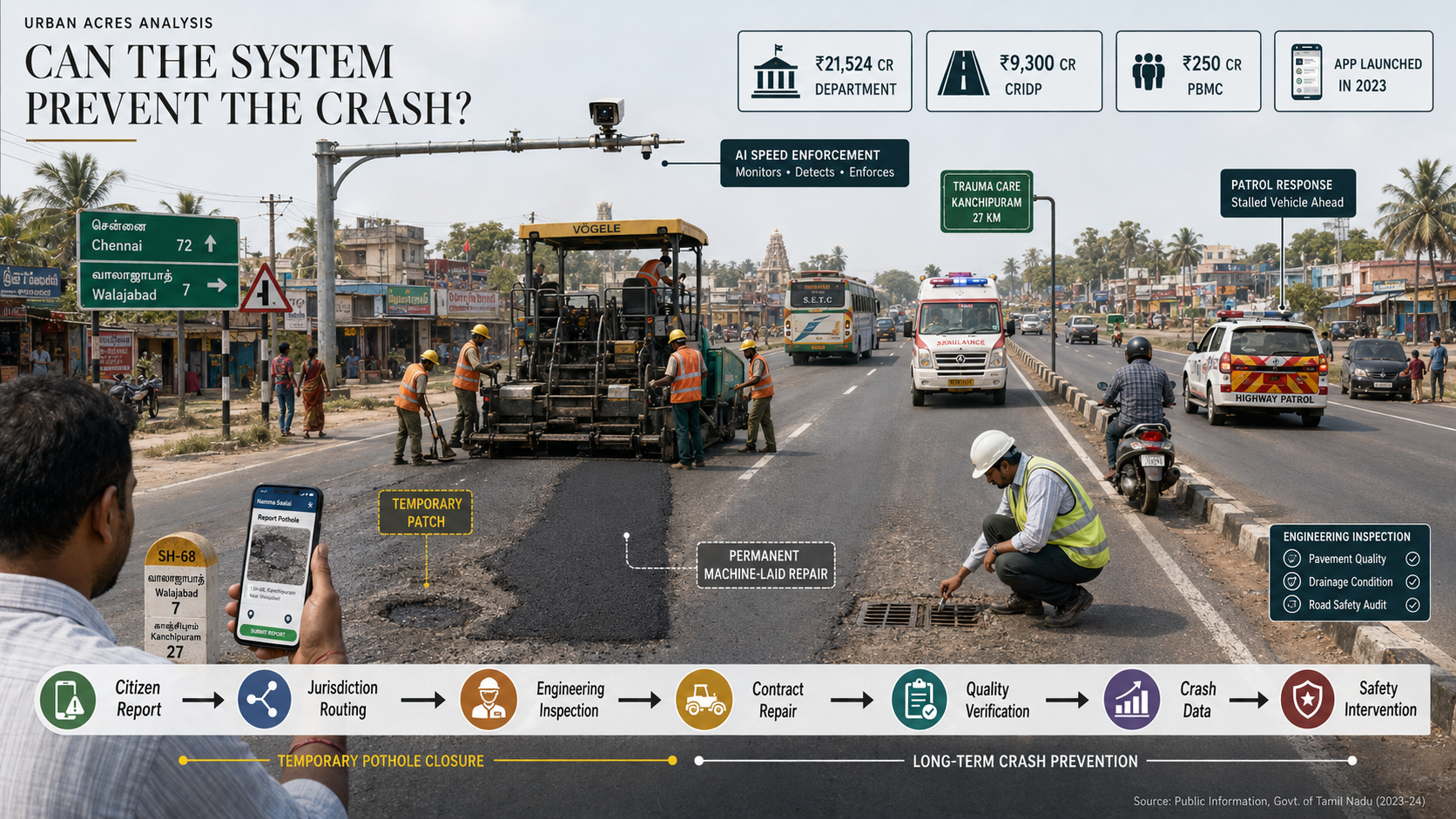
Tamil Nadu has announced a Safe Roads Mission combining road engineering, maintenance, AI-enabled enforcement, dedicated patrols and trauma care. The architecture is promising. The government must now publish the targets, funding, institutional responsibilities and performance data that will convert the announcement into a safety programme.
The Tamil Nadu Safe Roads Mission enters the policy agenda alongside a ₹21,524-crore revised allocation for the Highways and Minor Ports Department.
Of this, ₹9,300 crore is earmarked under the Comprehensive Road Infrastructure Development Programme for four-laning, bypasses, bridges, pedestrian overbridges, road-safety interventions, road-category upgrades and riding-quality improvement. Another ₹250 crore is intended to repair deteriorated stretches through performance-based maintenance contracts.
The mission itself is described through several connected interventions: safer road design, construction and maintenance; artificial intelligence for speed and traffic-rule enforcement; dedicated highway patrols; and stronger trauma-care facilities.
This is a stronger starting point than treating road safety solely as a matter of driver behaviour.
Fatal crashes emerge from the interaction of road geometry, speed, vehicles, enforcement, human behaviour and post-crash care. A dangerous junction cannot be corrected only through challans. An ambulance cannot compensate for an unprotected median opening. A pothole application cannot resolve a highway where repeated patch failure is caused by drainage or pavement-structure defects.
The mission’s eventual value will depend on whether these elements operate as one system.
The ₹21,524-crore figure is not the mission budget
The largest reporting risk is to describe the complete departmental allocation as funding for road safety.
The ₹21,524 crore covers the Highways and Minor Ports Department. It includes capital projects, bridges, widening, bypasses, maintenance and other functions. The available Budget reporting does not state how much is exclusively assigned to the Safe Roads Mission, AI enforcement, patrols or trauma care.
The government should issue a separate mission expenditure statement identifying:
| Component | Required disclosure |
|---|---|
| Safer road engineering | Corridors, blackspots and project cost |
| AI enforcement | Equipment, locations, operating cost and legal framework |
| Road patrols | Number of teams, vehicles, shifts and corridor coverage |
| Trauma care | Hospitals, upgrades, ambulances and response targets |
| Public reporting | App integration, software and verification cost |
| Evaluation | Baseline studies, audits and independent monitoring |
Without this split, it will be impossible to determine whether the mission is principally an engineering programme, an enforcement programme or an umbrella label over existing expenditure.
Namma Saalai is an existing system
The Budget announcement creates the impression that the Namma Salai application is being launched.
Tamil Nadu’s own Highways policy note states that it was launched on November 1, 2023. The original system enabled users to submit photographs and locations of potholes or road defects on department-controlled roads. The policy promised repair within 24 hours on State Highways and 72 hours on MDRs and ODRs.
The official website still describes those jurisdictional limits. Municipal roads, panchayat roads, National Highways and roads maintained by other agencies are not covered through the existing Highways application.
This is not a minor technical limitation.
Citizens typically know where a damaged road is; they do not necessarily know whether its owner is the Highways Department, a municipal corporation, a panchayat, NHAI or another agency.
In June 2025, Tamil Nadu announced that Namma Saalai would be expanded to integrate roadwork and complaints across departments. Officials acknowledged that complaints were being escalated or answered generically because people selected the wrong platform or authority.
The 2026 Budget should therefore clarify whether it is:
- relaunching the existing app;
- completing the promised all-agency integration;
- introducing a redesigned version;
- or assigning the app a new role within the Safe Roads Mission.
That clarification is necessary for accurate public information.
Complaint closure is not the same as repair quality
The Highways Department reported resolving 2,129 Namma Saalai complaints in 2023–24 within the prescribed period.
The number shows administrative activity. It does not establish whether:
- the repair lasted through the next rain;
- the correct pavement material was used;
- drainage defects were addressed;
- the complaint recurred;
- the road became safer;
- or an independent inspector verified the closure.
A pothole can be filled quickly and fail again within weeks. A photograph taken immediately after patching will show a closed complaint even if the underlying pavement remains structurally weak.
The revised system should retain the original response-time target but add durability verification:
- geo-stamped before and after photographs;
- repair method and material;
- contractor and engineer responsible;
- inspection after 30 and 90 days;
- recurrence status;
- citizen reopening facility;
- and random third-party testing.
The app should distinguish temporary emergency patching from permanent structural repair.
Performance-based contracts require visible performance standards
The Budget’s ₹250-crore allocation for performance-based maintenance is one of the more important announcements.
Traditional repair contracts can reward the quantity of work executed. A performance contract can instead require the contractor to maintain an entire road at an agreed service level for a defined period.
That approach will work only when the tender specifies measurable outputs such as:
- pothole-free carriageway;
- maximum surface roughness;
- functioning drainage;
- visible lane markings and signs;
- safe shoulders;
- cleared vegetation;
- repaired guardrails;
- rapid incident response;
- and monsoon restoration standards.
Payments should be reduced automatically when inspections find non-compliance.
The public should be able to see the contracted road, contractor, service period, inspection result, deductions and unresolved defects. Otherwise, “performance-based” becomes a procurement label without public verification.
Safer design must precede AI enforcement
Artificial intelligence can identify speed violations, red-light running, wrong-way driving or other behaviours. It cannot redesign a dangerous intersection.
The mission should start with corridor diagnosis:
- Where are fatal and serious crashes concentrated?
- Which road users are being killed?
- What movements produce conflicts?
- Are road speeds compatible with villages, schools and commercial streets?
- Are pedestrians and two-wheelers protected?
- Do service roads and safe crossings exist?
Tamil Nadu’s Highways Department already operates a GIS-based Road Accident Data Management System and a road-asset management platform.
The mission should integrate those systems with police records, hospital injury data, Namma Saalai defects, speed data and engineering inspections.
AI enforcement should then target risks identified through evidence rather than merely locations that can generate large numbers of challans.
Every automated enforcement programme should publish:
- legal authority;
- device certification;
- error rate;
- human-review process;
- evidence supplied to motorists;
- appeal procedure;
- data-retention period;
- camera-placement criteria;
- and the safety outcome at each site.
The relevant measure is not the number of violations detected. It is whether speeds, crashes and injuries decline.
Road patrols need defined operational coverage
Dedicated road patrols could improve stalled-vehicle response, incident warning, debris removal, first aid and coordination with police and ambulances.
The Budget reporting does not identify how many patrol teams will be created, which highways they will cover or their response standard.
A patrol plan should identify:
| Measure | Public target required |
|---|---|
| Corridor coverage | Kilometres and operating hours |
| Detection time | Crash or obstruction to control-room alert |
| Dispatch time | Alert to patrol movement |
| Arrival time | Dispatch to on-scene presence |
| Clearance time | Obstruction to reopened lane |
| Equipment | Warning signs, rescue tools and first-aid capability |
| Coordination | Police, fire, ambulance, hospitals and road authority |
Patrol performance should be reported by corridor and time of day.
Trauma care is a transport-system responsibility
Tamil Nadu recorded 17,884 road fatalities in 2022, equivalent to approximately 49 deaths each day.
Strengthening trauma care is therefore integral to road safety.
The mission should measure the complete post-crash chain:
crash occurrence → detection → emergency call → ambulance dispatch → scene arrival → stabilisation → hospital arrival → definitive treatment
Announcing additional trauma centres without reducing these intervals may produce limited impact.
The government should publish district-level response times, ambulance availability, hospital capability, referral delays and outcomes for serious injuries.
The mission needs a fatality and serious-injury target
The current announcement describes tools but does not state a measurable safety target.
Tamil Nadu should publish:
- baseline year;
- baseline fatalities and serious injuries;
- five-year reduction target;
- district and corridor targets;
- high-risk road-user targets;
- and annual independently verified progress.
Fatality counts should not be the only metric. Severe injuries, pedestrian risk, two-wheeler casualties, night crashes, speed compliance and emergency response must also be tracked.
One dashboard should connect the complete system
Tamil Nadu already has several relevant databases and platforms. The mission should create a unified operational dashboard rather than another standalone portal.
The dashboard should connect:
- road ownership and asset condition;
- Namma Saalai complaints;
- contractor maintenance obligations;
- crash and injury locations;
- speed and enforcement data;
- patrol and ambulance response;
- hospital outcomes;
- engineering corrections;
- public expenditure;
- recurring defects and crashes.
A complaint about a broken barrier at a location with repeated run-off-road crashes should automatically receive higher priority than a low-risk cosmetic defect.
A closed maintenance ticket should also be linked to later crash and recurrence data. This would allow Tamil Nadu to learn which repairs actually reduce risk.
The public-interest test
The Safe Roads Mission contains the right categories: engineering, maintenance, enforcement, patrol and trauma response.
What remains missing is a published implementation architecture.
The government has not yet disclosed:
- a dedicated mission budget;
- fatality targets;
- corridor priorities;
- AI-enforcement standards;
- patrol numbers;
- trauma-centre details;
- or whether the promised all-agency Namma Saalai integration is operational.
Until those details emerge, the mission remains an important policy announcement rather than an auditable safety programme.
The app can show where the road is broken. The mission must show whether the system fixed the road, prevented the crash and saved the injured person.
