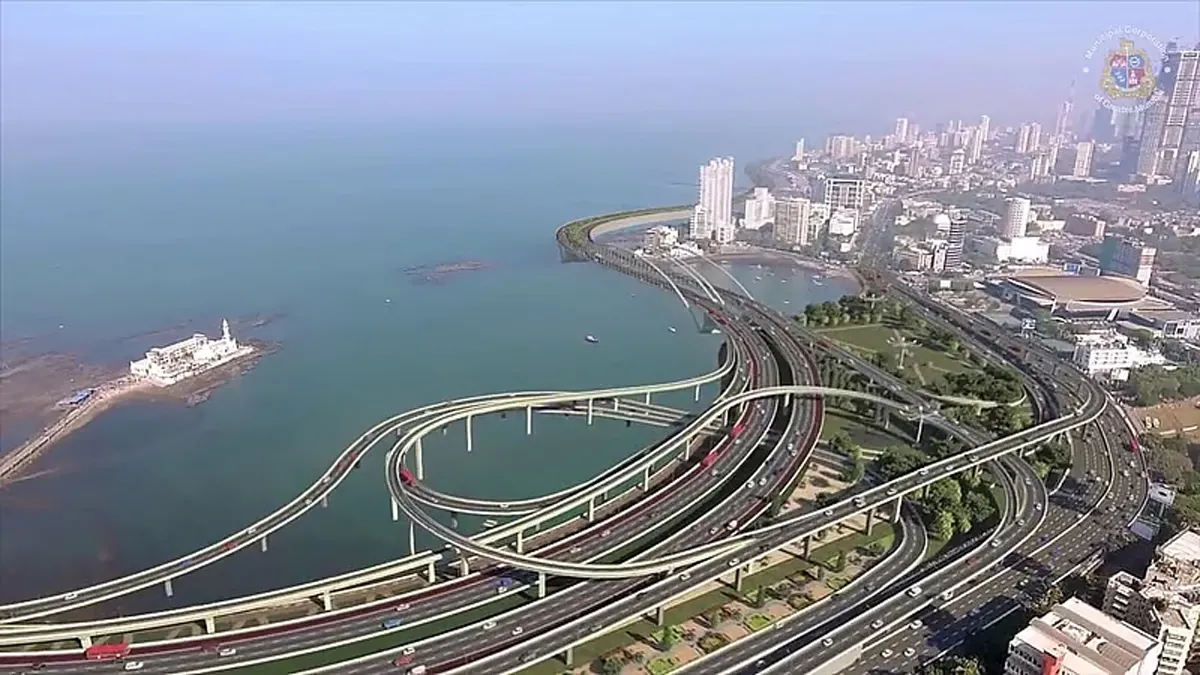
Mumbai’s civic administration is redesigning road connectivity around the upcoming northern arm of the Coastal Road project in an effort to prevent severe congestion at entry and exit points, signalling a broader shift in how the city approaches large-scale transport infrastructure integration. The proposed interventions, spread across the western suburbs between Versova and Dahisar, are intended to distribute vehicle movement more evenly across feeder roads rather than concentrating traffic at limited junctions. Urban mobility experts say the strategy reflects lessons learned from earlier expressway and flyover projects where high-speed corridors improved travel time on the main carriageway but shifted bottlenecks into surrounding neighbourhoods.
The Mumbai Coastal Road network is being developed as an alternative north-south transport spine to ease pressure on heavily burdened routes such as the Western Express Highway, Linking Road and SV Road. However, planners within the civic body acknowledged that uninterrupted movement on the main corridor alone would not solve congestion unless adjoining roads are redesigned simultaneously. Officials involved in the project said the administration is planning multiple access points and interchange links to prevent excessive traffic accumulation near single-entry nodes. Proposed upgrades include improved connections between suburban flyovers, link roads and interchange corridors extending towards the western suburbs and eastern transport routes. Among the key mobility interventions are new connections linking suburban arterial roads to the coastal corridor through Versova, Lokhandwala, Goregaon, Malad, Charkop and Dahisar. Several planned bridges and flyovers are also expected to feed traffic towards the route while creating alternate dispersal channels into residential and commercial districts. A major element of the broader transport strategy is a proposed high-speed connector between Goregaon and Magathane, which would run parallel to the Western Express Highway. The corridor is expected to integrate with the Goregaon-Mulund Link Road and future tunnel infrastructure, potentially reshaping east-west connectivity across Mumbai’s suburban belt.
Urban planners tracking the project say the success of the Mumbai Coastal Road expansion will depend less on engineering scale and more on network efficiency, last-mile integration and public transport coordination. Without multimodal planning, they warn, road widening alone could induce higher private vehicle dependency and increase long-term traffic volumes. Environmental concerns also remain central to the project’s next phases. Some proposed link roads and interchange works are still awaiting coastal regulation and environmental approvals due to their proximity to ecologically sensitive zones. Infrastructure analysts note that balancing mobility demands with shoreline protection and flood resilience will become increasingly important as Mumbai continues expanding transport systems along vulnerable coastal stretches. The northern extension of the Mumbai Coastal Road is being executed in multiple construction phases, including elevated corridors, interchanges and underground tunnel sections. Once operational, the route is expected to alter commuting patterns across western Mumbai by reducing travel times between major suburban zones.
For residents, the larger test will be whether the project delivers smoother daily mobility without simply relocating congestion from highways to local streets. As Mumbai accelerates infrastructure expansion, transport planners increasingly face pressure to ensure that future corridors support not just faster movement, but also more liveable and climate-resilient urban growth.