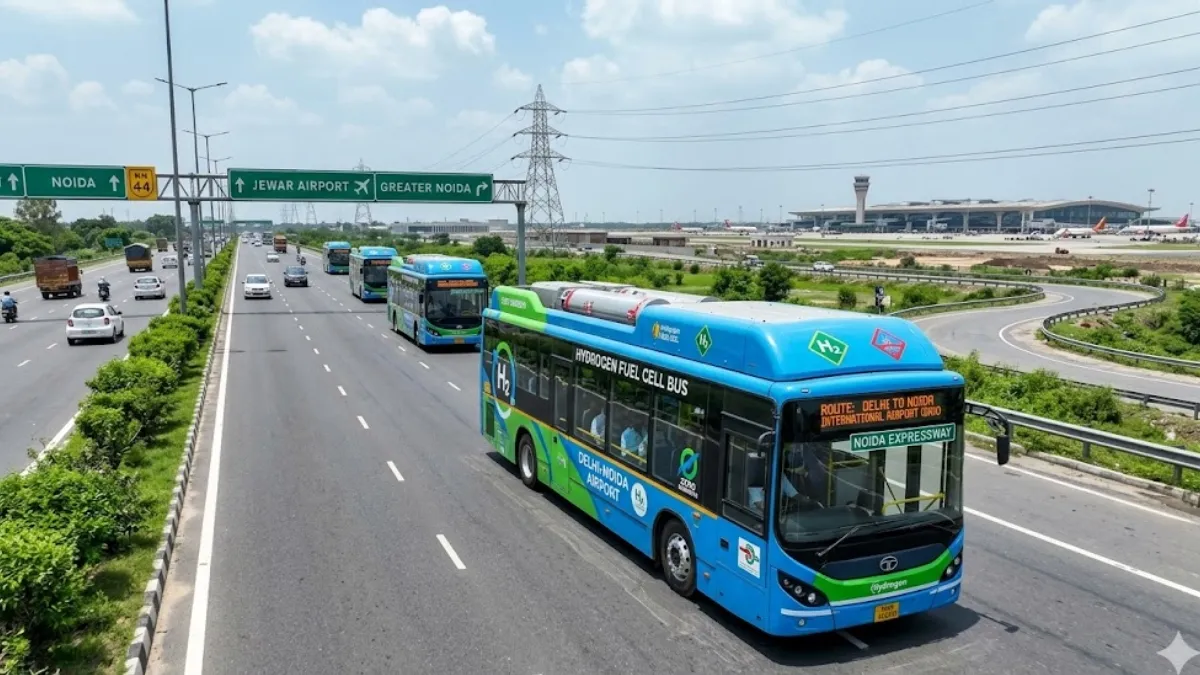
A new hydrogen-powered bus corridor linking Delhi, Noida and the upcoming Noida International Airport is set to begin operations from June, marking one of the National Capital Region’s earliest attempts to integrate low-emission public transport with airport connectivity infrastructure.
Officials associated with the project said an initial fleet of five hydrogen buses will operate along a route connecting Akshardham, Mayur Vihar, Botanical Garden, City Centre and Pari Chowk before reaching the airport zone in Jewar. The service is expected to become operational ahead of commercial flight activity scheduled at the greenfield airport later in June. The hydrogen bus initiative comes at a time when regional authorities are under growing pressure to reduce transport emissions while improving inter-city mobility across rapidly urbanising corridors. Urban planners say the NCR’s dependence on private vehicles has intensified congestion, worsened air quality and increased pressure on road infrastructure, particularly around emerging economic hubs such as Greater Noida and the Yamuna Expressway belt.
Transport officials indicated that the service will be operated by the state road transport corporation, while fuel supply and technical support are being facilitated through a public-sector energy provider. Financial support mechanisms have also been worked out to absorb operational losses during the initial phase, reflecting the high capital costs typically associated with hydrogen mobility projects. The hydrogen bus rollout is being closely watched by clean mobility experts because India’s public transport transition has so far largely centred on battery-electric systems. Hydrogen fuel cell vehicles, while costlier to deploy, are viewed as a potential solution for longer intercity routes where quick refuelling and extended operational range are important. For commuters, the project could significantly improve first- and last-mile airport access across the eastern NCR region. Residents travelling from dense residential and commercial districts in Noida and East Delhi currently rely heavily on taxis or private vehicles for airport transfers, particularly during peak traffic hours. A direct hydrogen bus network may reduce travel uncertainty while also offering a lower-emission alternative.
The development also reflects how large-scale infrastructure projects are increasingly being tied to broader sustainability targets. Analysts note that airports, industrial corridors and logistics zones across India are now expected to integrate cleaner transit systems as part of future-ready urban planning frameworks. Parallel discussions are underway with transport agencies from neighbouring states to expand bus connectivity into the airport region. Ride-hailing operators and shared mobility providers are also preparing services around the upcoming aviation hub, signalling a wider transport ecosystem beginning to form around the new airport economy. While the long-term commercial viability of hydrogen mobility remains uncertain, urban policy experts argue that early pilot corridors such as this could help cities test cleaner transport technologies before wider adoption. The effectiveness of the project will ultimately depend on affordability, operational reliability and whether public transport remains convenient enough to shift commuters away from private vehicles.