


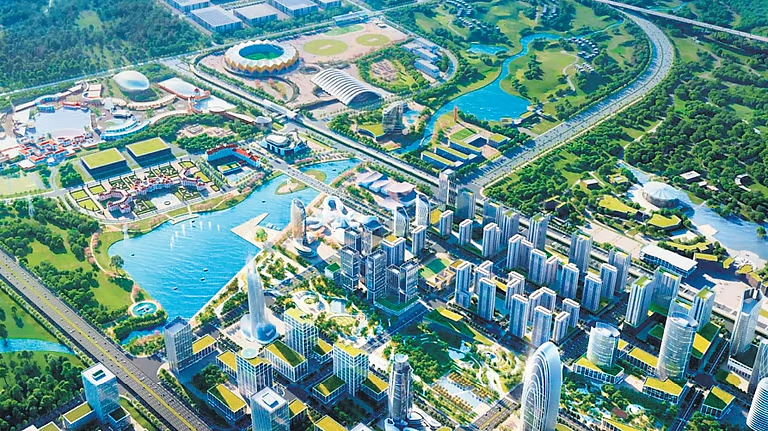
The Telangana government has formally initiated development of a proposed Hyderabad Future City, signalling a strategic push to manage the metropolitan region’s accelerating growth. The project, launched on the outskirts of Hyderabad, is envisioned as a large-scale urban extension designed to accommodate rising population pressures and evolving economic activity.
Officials describe the Hyderabad Future City as a planned urban district that will combine residential neighborhoods, commercial centers, and industrial clusters. The initiative is expected to attract investment across sectors such as technology, manufacturing, and services. However, urban development experts caution that the success of such projects depends less on scale and more on how effectively they integrate infrastructure, governance, and sustainability.Hyderabad has seen rapid expansion over the past decade, driven by its growing role as a technology and business hub. This growth has increased demand for housing, transport, and civic amenities, often stretching existing infrastructure. Planned extensions like the Hyderabad Future City are being positioned as a solution to decongest the core city while creating new economic nodes. Yet, planners emphasize that without strong connectivity, such developments risk becoming isolated urban pockets rather than integrated parts of the metropolitan system.A key concern in greenfield urban development is environmental impact. Large land parcels earmarked for new cities often include natural ecosystems such as water bodies and agricultural land.
Experts highlight the importance of preserving these features through water-sensitive planning, green corridors, and low-impact construction practices. Incorporating renewable energy systems and reducing dependence on private vehicles are also seen as critical to aligning the project with climate-resilient goals.The economic dimension of the project is equally significant. New urban zones typically influence surrounding land markets, leading to increased real estate activity. While this can boost regional economies, it also raises questions about affordability and equitable access. Analysts note that ensuring a mix of housing options, including affordable units, will be essential to prevent socioeconomic segregation.Governance frameworks will play a decisive role in shaping outcomes. Past experiences with large-scale city projects in India have shown that delays in infrastructure rollout and fragmented institutional coordination can hinder progress. For the Hyderabad Future City, experts recommend phased development aligned with infrastructure readiness, along with transparent regulatory processes to build investor and public confidence.
Mobility planning remains another critical factor. Integrating the new development with existing metro networks, bus systems, and regional transport corridors can reduce travel times and emissions while enhancing accessibility. Without such integration, the project could add to traffic congestion rather than alleviate it.As Hyderabad continues to evolve, the Future City initiative represents both an opportunity to re imagine urban growth and a test of sustainable planning practices. Its long-term impact will depend on whether it can deliver a balanced model that supports economic expansion while prioritizing environmental stewardship and inclusive urban living.
Also Read: Hyderabad Real Estate Deals Face Benami Scrutiny
