


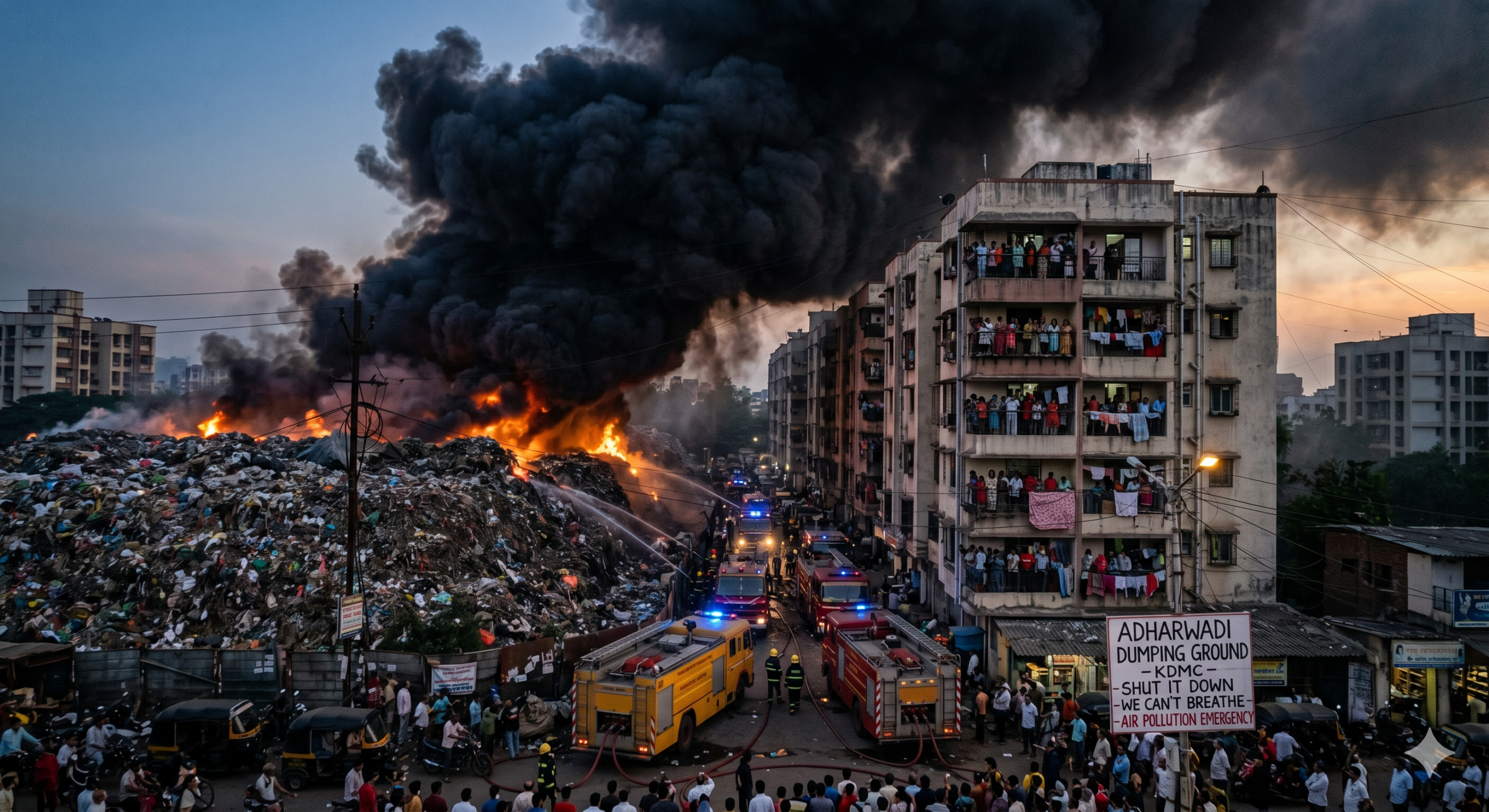
A thick black smoke sheet is now hanging over Adharwadi and nearby Kalyan West neighbourhoods after a major fire breaks out at the Adharwadi dumping ground on Sunday evening, forcing multiple fire engines into overnight containment work and leaving residents reporting breathing discomfort across surrounding housing clusters. Officials say the blaze begins in the upper layers of the garbage mound and spreads rapidly through accumulated waste, with a parallel fire also reported at the Umbarde dump site.
Kalyan-Dombivli Municipal Corporation has deployed firefighting teams, but the more relevant civic fact is that Adharwadi remains an active combustible waste hill inside a dense residential catchment even after years of closure promises. The Adharwadi dumping ground has repeatedly drawn objections from residents because smoke, odour and leachate do not stay inside the municipal boundary wall; they travel into homes, schools and road corridors every time the garbage mass heats up.
At Adharwadi tonight, the visible object is not the flame. It is the height of the dump itself.
Fire officials have said the blaze is difficult to control because it has erupted in the topmost section of the landfill, where layered dry waste, methane pockets and wind exposure allow flames to travel laterally even when water spraying begins below. This is why dumpyard fires in Indian cities are rarely treated like ordinary accidental fires. They are usually the result of long-term unmanaged waste accumulation reaching ignition conditions.
That makes this a governance story before it becomes a fire story.
KDMC has already initiated what it describes as a scientific closure process for Adharwadi, but public reporting shows that the site is still carrying enough exposed municipal waste to generate large-scale surface combustion. The authority is therefore managing two contradictory systems at once: announcing remediation on paper while still depending on the old waste mound as a live environmental liability. The trade-off is familiar — engineered closure and waste diversion require time, land and sustained spending, while continuing to stack and cap legacy garbage remains administratively easier in the short term.
Residents are living inside that interim.
Unlike remote sanitary landfills, Adharwadi sits beside populated Kalyan West residential belts where smoke dispersal becomes a public health event within minutes. Sunday night’s complaints were immediate: thick fumes, eye irritation and difficulty breathing, particularly for children and elderly residents. Similar dump fires in Mumbai’s Deonar dumping ground have repeatedly shown how legacy waste sites stop being invisible municipal backend spaces the moment they ignite.
No public record of Adharwadi’s final remediation completion date is currently available.
That missing date matters more than the cause of this individual fire.
Because whether Sunday’s blaze began from methane, heat retention or combustible material is only the technical trigger. The larger condition is unchanged: Kalyan still stores a mountain of decomposing city waste close enough to housing that one ignition can convert an ordinary evening into an air emergency.
And by Monday morning, the dump is still where it was — above the homes that have to wait for the smoke to thin.
