


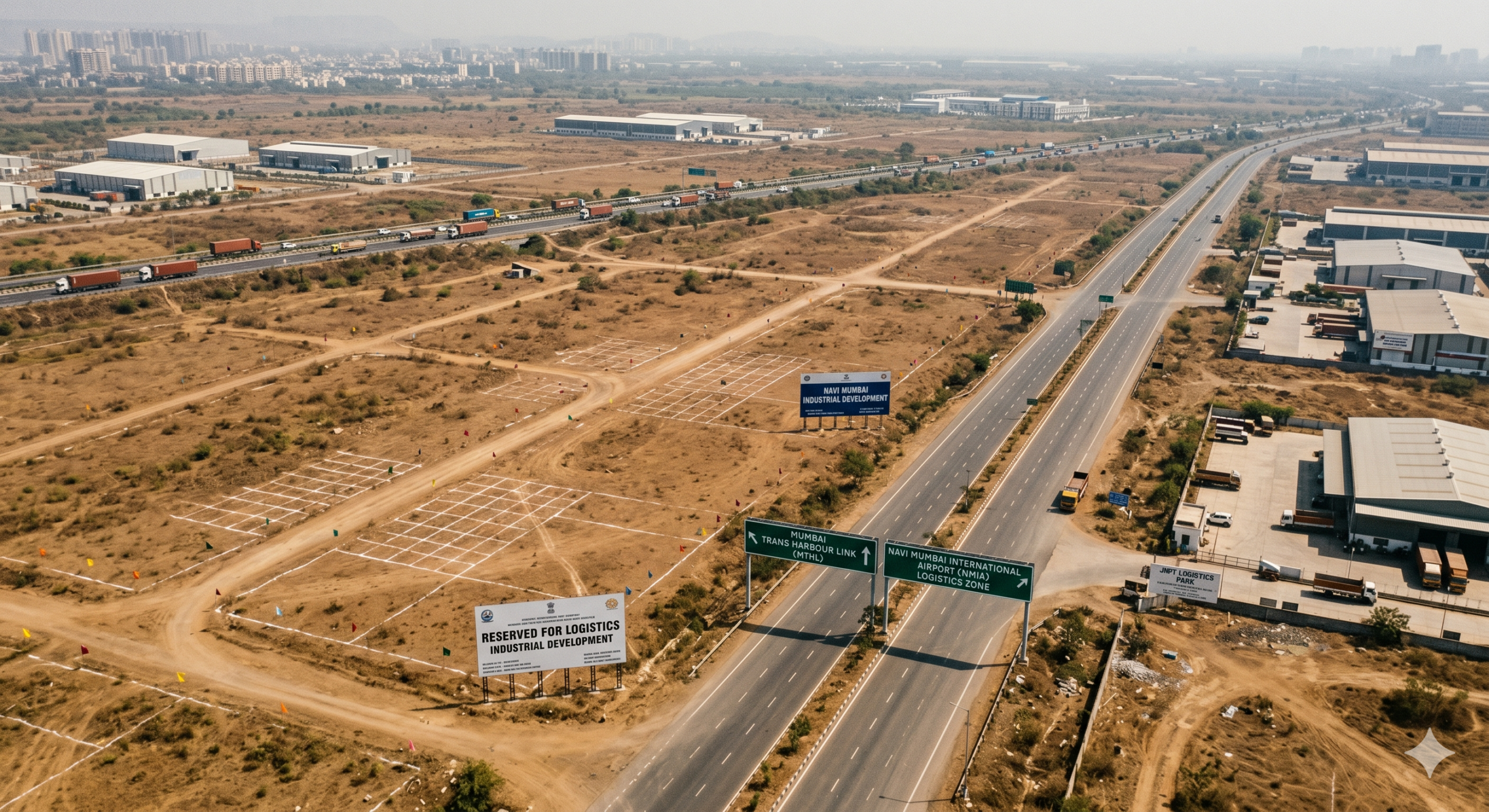
CIDCO has now opened 12 plots across 72 hectares near Chirle village for bids under the first phase of an Integrated Logistics Park, turning a large stretch of Navi Mumbai’s Pushpak Node away from residential sale and toward freight movement. The larger project covers 374 hectares — or roughly 924 acres — and is positioned between Jawaharlal Nehru Port, the Navi Mumbai International Airport corridor and the Mumbai Trans Harbour Link approach roads.
This means Navi Mumbai is no longer using all newly serviceable land around the airport influence zone for housing, commercial towers or institutional branding. CIDCO is now reserving a significant part of that geography for warehousing, container handling, inland freight yards and logistics-linked industrial storage under what it calls a future integrated cargo ecosystem.
At Chirle today, the available plots are not being advertised as sectors to live in. They are being measured as sectors where goods can pause, sort, transfer and leave.
According to CIDCO’s expression of interest notice issued this week, the pilot package covers land parcel L1 in Pushpak Node and invites logistics developers, freight operators and infrastructure firms to propose planning and operational models for the park. CIDCO will provide trunk roads, drainage, water supply, sewerage and utility support before allotment. Public records show the authority has also divided the full 374-hectare spread into seven logistics zones for phased commercial activation.
The significance of this lies less in warehousing and more in land-use choice.
For decades, CIDCO’s dominant financial model has depended on monetising Navi Mumbai land through residential, institutional and mixed-use disposals. Here, however, the authority is choosing slower but strategically industrial land absorption over immediate township-style parcel liquidation. The trade-off is explicit: land near the new airport can generate quick real estate premiums, but freight-linked logistics land can lock the airport-port belt into long-term cargo utility and recurring industrial investment.
That is why the location matters.
Chirle sits inside the southern airport influence geography where Route 9’s new stilt bridge, JNPA-bound cargo traffic, the Dedicated Freight Corridor linkage and the trans-harbour road spine are beginning to converge. CIDCO is effectively building a backend movement district behind Navi Mumbai’s front-facing airport growth narrative. While one part of the new city is being marketed through terminals, metros and business parks, another part is now being reserved for trucks, containers and fulfilment sheds that make those headline projects economically viable.
This is not CIDCO’s first attempt to use Navi Mumbai land as an economic instrument beyond housing. Earlier node planning around Dronagiri and JNPA also pushed port-based industrial logic, but those areas remained fragmented by slower infrastructure sequencing and piecemeal uptake. The Integrated Logistics Park is materially larger and arrives at a moment when the airport, MTHL and cargo corridors are operationally closer to one another than before.
No public record of final bidder selection timelines has yet been released.
But one civic shift is already visible in Pushpak Node. In a city long sold plot by plot as the suburban alternative to Mumbai, 924 acres are now being mapped less as neighbourhoods and more as the distance a container can travel between port, runway and warehouse.
