Delhi Blue Line Maintenance Impacts Morning Travel
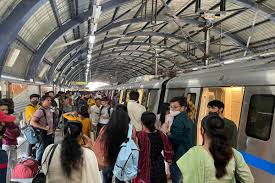
Early morning commuters in Delhi encountered temporary disruptions on the metro’s busiest corridor as scheduled maintenance work altered services on the Blue Line on Sunday. The adjustment, though brief, underscores the growing pressure on ageing urban transit infrastructure and the need for continuous upkeep in high-density cities.
The service regulation was implemented between Indraprastha and Supreme Court stations, a critical stretch on the Blue Line network that connects key residential and commercial hubs across Delhi, Noida, and Ghaziabad. Authorities scheduled the maintenance during early hours to minimise disruption, with normal operations restored after approximately 6:30 am. Revised timings affected select routes heading towards Dwarka, including delayed departures from major stations such as Vaishali, Laxmi Nagar, and Yamuna Bank. However, services originating from Dwarka towards Noida and Vaishali remained largely unchanged, indicating a targeted operational strategy rather than a full corridor shutdown. The Delhi Metro Blue Line, among the oldest and most heavily used corridors in the network, spans over 60 kilometres and serves a wide cross-section of daily commuters. Its operational complexity—covering elevated, underground, and intercity stretches—requires periodic maintenance interventions to ensure safety and reliability.
Urban transport experts point out that such short-duration service regulations reflect a broader shift in infrastructure management. Instead of prolonged shutdowns, transit agencies are increasingly opting for targeted, off-peak maintenance windows to balance commuter convenience with system longevity. This approach is particularly relevant in cities like Delhi, where public transport forms the backbone of daily mobility and economic activity. From a sustainability perspective, maintaining high-frequency metro corridors is critical to reducing dependence on private vehicles and lowering urban emissions. Even minor disruptions, however, can temporarily shift commuter behaviour toward road-based transport, contributing to congestion and pollution spikes if not managed effectively. The maintenance also highlights the lifecycle challenges faced by early-phase metro infrastructure. As systems mature, periodic upgrades and track work become essential to avoid larger service breakdowns. Officials have increasingly focused on preventive maintenance to extend asset life while maintaining operational efficiency.
For commuters, the incident reinforces the importance of real-time travel planning in rapidly evolving urban mobility systems. Digital updates and early advisories helped mitigate inconvenience, but the episode serves as a reminder that infrastructure resilience depends not only on expansion but also on consistent upkeep. As Delhi continues to expand its metro footprint under newer phases, balancing network growth with maintenance of existing corridors will remain a critical challenge. The effectiveness of such interventions will shape commuter trust and determine how well the system supports a low-carbon, high-efficiency urban future.