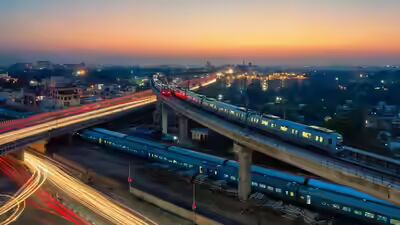
Jaipur is set for a major mobility upgrade with the approval of Metro Phase 2, a 41-km corridor designed to expand the city’s rapid transit network and improve connectivity across key residential, industrial, and institutional zones. The project marks a critical step in transitioning Jaipur towards a more integrated and sustainable urban transport system.
The new Jaipur Metro Phase 2 corridor will run along a north–south alignment connecting Prahladpura in the south to Todi Mod in the north, covering 36 stations across the city. This expansion significantly extends the current metro footprint, which is limited to a single operational line of just under 12 km, and is expected to reshape commuting patterns in the rapidly growing city. Urban mobility experts highlight that the Jaipur Metro Phase 2 project addresses a long-standing gap in intra-city connectivity. While Jaipur’s road network has expanded over the years, rising vehicle ownership and congestion have strained travel efficiency. A high-capacity metro system is expected to reduce dependence on private vehicles, ease traffic pressure, and lower emissions over time. The corridor is strategically aligned to connect key economic and civic nodes, including industrial hubs, healthcare institutions, and transport gateways such as the airport. This integration is expected to strengthen labour mobility, improve access to jobs, and enhance the city’s attractiveness for investment and tourism.
From an infrastructure perspective, the project will largely feature elevated tracks, with a limited underground section in sensitive zones. This design approach balances cost efficiency with urban constraints, particularly in dense areas where land acquisition and heritage preservation are key considerations. The Jaipur Metro Phase 2 project is also aligned with broader transit-oriented development (TOD) strategies. By promoting higher-density, mixed-use development around metro stations, planners aim to create compact, walkable neighbourhoods that reduce travel demand and improve urban liveability. This approach is increasingly being adopted across Indian cities as a response to sprawl and climate stress. However, the scale of the project brings execution challenges. With an estimated investment exceeding ₹12,000 crore, timely completion will depend on coordinated efforts between state and central agencies, financial institutions, and contractors. Land acquisition, integration with existing transport systems, and last-mile connectivity remain critical factors that will influence project outcomes.
Environmental considerations are also central to the project’s long-term impact. By shifting commuters from road to rail, the metro expansion has the potential to significantly reduce vehicular emissions—a key contributor to urban air pollution. Yet, experts caution that these benefits will materialise only if the system is supported by feeder networks, pedestrian infrastructure, and affordable access. For Jaipur, the metro expansion represents more than a transport upgrade—it signals a shift towards structured urban growth. As the city continues to expand beyond its historic core, infrastructure-led planning will play a decisive role in shaping its future form. The success of Jaipur Metro Phase 2 will ultimately depend on how effectively it integrates with the broader urban ecosystem—ensuring that connectivity improvements translate into more inclusive, efficient, and climate-resilient city development.