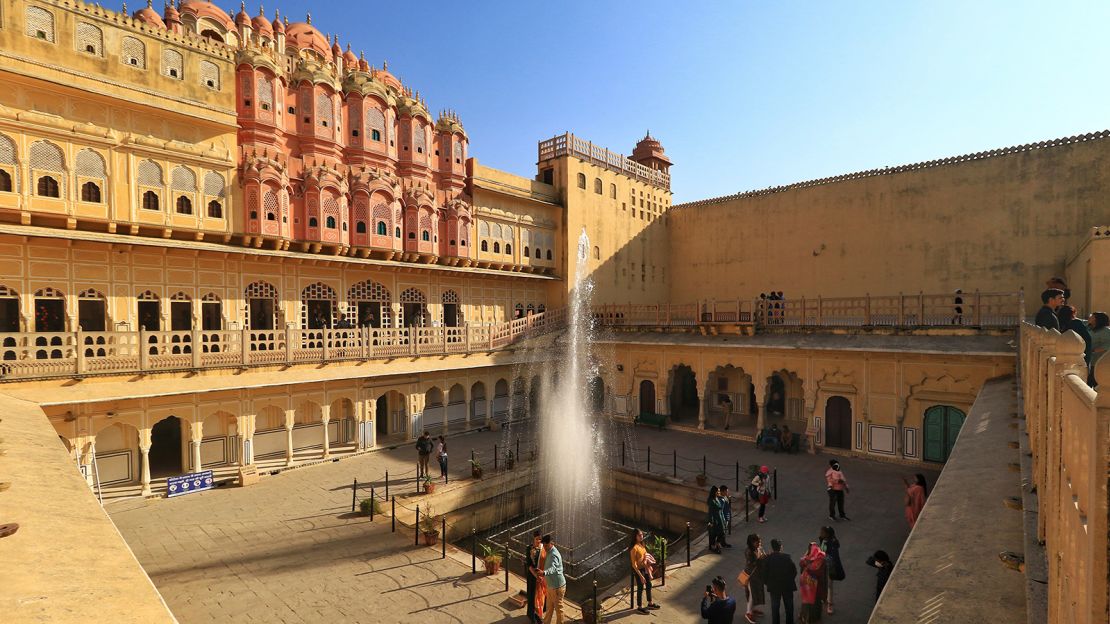
Hawa Mahal, one of Jaipur’s most recognisable landmarks, continues to offer valuable lessons for modern urban design, blending heritage architecture with climate-responsive engineering. Built in 1799, the structure was designed not just as a royal extension but as a functional response to heat, privacy, and urban life—issues that remain central to contemporary city planning.
Commissioned by a Rajput ruler and designed by court architect Lal Chand Ustad, the five-storey structure stands out for its distinctive honeycomb façade made of red and pink sandstone. The building features 953 intricately carved windows, or jharokhas, which were designed to allow air circulation while shielding occupants from direct sunlight. The architectural intent was both social and environmental. Historically, the structure enabled royal women to observe street life and processions without being seen, aligning with the cultural norms of the time. At the same time, the lattice design created a natural ventilation system, allowing cool air to flow through the building even during extreme summer heat. Urban design experts increasingly point to such features as early examples of passive cooling—an approach now being revisited as cities grapple with rising temperatures and energy consumption. Unlike modern buildings that rely heavily on mechanical cooling, structures like Hawa Mahal demonstrate how airflow, shading, and material choice can significantly improve thermal comfort.
The palace’s integration within Jaipur’s dense urban fabric also reflects a planning philosophy that prioritised compact, climate-sensitive development. Located along a busy street in the Walled City, it functioned as both an architectural screen and a public interface, connecting private royal spaces with the city’s everyday life. However, the site today faces challenges common to heritage urban zones. Increasing tourist footfall, traffic congestion, and pressure on civic amenities highlight the strain on historic precincts adapting to modern demands. Recent observations in Jaipur’s Walled City have pointed to gaps in sanitation and infrastructure, raising concerns about balancing conservation with usability. From a sustainability perspective, the relevance of Hawa Mahal extends beyond tourism. As Indian cities confront urban heat islands, rising energy demand, and dense built environments, the principles embedded in such heritage structures—natural ventilation, compact design, and material efficiency—are gaining renewed importance.
Urban planners argue that integrating these traditional design strategies into contemporary architecture could help reduce dependence on energy-intensive cooling systems while improving liveability. Retrofitting modern buildings with passive design elements and preserving heritage knowledge systems may offer a dual pathway towards sustainable urban growth. The enduring significance of Hawa Mahal lies not just in its visual identity, but in its functional intelligence. As cities look ahead to climate-resilient futures, this 18th-century structure continues to demonstrate that effective urban solutions often lie in reinterpreting the past rather than reinventing from scratch.