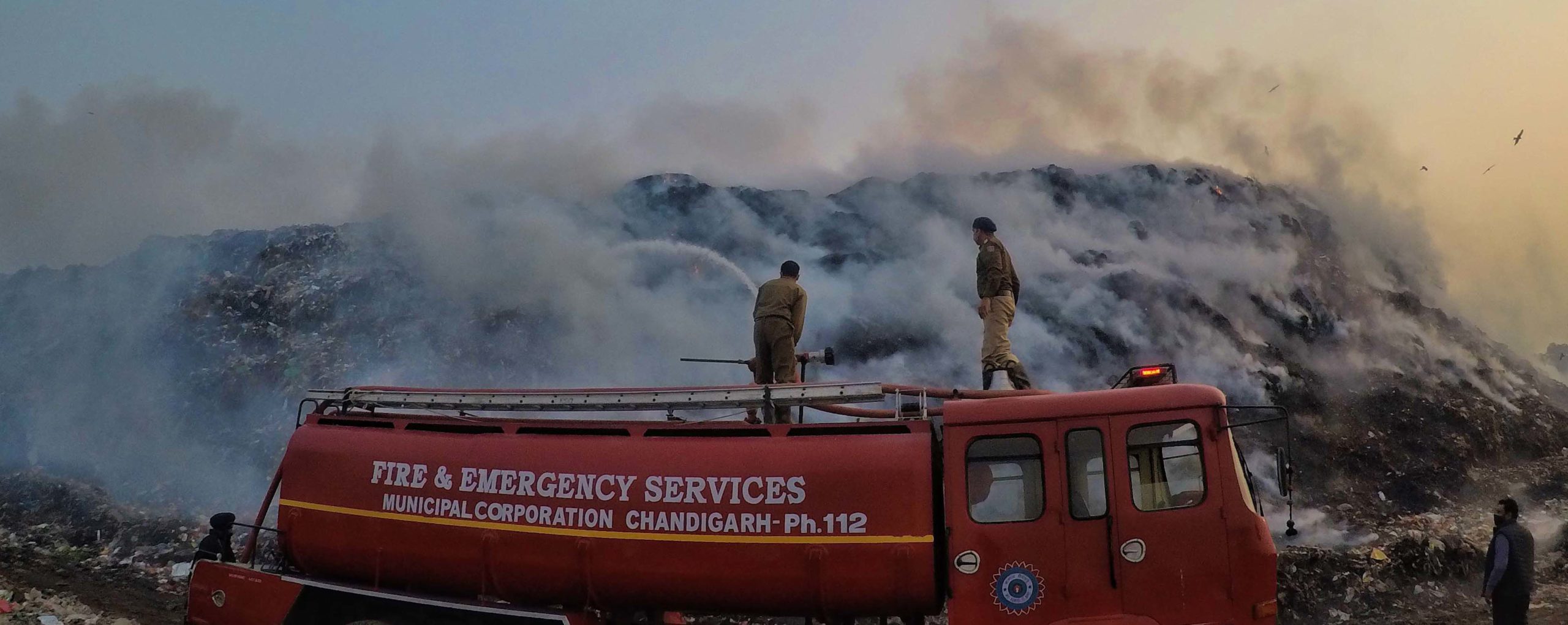
Bandhwari landfill continues to witness recurring fires, with the latest blaze taking nearly two days to control, once again exposing systemic failures in waste management across the National Capital Region. The incident highlights how unmanaged landfill ecosystems are becoming critical urban risk zones—impacting air quality, public health, and environmental resilience.
The recent fire spread across large sections of accumulated waste and required an extended firefighting operation, with smouldering pockets continuing to reignite even after initial containment. Officials attribute such incidents largely to methane accumulation—a byproduct of decomposing organic waste—which can ignite under high temperatures and dry conditions. Urban environmental experts point out that these fires are not isolated events but part of a recurring pattern linked to landfill design and management gaps. The Bandhwari site, operational since 2008, was originally designed for significantly lower waste volumes but now receives far more than its intended capacity, leading to unstable waste mounds and increased fire risk. The consequences extend beyond the landfill boundary. Thick plumes of smoke from such fires often spread across nearby residential and ecological zones, raising concerns about toxic exposure and deteriorating air quality. Given the site’s proximity to the Aravalli range—a sensitive ecological corridor—repeated fires also threaten biodiversity and long-term environmental health.
The Bandhwari landfill crisis underscores deeper structural issues in urban waste systems. Despite ongoing efforts to process legacy waste and introduce waste-to-energy solutions, large volumes of untreated garbage continue to accumulate. Reports indicate that millions of tonnes of waste remain unprocessed, while fresh waste inflow continues daily, further compounding the problem. Experts argue that the persistence of fires points to gaps in preventive infrastructure, including inadequate methane monitoring, lack of proper waste segregation, and insufficient scientific landfill management. Without active gas extraction systems, temperature control, and layered waste processing, landfill sites effectively become combustible zones during summer months. From a governance perspective, the issue also reflects coordination challenges. Waste management in the NCR involves multiple agencies across state boundaries, often resulting in fragmented accountability. Regulatory interventions and audits have increased in recent years, but consistent enforcement and long-term planning remain uneven.
The Bandhwari landfill crisis also raises questions about the sustainability of landfill-dependent urban growth models. As cities expand and consumption patterns intensify, reliance on dumping sites is proving increasingly untenable. Urban planners suggest a shift towards decentralised waste processing, segregation at source, and circular economy approaches to reduce landfill dependency. For residents, the recurring fires are a visible reminder of how waste mismanagement translates into everyday risks—from polluted air to disrupted mobility. The issue is particularly acute during summer, when heat and wind conditions accelerate fire spread, making containment more difficult. As authorities continue firefighting and remediation efforts, the focus is likely to shift towards long-term solutions. Addressing the Bandhwari landfill crisis will require not just clearing waste, but redesigning how cities handle it—integrating environmental safeguards, technological systems, and citizen participation into a more resilient urban waste framework.