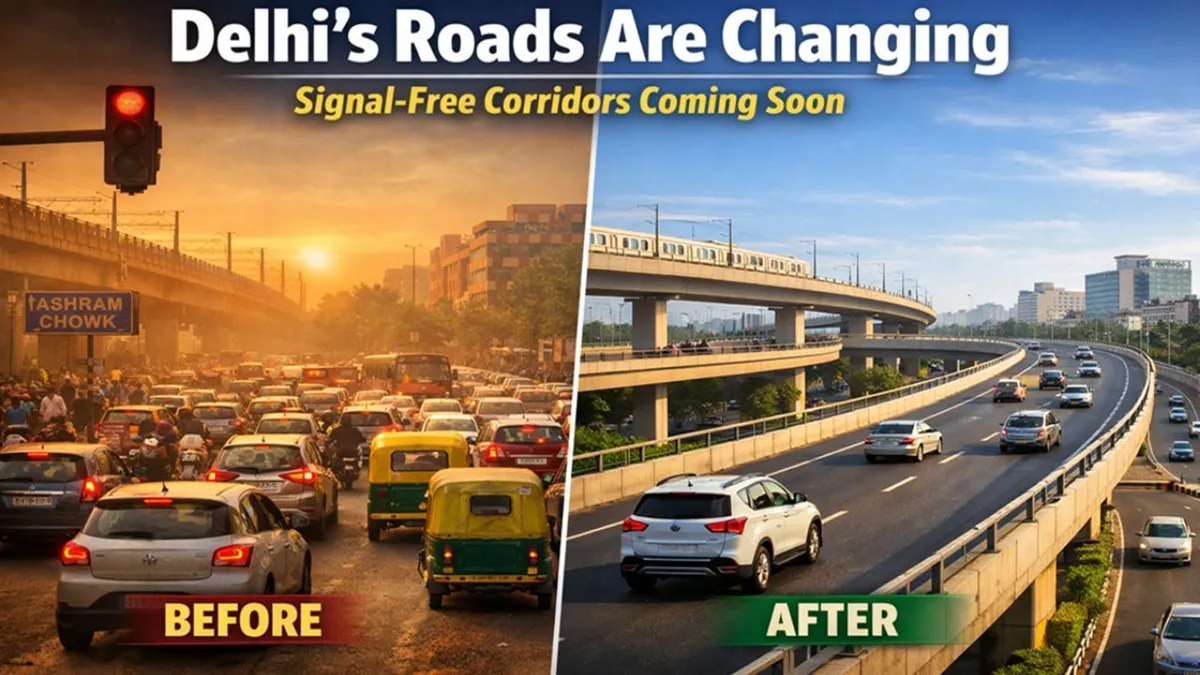
A fresh traffic management intervention is being prepared for North Delhi’s Burari corridor as authorities move to address chronic congestion along the Outer Ring Road, one of the capital’s most overstretched urban transport stretches. The proposed redesign comes amid rising commuter pressure, expanding residential density, and growing concerns around road safety and pedestrian mobility in the area.
According to officials involved in the assessment process, traffic engineers and enforcement teams recently conducted a field inspection at multiple bottleneck points near Burari to identify structural causes behind long vehicle queues that routinely spill over during peak hours. The stretch connects several high-density residential clusters with key transit routes, making it critical for daily movement across northern parts of Delhi. The Burari Traffic Plan is expected to focus on redesigning vehicular movement near a major roundabout where conflicting turning patterns and unmanaged U-turns frequently slow traffic flow. Authorities are considering lane segregation and revised turning geometry to streamline movement across directions and reduce unnecessary merging points. Urban mobility experts say such interventions, if scientifically implemented, can improve corridor efficiency without large-scale road widening.
The area has witnessed rapid urban expansion over the last decade, but transport infrastructure has struggled to keep pace with rising vehicle ownership and mixed-use development. Residents, school transport vehicles, delivery operators and emergency services are often caught in prolonged congestion, particularly during office hours. Planners note that such recurring bottlenecks not only reduce productivity but also worsen localised air pollution and fuel consumption. Alongside roadway redesign, agencies are also preparing a pedestrian-focused intervention near the metro station zone. A proposed foot overbridge is being examined to improve safer crossing access for commuters moving between the transit station and surrounding residential pockets. At present, heavy pedestrian movement across fast-moving traffic lanes contributes to delays as well as safety risks.
Urban planners increasingly argue that transport planning in dense city corridors must prioritise integrated mobility rather than isolated road expansion. In Burari’s case, the combination of metro connectivity, informal commercial growth and rising private vehicle usage has created pressure on infrastructure that was not originally designed for present-day traffic volumes. The Burari Traffic Plan also reflects a wider shift in Delhi’s urban governance approach, where authorities are attempting smaller but targeted corridor-level interventions instead of relying solely on large flyover projects. Experts believe such localised redesign measures can offer faster implementation timelines and lower environmental disruption when combined with better pedestrian infrastructure and public transport integration. Officials indicated that groundwork for the proposed modifications could begin within days, subject to inter-agency coordination between civic authorities, transport planners and metro-linked infrastructure teams. However, the long-term success of the project will depend on enforcement consistency, commuter compliance and whether future urban growth in the area is matched with sustainable mobility planning.