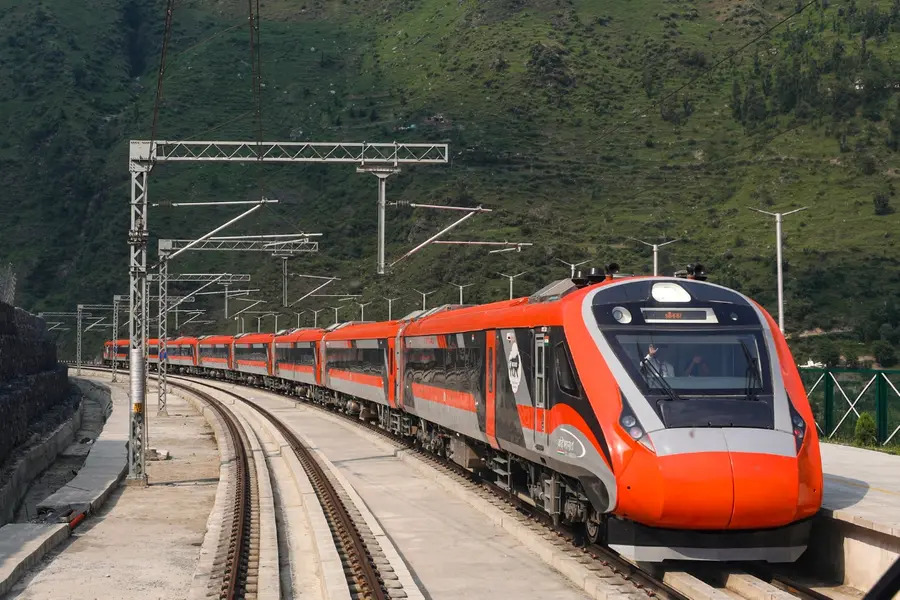
Indian Railways has approved a new Udaipur–Ahmedabad Vande Bharat service while withdrawing two existing premium trains from Udaipur this week, signalling a strategic recalibration of high-speed connectivity in western India. The decision reflects shifting passenger demand patterns and revenue considerations as the national transporter refines its semi-high-speed network to better align with regional mobility needs. Under the revised schedule, services linking Udaipur with Agra Cantt and Jaipur will cease operations from mid-February. In their place, a new Vande Bharat Express connecting Udaipur City with Asarwa in Ahmedabad will operate six days a week, offering faster inter-state access between southern Rajasthan and Gujarat’s commercial hubs.
Railway officials indicate that the Udaipur–Ahmedabad Vande Bharat will depart early in the morning from Udaipur and return in the evening from Ahmedabad, with intermediate halts at Zawar, Dungarpur and Himmat Nagar. Designed for speeds of up to 160 kmph, the train is expected to reduce travel time and improve reliability for business travellers, students and small traders who frequently commute across the Rajasthan–Gujarat corridor. Urban mobility experts note that this corridor holds growing economic relevance. Ahmedabad’s industrial clusters and emerging logistics hubs increasingly interact with tourism-driven and mining-linked economies in southern Rajasthan. Strengthening rail connectivity between these regions could ease highway congestion, lower emissions from private vehicle use and encourage more sustainable inter-city movement, a priority as cities confront air quality and carbon reduction targets.
The restructuring also underscores a broader reality within the Vande Bharat ecosystem. While the train series has become synonymous with punctuality and upgraded passenger comfort, occupancy rates vary significantly by geography. Railway data shows that Kerala’s Vande Bharat trains are currently recording some of the highest occupancy levels in the country, reportedly nearing double-capacity utilisation due to strong daily commuter flows and limited alternative high-speed options. By contrast, several other routes across India, particularly shorter inter-city stretches with competing road infrastructure are witnessing subdued demand. Industry analysts suggest that route planning, ticket pricing and local travel behaviour play decisive roles in determining viability. Eight-coach configurations, in particular, are said to face revenue pressures when load factors dip below optimal thresholds.
Transport economists argue that the latest adjustments reflect a necessary evolution rather than retrenchment. Premium rail assets, they say, must be deployed where ridership density supports operational sustainability. In rapidly urbanising regions, such alignment can enhance economic productivity while reinforcing climate-resilient transport choices. For Rajasthan and Gujarat, the success of the new Udaipur–Ahmedabad Vande Bharat will depend on consistent demand and seamless last-mile connectivity. As India continues expanding its semi-high-speed network, data-led deployment may determine whether these flagship trains remain aspirational symbols or become foundational components of sustainable urban growth.