


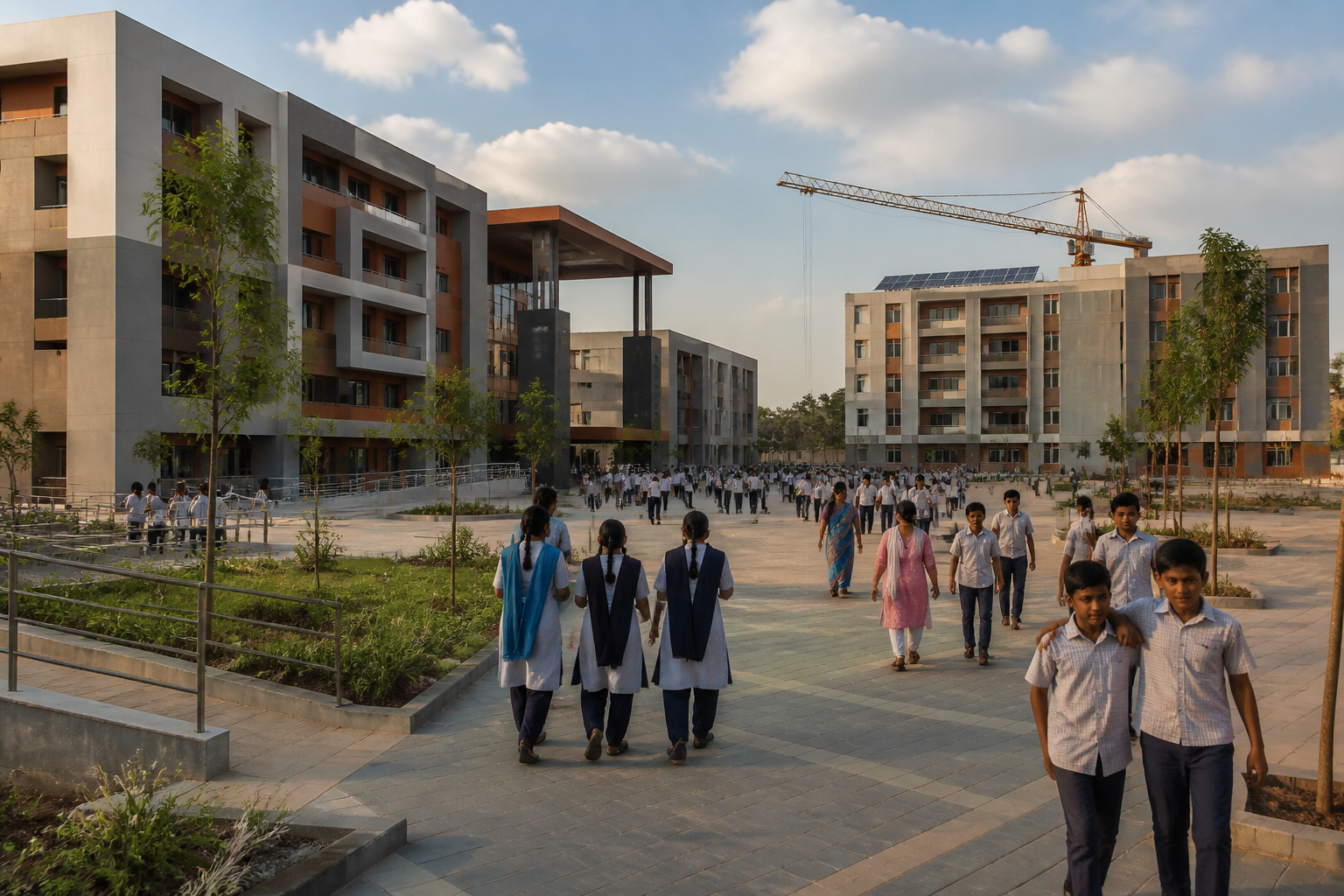
Telangana’s proposed Rs 24,000 crore investment in Young India Integrated Residential Schools is being presented as an education expansion, but its larger significance lies in the creation of a new public infrastructure network. The plan would combine residential campuses, digital facilities, nutrition services, classrooms and specialised academic support across the state, placing questions of land, construction, funding and long-term management at the centre of its implementation.
The scale is substantial. Each Young India Integrated Residential School campus is planned to accommodate 2,560 students from Classes 5 to 12, while the overall initiative is expected to benefit around 2.7 lakh students statewide. The campuses are intended to provide shared facilities for Scheduled Caste, Scheduled Tribe, Backward Class and minority students, as well as provisions for children with special needs. Officials also outlined a proposed Young India Police School for children of police personnel.
These details indicate that the programme is not limited to adding classrooms. It involves creating residential institutions with a wide range of common facilities and services. That changes the infrastructure challenge. A conventional school project can be assessed largely through classroom capacity, sanitation and basic services. A residential campus must also support accommodation, food, health and welfare functions, safety, accessibility and daily operations, although the supplied report does not specify the design standards or operating arrangements for these facilities.
The state’s parallel plan for Telangana Public Schools adds another layer to the proposed network. Telangana plans 162 such campuses in 2026-27 at a reported cost of Rs 1,141.15 crore, with education from the pre-primary level through Class 12. Officials also described a broader objective of establishing one Telangana Public School in each of the state’s 630 mandals. The difference between the number planned for 2026-27 and the longer-term mandal-level vision suggests that the programme is expected to develop in stages rather than through a single construction cycle.
The distinction between an announced ambition and a funded, operational asset is important. The Rs 24,000 crore figure covers the Young India Integrated Residential Schools initiative as described by officials, while other figures in the report relate to specific components, funding proposals or existing works. These numbers should not be treated as interchangeable. The state has proposed Rs 7,004.92 crore in externally aided funding through the Asian Infrastructure Investment Bank. Separately, Rs 1,234.53 crore has been sanctioned for 16 integrated school complexes, upgrades to 17 institutions and 501 classrooms across 164 urban schools.
The funding structure therefore appears to contain several layers: a large programme-level investment plan, externally aided funding under proposal, and sanctioned allocations for defined construction and upgrading works. The supplied material does not establish how these amounts will be sequenced, what share will come from the state budget, or whether the external funding has been approved and drawn. Those distinctions will determine how quickly campuses can move from announcement to construction and from construction to functioning institutions.
The urban dimension is particularly visible in the reference to 164 urban schools and 501 classrooms. Urban school infrastructure often has to work within built-up areas where land is constrained and existing campuses must continue operating during upgrades. The report does not provide land details, ward-level locations or construction timelines, so it is not possible to assess the spatial distribution of the planned facilities. However, the inclusion of urban schools within a statewide infrastructure package shows that the programme will have to address different physical conditions rather than apply one uniform campus model.
The state-level workshop at which these plans were outlined was organised by the planning and school education departments under NITI Aayog’s State Support Mission. That institutional setting is significant because it places school construction within a wider planning and administrative framework. The programme will require coordination between departments responsible for education, finance, planning, construction, digital systems, nutrition and possibly social welfare. The available report does not specify the delivery agency for each component, but the range of announced works points to a governance structure more complex than a single-department building programme.
Digital infrastructure is another major component. Works worth Rs 666.75 crore were planned for 2023-26, according to the report. The material does not specify whether this covers connectivity, devices, laboratories, classroom systems or other forms of technology. That lack of detail matters because digital infrastructure has both a capital cost and a continuing operational cost. Equipment, connectivity and maintenance can determine whether a digitally equipped campus remains functional after installation. The reported figure confirms the scale of planned spending but does not by itself establish the quality or reach of the services delivered.
Sanitation has been assigned a separate allocation of Rs 208.91 crore for 4,355 toilet units. In a residential and school system serving students from pre-primary to Class 12, toilets are not a peripheral facility. They are part of the basic capacity of a campus and directly affect safety, dignity and daily usability. Yet the supplied information does not identify the locations of the units, their distribution between urban and rural schools, or whether the allocation includes water supply and maintenance. The spending figure is therefore an important infrastructure indicator, but not a complete measure of sanitation performance.
The programme also combines physical infrastructure with recurring support. Morning nutrition reaches more than 20.59 lakh students through 39 central kitchens. Diet charges have reportedly been raised by 40%, while cosmetic charges have increased by between 142% and 267%. These measures suggest that the state is addressing the operating costs associated with student welfare alongside capital expenditure on campuses. For residential schools, such recurring costs are central to whether facilities can operate as intended. The report, however, does not provide the revised per-student amounts or the budgetary impact of the increases.
The reported enrolment performance of the Arutla demonstration campus offers one indication of demand for the model. Enrolment rose by 113%, from 744 to 1,585 students, and 72% of new admissions reportedly came from private schools. The figures show that the campus attracted students who had previously been enrolled in private institutions, but they do not establish whether this pattern will be replicated statewide. Nor does the report identify the factors behind the shift, such as fees, facilities, academic performance, location or residential provision. The demonstration campus is therefore evidence of interest, not proof of the programme’s future reach.
Academic support is being built into the institutional model as well. Young India Institutes of Excellence across 93 Kasturba Gandhi Balika Vidyalayas have been allocated Rs 10 crore annually for coaching for the Joint Entrance Examination, National Eligibility cum Entrance Test and Common Law Admission Test. This extends the programme beyond basic schooling and into competitive examination preparation. It also creates a more specialised requirement for staffing, teaching resources and monitoring, although the source does not provide details on how the annual allocation will be distributed among the 93 institutions.
The report further cites 58,632 school improvement works costing Rs 642.10 crore and up to sevenfold gains in foundational literacy and numeracy. These figures connect the new campus strategy to the existing school network. Large new institutions may attract attention because of their scale, but statewide educational capacity also depends on the condition and performance of existing schools. The improvement works indicate an attempt to combine expansion with upgrading, while the learning gains point to outcomes that officials associate with the broader programme. The supplied material does not identify the baseline period, measurement method or individual interventions behind those gains, so the result cannot be independently interpreted from the announcement alone.
The central administrative question is how Telangana will align a long-term physical network with a system of ongoing services. A campus can be completed as a construction project while remaining underused if staffing, transport, food, digital maintenance or student support are not aligned. Conversely, improvements to existing urban schools may produce immediate capacity without creating entirely new institutions. The announced package includes both types of intervention, but the source does not provide a consolidated implementation calendar or performance framework linking expenditure to enrolment and learning outcomes.
The numbers also reveal the range of scales involved. The programme is framed around Rs 24,000 crore and 2.7 lakh potential beneficiaries, while individual components include 162 planned public school campuses, 630 mandal-level institutions as a longer-term vision, 164 urban schools receiving classroom upgrades, 4,355 toilet units, 39 central kitchens and 93 institutions receiving examination coaching support. These are not separate stories; they are different layers of the same public system. The challenge will be to ensure that the layers reinforce each other rather than develop as disconnected schemes.
What is established at this stage is that Telangana is pursuing a large, multi-part public education infrastructure programme with residential schools, public schools, urban upgrades, digital works, sanitation, nutrition and academic support. What remains unclear is the implementation sequence, the status of external financing, the locations and designs of campuses, the division of responsibilities between agencies, and the operational costs after construction. Those details will determine whether the proposal becomes a coherent statewide network or remains a collection of separately funded projects. The next milestones will be the financing decisions, campus-level planning, construction progress and evidence on whether the reported improvements in enrolment and learning can be sustained across the state.

