


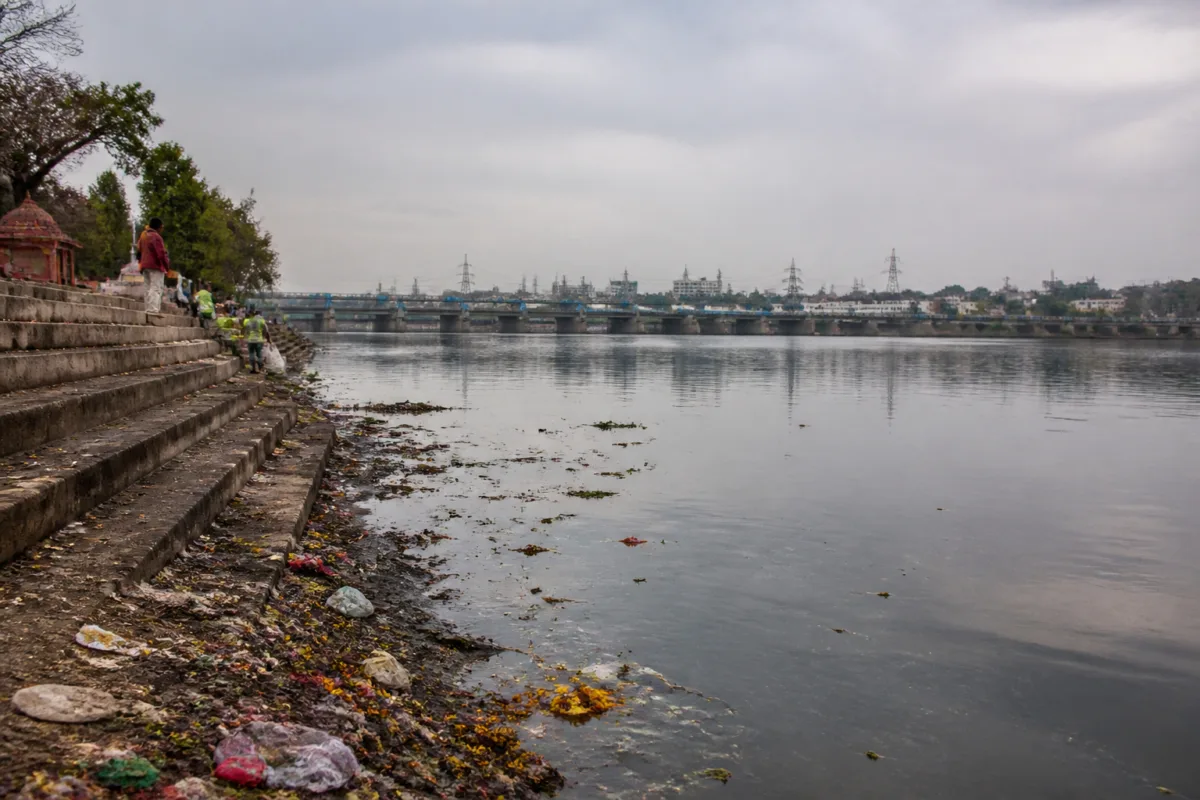
A video of North East Delhi MP Manoj Tiwari drinking water from the Yamuna and washing his face with it has drawn attention to a larger problem that a public demonstration cannot settle: Delhi’s river pollution is shaped not only by visible waste on the banks, but also by the volume of sewage entering the river system each day.
According to Live Hindustan – NCR, Tiwari used water collected in his palm to rinse his mouth and drink, then washed his face at a Yamuna ghat. He said the river was still giving Delhi an opportunity to protect its children and appealed to people to keep the banks clean. He also pointed towards flowers, coconuts, plastic and other waste lying near the ghat, arguing that such material was brought there by people rather than by the river.
The video presents two different dimensions of the Yamuna problem together. One is the public-facing condition of the riverbank: litter, religious offerings and plastic waste that can be seen and removed. The other is the less visible flow of untreated sewage through drains and outfalls. The second problem is not resolved merely by cleaning the bank or showing water collected at one location.
The distinction matters because a single visual demonstration cannot establish the overall quality of a river. The supplied report does not provide laboratory testing of the water consumed by Tiwari, nor does it identify the exact ghat where the video was recorded. It therefore records his claim and actions, but does not independently establish that the Yamuna is safe for drinking, rinsing or other direct contact.
The available evidence points to a more complicated picture. The report cites an Indian Express report published on October 15, 2026, which said that thousands of dead fish had been found near the Yamuna at Burari. The location is above the Wazirabad barrage and is described in the report as part of the comparatively cleaner stretch of the river in Delhi. Experts cited in that account treated the fish deaths as a serious concern for aquatic biodiversity.
That reported incident does not, by itself, explain the cause of the fish deaths. But it shows why river health cannot be assessed only through a brief appearance of clear-looking water or the absence of waste in a camera frame. Aquatic life responds to conditions that may not be visible to residents standing at the edge of the river, including changes in water quality and the presence of pollutants. The supplied material does not provide test results or a final official explanation for the fish deaths, so those causes remain unestablished here.
The more concrete administrative evidence is the sewage data cited from information released by the Centre on July 31, 2025. The figures, attributed to Delhi Jal Board data, said Delhi generated approximately 3,596 million litres of sewage every day. The city had 37 operational sewage treatment plants with a combined installed capacity of 3,474 million litres per day. Despite that capacity, around 641 million litres of sewage was reportedly reaching the river or drains without treatment each day.
These figures reveal the central governance gap. Installed capacity is not the same as effective treatment. A city may have treatment plants on paper and still discharge a substantial volume of untreated sewage if the plants are insufficiently connected to the drainage network, receive less sewage than expected, operate below capacity, or are unable to handle the waste reaching them. The supplied report does not identify which of these factors accounts for the gap in Delhi, but the difference between the city’s sewage generation and the untreated volume establishes that infrastructure capacity alone has not closed the pollution problem.
The numbers also put the visible litter shown in the video in perspective. Waste thrown near a ghat is an immediate public-space and sanitation issue. It can obstruct access, degrade the riverbank and add plastic and organic matter to the water. Yet the reported 641 MLD untreated sewage flow represents a continuous urban systems problem. It is linked to how sewage is collected, conveyed, treated and monitored across the city, rather than only to the behaviour of visitors at a particular bank.
This is why responsibility for the Yamuna cannot rest solely with citizens. Tiwari’s appeal for people not to throw flowers, coconuts and plastic on the banks addresses one part of the problem. The sewage figures point to responsibilities that sit with public agencies and infrastructure operators: expanding and maintaining treatment capacity, ensuring that sewage reaches plants, preventing untreated flows into drains and the river, and making performance data available for scrutiny. The source material does not provide an agency-wise account of these responsibilities or details of current remedial projects, so the precise institutional causes of the gap cannot be assigned from the report alone.
The episode also highlights a recurring communication problem in urban environmental governance. A river can look different from one location to another, and its appearance can change with flow, weather, waste accumulation and local conditions. A public demonstration at one ghat may create a strong impression, but it cannot substitute for systematic monitoring across the river, its drains and its treatment infrastructure. Conversely, a report of dead fish is an important warning signal, but it also requires documented investigation before a definitive cause is stated.
For residents, the distinction has practical importance. People encounter the Yamuna through ghats, roads, bridges and neighbourhood drains, while the pollution process operates across a much larger network. The riverbank is the visible endpoint of decisions made upstream and within the city’s sewage system. If attention remains focused only on litter removal at public locations, the less visible flows that carry sewage into the river can continue without comparable public scrutiny.
The Delhi case therefore involves at least three linked administrative tasks. The first is maintaining clean and usable riverfront areas, including the removal and prevention of dumped waste. The second is ensuring that the sewage generated by homes, institutions and commercial areas is connected to a functioning treatment chain. The third is measuring river and aquatic conditions in a way that allows residents to distinguish a temporary visual improvement from sustained ecological recovery. The supplied report gives evidence of the first problem and quantifies part of the second, but does not provide enough data to assess the third.
The Yamuna pollution debate is consequently not resolved by deciding whether the water shown in the video looked clean or dirty. The stronger question is whether Delhi’s entire urban water and sewage system is preventing pollutants from reaching the river. On the evidence cited in the report, the answer remains incomplete: the city had substantial installed treatment capacity, but approximately 641 MLD of sewage was still reported to be entering the river or drains untreated.
Tiwari’s video has made the river’s condition visible through a political demonstration. The government data and reported fish deaths point to what the camera cannot show: the health of the Yamuna depends on continuous infrastructure performance, not on a single act at a single ghat. Future assessment will require official water-quality findings, an explanation of the Burari fish deaths and clearer information on how Delhi plans to account for the untreated sewage volume.

