


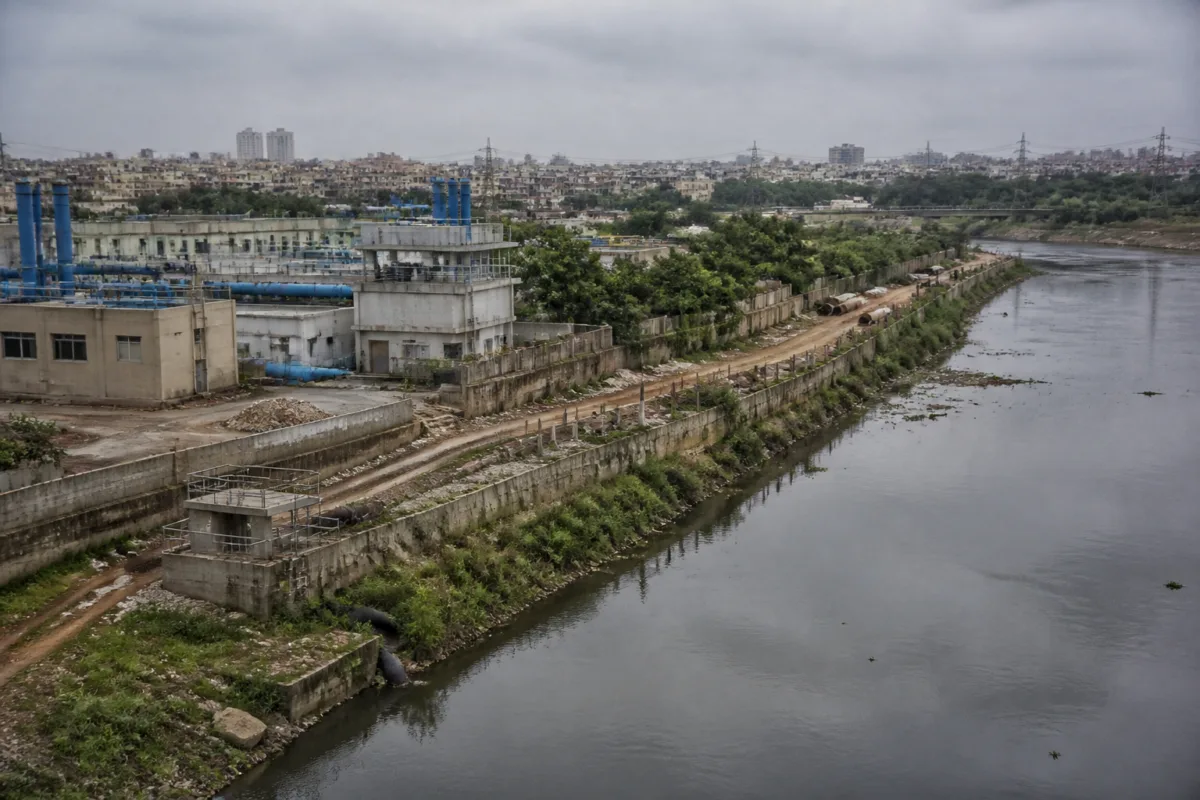
The launch of Yamuna clean-up projects worth Rs 8,941 crore has again placed Delhi’s sewage infrastructure at the centre of the city’s river-pollution problem. The announcement, made at a Delhi Jal Board event by Union home minister Amit Shah, included the inauguration of 10 projects and the initiation of 33 others, covering sewage treatment plant upgrades, new sewage treatment plants and a decentralised sewage treatment plant pumping station.
The political claims surrounding the launch were prominent, but the urban question is more practical: can Delhi ensure that wastewater is collected, conveyed, treated and monitored before it reaches the Yamuna? Delhi chief minister Rekha Gupta said the government’s goal was to connect every household and sewer line to a sewage treatment plant so that untreated wastewater does not flow into the river. That statement identifies the central infrastructure gap. A treatment plant can only perform its intended role when sewage reaches it through a functioning and adequately connected network.
The announcement also shows how Yamuna pollution is being framed by the administration: not only as an environmental failure, but as a problem of incomplete urban service coverage. A city’s river receives the consequences of decisions made across neighbourhoods, unauthorised areas, sewer networks, pumping stations and treatment facilities. The river-cleaning programme therefore depends on more than the construction or inauguration of individual plants. It depends on the integration of household connections, local sewer lines, trunk infrastructure, pumping capacity and treatment operations.
## The infrastructure chain behind river pollution
The details supplied in the report point to several parts of that chain. Existing sewage treatment plants are to be upgraded, new plants are to be installed, and a decentralised treatment plant pumping station has been set up. These interventions address different stages of the wastewater system. Upgrades may improve the performance of existing facilities, new plants may add treatment capacity, while decentralised infrastructure can serve areas where connecting every flow to a distant central facility is difficult.
However, the announcement does not provide a project-wise breakdown of capacity, locations, completion dates, tender values or the volume of sewage each intervention is expected to handle. It also does not establish how much untreated wastewater currently enters the Yamuna, how many households remain unconnected to sewerage, or how the newly announced works will change those figures. Those omissions matter because the public value of a clean-up programme cannot be assessed only by its headline financial allocation.
The chief minister said sewerage infrastructure had been strengthened over the past one-and-a-half years and that all projects would be completed within stipulated timelines. The statement establishes an administrative commitment, but the report does not identify those timelines or the mechanisms that will be used to measure progress. For residents, the relevant milestones will include actual sewer connections, functioning pumping stations, reliable plant operations and a reduction in untreated discharges.
Shah attributed the failure to prevent untreated sewage from entering the Yamuna to previous governments. Water minister Parvesh Verma said that under the previous government, tenders were floated, cancelled and floated again. Delhi Congress president Devender Yadav disputed the government’s record, alleging that no Yamuna project had been completed in the past two years and accusing the administration of making hollow declarations. These competing claims show that project continuity and execution have become part of the political contest, but the supplied material does not independently establish the full record of completed or delayed works.
## Announcements are not the same as network performance
The difference between announced infrastructure and functioning infrastructure is particularly important in sewage management. A plant may be completed, but its impact depends on whether sewage is diverted to it, whether the plant operates consistently and whether the treated output meets the required standard. Similarly, a sewer line may be laid without achieving full household connectivity. A pumping station may be installed but still face operational or maintenance constraints.
The report does not provide operating data for Delhi’s existing sewage treatment plants. It does not state how many plants are currently functional, how much of their designed capacity is being used, or whether treatment performance varies across facilities. It also does not identify the specific sites covered by the Rs 8,941-crore package. Without those details, the announcement can confirm the scale of planned public spending but not its eventual effect on the river.
The government’s stated objective of connecting every household and sewer line to an STP is significant because it treats the sewer network as part of the clean-up solution rather than treating the river as a standalone environmental project. The approach implies that pollution control begins upstream, at the point where wastewater is generated and collected. It also places responsibility on multiple administrative layers: the Delhi government, the Delhi Jal Board, local implementation agencies and contractors responsible for construction and operations.
That institutional chain can make accountability difficult. If untreated sewage reaches the river, the failure may originate in a missing household connection, a blocked or incomplete sewer, inadequate pumping capacity, a non-operational treatment plant or poor monitoring. A credible implementation system must therefore connect each project to a defined service area and a measurable outcome. The material supplied for this report does not say whether such a public tracking framework has been announced.
## The political timetable and the delivery timetable
Shah said the government would return to the people in May 2029 with a clean Yamuna. That political timetable gives the programme a clear endpoint, but river restoration depends on milestones that occur much earlier. The report says 10 projects were inaugurated and 33 initiated, yet it does not specify the expected completion dates for each work or distinguish between construction, commissioning and full operation.
This distinction is important for a city where sewage infrastructure is experienced at street level. Residents do not benefit from a project merely because its foundation stone has been laid. They benefit when wastewater from homes, markets and institutions is reliably collected and treated. The difference between an initiated project and an operating asset is therefore central to evaluating the programme.
The reference to tenders being floated and cancelled also highlights the procurement dimension of urban infrastructure. Repeated tendering can delay works, increase uncertainty for agencies and defer benefits to residents. At the same time, the report does not provide details of the tenders in question, their values, the reasons for cancellation or the present status of replacement contracts. Those facts would be necessary to assess whether procurement delays have materially affected the Yamuna programme.
## What Delhi’s sewage challenge reveals
The Yamuna clean-up announcement reveals a familiar urban governance problem: environmental outcomes depend on basic infrastructure that is distributed across the city. River pollution cannot be separated from the extent and quality of sewerage coverage. Nor can the performance of a treatment plant be separated from the network that feeds it.
The scale of the announced package indicates that the administration considers the problem substantial enough to require simultaneous work on existing plants, new treatment capacity and decentralised infrastructure. Yet the available information does not show whether these interventions have been prioritised according to the largest untreated flows, the most underserved settlements or the facilities with the greatest operational deficiencies. It also does not establish the expected reduction in pollution after completion.
For citizens, the most important measure will be whether the programme converts expenditure and construction activity into dependable sanitation services. That requires information on household connections, plant capacity and utilisation, project-wise deadlines, treatment performance and the volume of untreated sewage entering the river. The competing political claims make transparent reporting more important, not less.
The current announcement confirms that Delhi has launched and initiated a large set of Yamuna-related works, but it does not yet demonstrate the final environmental outcome. The next stage will be judged by whether the listed projects are completed within their promised timelines, whether sewerage reaches the treatment facilities and whether the administration publishes evidence of improved treatment and reduced untreated discharge. Those are the milestones that will determine whether the programme becomes a functioning citywide sewage intervention rather than another cycle of announcements and counter-claims.

