


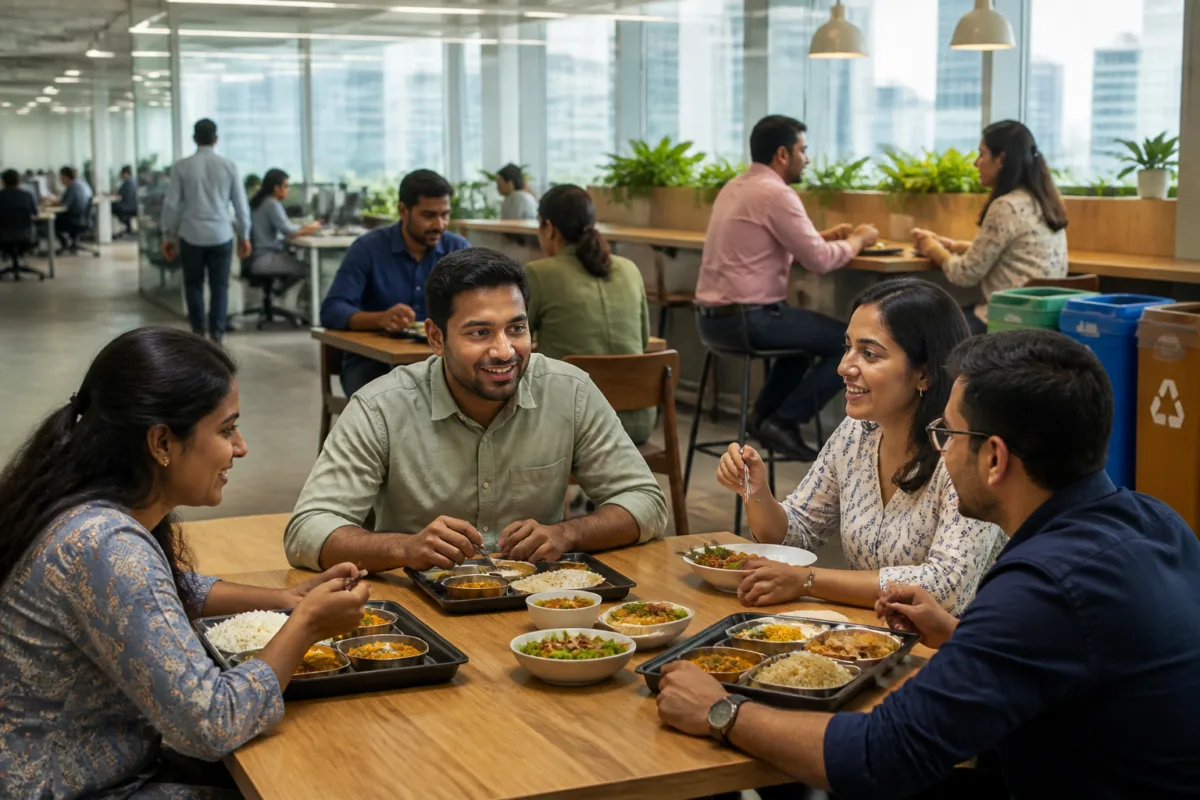
A new study on workplace breaks in India points to a contradiction at the centre of the modern office: employees increasingly associate pauses, healthier food and social interaction with productivity and wellbeing, but many workplaces still make these activities difficult to practise. The findings suggest that the office is no longer only a place where desks, meeting rooms and technology need to function. Its dining, movement and social spaces are becoming part of the employee experience, even as work schedules leave limited room to use them.
The Global Eating at Work study by food services company Compass Group India surveyed 2,000 people working across corporates and Global Capability Centres in India. It found that 95 per cent of respondents felt more productive after taking a break. At the same time, 63 per cent believed their organisations undervalued breaks. This gap between perceived value and workplace practice is the central finding: employees may understand the benefits of stepping away from work, but the organisation of the working day does not consistently support it.
The trend is visible in the frequency and duration of breaks. According to the study, the proportion of employees taking regular breaks three to five times a week fell from 46 per cent in 2023 to 38 per cent in 2025. The share taking two or fewer breaks a week rose by 67 per cent compared with 2023, reaching 44 per cent. One in five employees spends less than 15 minutes on their main workday break, while nearly a quarter rarely takes a meaningful break during the day. Only 15 per cent reported taking a break lasting more than 45 minutes.
These figures describe more than an individual time-management problem. They show how workplace design, management expectations and operating schedules can shape everyday behaviour. A break requires more than permission. It requires a usable place to eat or sit, sufficient time to reach that place, food options that employees consider acceptable, and a workplace culture in which leaving the desk does not signal a lack of commitment. When any of these elements is missing, the formal availability of a cafeteria or lounge may not translate into actual use.
The survey found that 76 per cent of Indian employees preferred several shorter breaks to one long break. Yet 45 per cent said they took breaks only when circumstances allowed, and nearly one in four continued to eat lunch at their desk. The contrast indicates that the issue is not necessarily a preference for long periods away from work. It is the absence of predictable, manageable opportunities to step away during a demanding day.
This has implications for how offices are planned and operated. A workplace restaurant, cafeteria, breakout zone or outdoor area can be treated as an ancillary facility, separated from the core work environment. The study’s findings indicate that employees see these spaces differently. They connect food, movement, rest and social interaction to their ability to function during the day. The question for employers is therefore not only whether such facilities exist, but whether their location, capacity, ambience and operating model allow employees to use them without friction.
The infrastructure gap is not uniform across workplaces. Compass Group India reported that 51 per cent of Indian employees in the study had access to on-site dining facilities, compared with 29 per cent globally. That is a relatively high level of workplace dining access, but access alone does not establish whether the facility is affordable, attractive, convenient or available at the right times. A dining space can exist within an office campus and still fail to support regular breaks if queues are long, seating is inadequate or employees cannot leave their workstations.
The social role of workplace food is also significant in the study. Ninety-three per cent of Indian employees said they shared meals with colleagues at least a few times a month, while 91 per cent said they tried to catch up with colleagues over food or drink at work. The comparable global figure for the latter measure was 69 per cent. These findings position food spaces as part of the informal infrastructure through which workplace relationships are formed and maintained.
The design expectation is changing along with this social function. Nearly 87 per cent of respondents wanted workplace restaurants to reflect the experience and ambience of modern high-street dining destinations. The study also recorded interest in regional cuisines, healthier snacks and more personalised food choices. This does not mean every office needs to replicate a commercial food district. It does indicate that a basic canteen model may no longer match the expectations of a workforce that sees dining as part of the quality of its working environment.
Food facilities can also influence how offices perform as shared environments. If employees have several shorter breaks, they need spaces that can accommodate movement throughout the day rather than only a single concentrated lunch period. If meals are used for social connection, the space must support both short informal interactions and longer shared meals. If healthier choices are expected, the food service model must offer variety without making employees leave the campus or rely on individual workstations.
The study found that 90 per cent of Indian employees wanted healthier food options at work. More than 90 per cent said they were changing what they ate and drank to improve their long-term health. Nutrition, physical activity and quality sleep emerged as the three leading contributors to long-term wellbeing among respondents. These findings broaden the meaning of workplace amenities. They suggest that employees increasingly judge the office not only by its furniture or technology, but by whether its daily environment supports healthier routines.
This expectation places workplace dining within a larger employee-experience framework. Compass Group India managing director Rahul Shinde said taking breaks, eating well and connecting during the working day had become a productivity, engagement and talent-retention issue rather than only a wellbeing concern. Manika Awasthi, the company’s chief people and safety officer, said everyday choices, including whether employees could step away for lunch, move during the day or connect with colleagues, shaped engagement and wellbeing.
Both statements come from the company behind the study and should be read in that context. Compass Group India has a commercial interest in workplace food services, so the findings do not constitute an independent assessment of office design or employee productivity. Their value lies in the detailed picture they offer of employee preferences and reported behaviour, while their limitations mean they cannot establish that better dining facilities alone produce higher productivity or retention.
The sustainability findings add another layer to the workplace-infrastructure question. Ninety-two per cent of respondents agreed that employers had a responsibility to proactively promote sustainability. Among the measures identified as important, 41 per cent selected sustainable disposal of food waste, 36 per cent reducing carbon emissions, 31 per cent supporting small or independent farmers and 28 per cent supporting community initiatives.
These preferences connect the office cafeteria to systems beyond the building. Food procurement, waste disposal and the carbon impact of meals are operational decisions, but they are also visible parts of the workplace experience. Employees encounter them directly through menus, packaging, waste stations and the quality of food services. The study therefore presents workplace dining as a point where employee expectations, building operations and sustainability practices meet.
The institutional responsibility is distributed. Employers determine work schedules, break norms and the resources allocated to employee facilities. Workplace operators manage food services, seating, hygiene and waste. Building owners and facility managers influence the availability and configuration of shared areas. Employees, meanwhile, experience the combined result of these decisions but may have limited control over them. A workplace can therefore have a modern physical environment while maintaining routines that discourage its use.
The evidence supplied by the study does not establish how many offices have formal break policies, how much time employees spend travelling to dining facilities, or whether the reported decline in breaks differs by sector, city, job role or work arrangement. It also does not show whether on-site dining access leads to longer or more frequent breaks. Those unanswered questions matter because the same facility may function differently in a large corporate campus, a compact office building or a Global Capability Centre with extended operating hours.
What the findings do establish is a clear mismatch between employee preferences and reported workplace behaviour. Employees value breaks, want healthier choices and use food to maintain workplace relationships, yet many take few breaks, eat at their desks or wait for circumstances to permit time away. The broader urban question is how office environments are being planned for a workforce whose expectations increasingly include health, social connection and sustainability alongside conventional compensation.
For employers and workplace designers, the relevant measure is not simply the presence of a cafeteria or lounge. It is whether the daily organisation of the office makes these facilities usable. The study indicates that workplace infrastructure is becoming part of the productivity conversation, but it does not by itself prove which interventions work. Further evidence would be needed on space planning, operational capacity, break policies and employee outcomes before drawing stronger conclusions.

