


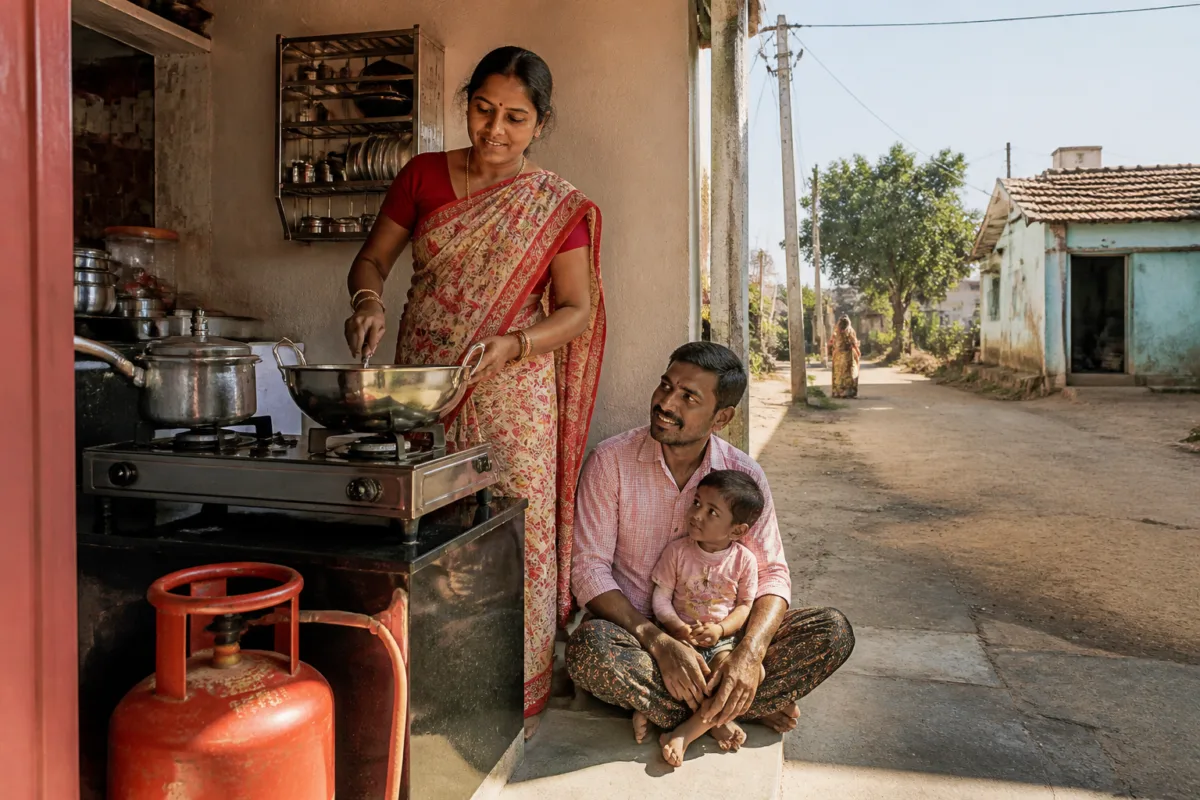
Telangana’s rural LPG usage has reached 95.3%, the highest among the states covered in a new analysis of national household consumption data. The figure is more than a state-level ranking: it shows how access to a basic household utility can be shaped by welfare programmes, central support, distribution networks and corporate social responsibility initiatives.
The findings come from SBI Research’s analysis of the National Statistics Office’s Household Consumption Expenditure Survey 2023-24. The survey was conducted between August 2023 and July 2024 and covered 2,61,953 households across rural and urban India. Telangana recorded overall LPG penetration of 84.4%, with usage at 95.3% in rural areas and 73% in urban areas.
That rural-urban pattern is unusual. In many public-service systems, cities tend to receive infrastructure and services earlier because of higher density, better connectivity and greater commercial viability. Telangana’s figures point to a different outcome for LPG access: rural households reported substantially higher usage than urban households. The available report does not establish the reasons for the urban figure of 73%, but the contrast makes the state’s distribution and support mechanisms particularly important to examine.
The central issue is not simply whether a household has an LPG connection. It is whether a clean cooking fuel system has been made accessible, affordable and usable at scale. A connection, a functioning distribution chain and the ability to obtain refills are distinct parts of that system. The supplied analysis reports the level of usage, while the explanations from industry representatives point to the institutional support that helped create it.
According to Jagan Mohan Reddy, president of the Telangana LPG Distributors Association, nearly half of the state’s population benefited from initiatives aimed at improving LPG access over the past 10 to 15 years. He said Telangana has around 1.3 crore active LPG consumers, of whom an estimated 40 lakh gained access through state government schemes. He attributed another 10 lakh connections to central government initiatives and said CSR programmes helped an additional five lakh people access LPG.
These figures describe a layered delivery model rather than a single programme. State schemes appear to have formed the largest reported component of access, while central initiatives and CSR interventions added further connections. The distinction matters because household energy transitions often depend on several institutions working across different stages: governments can support connections or subsidies, distributors can make cylinders available, and community or corporate programmes can help reach households that remain outside standard delivery channels.
The report also places Telangana within a sharply uneven national picture. Andhra Pradesh recorded rural LPG penetration of 86.9%, followed by Punjab at 84.1%, Karnataka at 81.5% and Tamil Nadu at 81.4%. At the other end of the reported range, rural penetration stood at 15.3% in Chhattisgarh, 16.8% in Odisha, 17.2% in Jharkhand and 22.9% in Rajasthan.
The gap between Telangana’s 95.3% and Chhattisgarh’s 15.3% is 80 percentage points. Between Telangana and Odisha, the difference is 78.5 percentage points; between Telangana and Jharkhand, it is 78.1 percentage points. These are not marginal variations in adoption. They indicate that clean cooking access remains highly differentiated across states, even when national programmes are available.
The figures should, however, be read precisely. The supplied report describes LPG as the primary cooking fuel and presents penetration figures based on the HCES 2023-24 analysis. It does not provide a state-by-state explanation of household income, refill frequency, cylinder prices, distance to distributors, fuel stacking or the proportion of households using LPG alongside firewood and other fuels. Those factors would be necessary to determine whether reported LPG usage represents complete substitution of traditional fuels or a mixed-fuel pattern.
That limitation is important for interpreting the infrastructure challenge. A household may be counted as an LPG user while still relying on another fuel for some cooking needs. The report supplied for this story does not provide that detail, so the data confirms access and reported primary-fuel usage, but not the full depth of the transition inside each household.
Even with that qualification, Telangana’s rural result points to the importance of last-mile delivery. Rural households are dispersed across larger areas, and service provision can be more difficult where settlement density is low. Reaching them requires more than a policy announcement. It requires distributor coverage, transport, storage, household registration and a system through which refills can be obtained. The association’s estimate of 1.3 crore active LPG consumers indicates the scale at which this delivery network operates in the state.
The reported role of state government schemes also raises a broader governance question: which level of government is responsible for turning a national energy objective into a functioning local service? Central initiatives can expand the number of connections, but state-level administration and local distribution conditions influence whether those connections translate into regular use. Telangana’s reported outcomes suggest that the interaction between these layers may be as important as any individual scheme.
CSR programmes form a smaller but still visible part of the account presented by the distributors’ association. The claim that such programmes helped five lakh people access LPG shows how non-government actors can supplement public delivery. It also underlines the need to distinguish between expanding access and sustaining usage. The supplied material identifies the number of people helped through CSR, but does not specify the nature, duration or geographic distribution of those interventions.
The regional comparison further shows why a national average would not be enough to understand India’s clean-cooking transition. A single national figure could conceal states where access has expanded substantially and others where households remain far more dependent on alternative fuels. The state-level spread reported by SBI Research makes the distribution of infrastructure and programme implementation visible.
It also complicates a simple rural-versus-urban assumption. Telangana’s rural usage of 95.3% exceeds its urban usage of 73%. The report identifies Telangana as one of the few states where rural households reported substantially higher LPG usage than urban households. Without additional data, the reasons cannot be established. They could relate to the reach of targeted schemes, the composition of households included in the survey, differences in fuel preferences or other factors not detailed in the supplied material. What is clear is that urban location alone did not guarantee the higher reported usage rate in this case.
For urban policy, the finding matters because energy access is part of the built environment even when the infrastructure is not visible in the form of roads or buildings. Cooking fuel depends on storage, distribution, household space, safety practices and recurring affordability. It affects the everyday functioning of homes, including those in expanding peri-urban settlements where formal urban services may be uneven.
For rural development, the result shows what a high-coverage outcome can look like when multiple interventions accumulate over time. The reported period of 10 to 15 years is significant because it indicates that the result was not attributed to a single recent announcement. It reflects a longer process involving state schemes, central support and CSR efforts, although the supplied report does not identify the individual programmes or measure their separate effectiveness.
The evidence also leaves several questions open. It does not show how frequently households refill cylinders, how much they spend on LPG, whether usage differs by income group, or how access varies within Telangana’s districts. It does not compare LPG use with electricity, piped gas, firewood or other cooking fuels in the same households. Nor does it establish whether the state’s high reported penetration has reduced exposure to traditional cooking fuels.
Those unanswered questions do not weaken the significance of the headline finding. They define what a fuller assessment would need to measure. Access statistics are an essential starting point, but a complete clean-cooking evaluation would have to connect connections with affordability, reliability, refill behaviour and actual household use.
Telangana’s 95.3% rural LPG usage therefore offers two conclusions at once. First, the state has recorded the strongest rural result among those covered in the SBI Research analysis of HCES 2023-24. Second, the national comparison shows that clean cooking access remains uneven, with a gap of more than 80 percentage points between the highest and lowest reported rural figures. The next stage of scrutiny is whether the institutions that expanded access can sustain regular, affordable use—and whether the administrative lessons behind Telangana’s outcome can be identified from comparable state-level data.

