


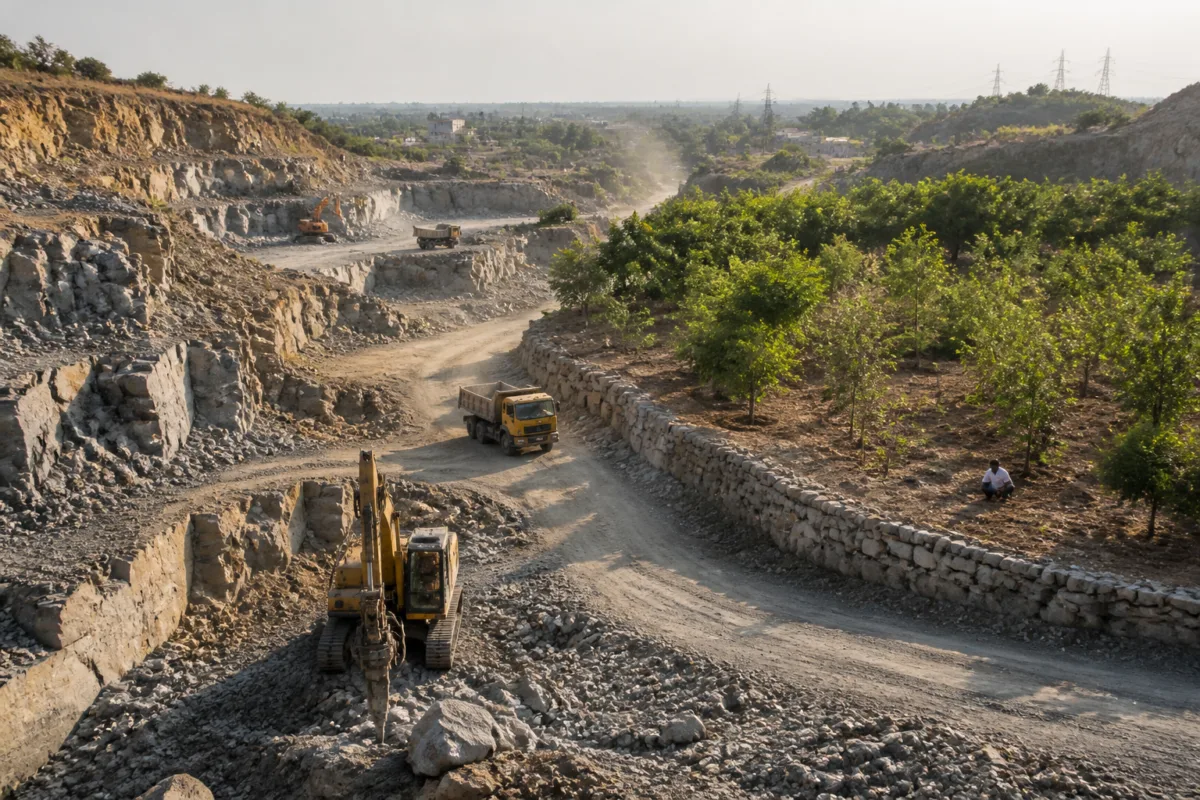
The Madurai Bench of the Madras High Court has upheld Tamil Nadu’s legal amendment allowing the state to collect a mandatory green fund contribution from quarry owners, clearing the way for the mechanism to support restoration of abandoned quarries and address environmental damage caused by mining activity.
The ruling came in a petition filed by Narayana Perumalsamy, secretary of the Virudhunagar District Quarry Owners’ Association. The petitioner challenged a government order issued by the state Industries Department on February 23, 2022, which amended the Minor Mineral Rules and introduced provisions for establishing the green fund.
The quarry owners’ association argued that the state government did not have the authority to make the amendment and that the mandatory collection placed an additional financial burden on operators. The petition also contended that the measure interfered with the right to carry on a business.
The state government defended the amendment by arguing that states have the authority to create necessary provisions under the minor mineral rules. It told the court that the green fund should not be treated as a tax, but as a regulatory contribution linked to the environmental impact of quarrying. According to the government’s submission, the money would be used to rehabilitate abandoned quarries.
A bench comprising Justices M. Dhandapani and N. Dilipkumar held that the government has the authority to remedy damage caused by quarrying. The judges said the state was required to act on the principles of rehabilitation, recovery and restoration while maintaining ecological balance.
The court found that the amendment imposed reasonable restrictions on the conduct of the quarrying business rather than denying the right to operate. It also distinguished the green fund from the existing District Mineral Foundation, indicating that the two funds serve different purposes.
The court’s reasoning places the contribution within a broader environmental governance framework: the party responsible for pollution should bear the cost of remedying it. The judges also referred to a Supreme Court ruling that states should create dedicated funds to protect the environment and ensure that environmental harm is addressed.
The distinction between the green fund and the District Mineral Foundation is significant for mining administration. A District Mineral Foundation is generally associated with the welfare and development of communities affected by mining, while the green fund, as described during the proceedings, is intended to finance environmental rehabilitation, including the restoration of abandoned quarry sites.
Quarries supply construction materials used in roads, buildings and other urban infrastructure, but their operations can leave behind degraded land and altered local environments. The court’s order confirms the state’s legal basis to require a separate financial contribution for dealing with those impacts. The ruling does not, in the material available, specify the contribution rate, the total fund collected or the individual restoration projects to be financed.
The petition was dismissed after the bench held that the amendments to the Minor Mineral Rules were legally valid. The state’s implementation of the green fund and the manner in which collected money is used will determine how effectively the mechanism translates the court-accepted principle of environmental restoration into action.

