


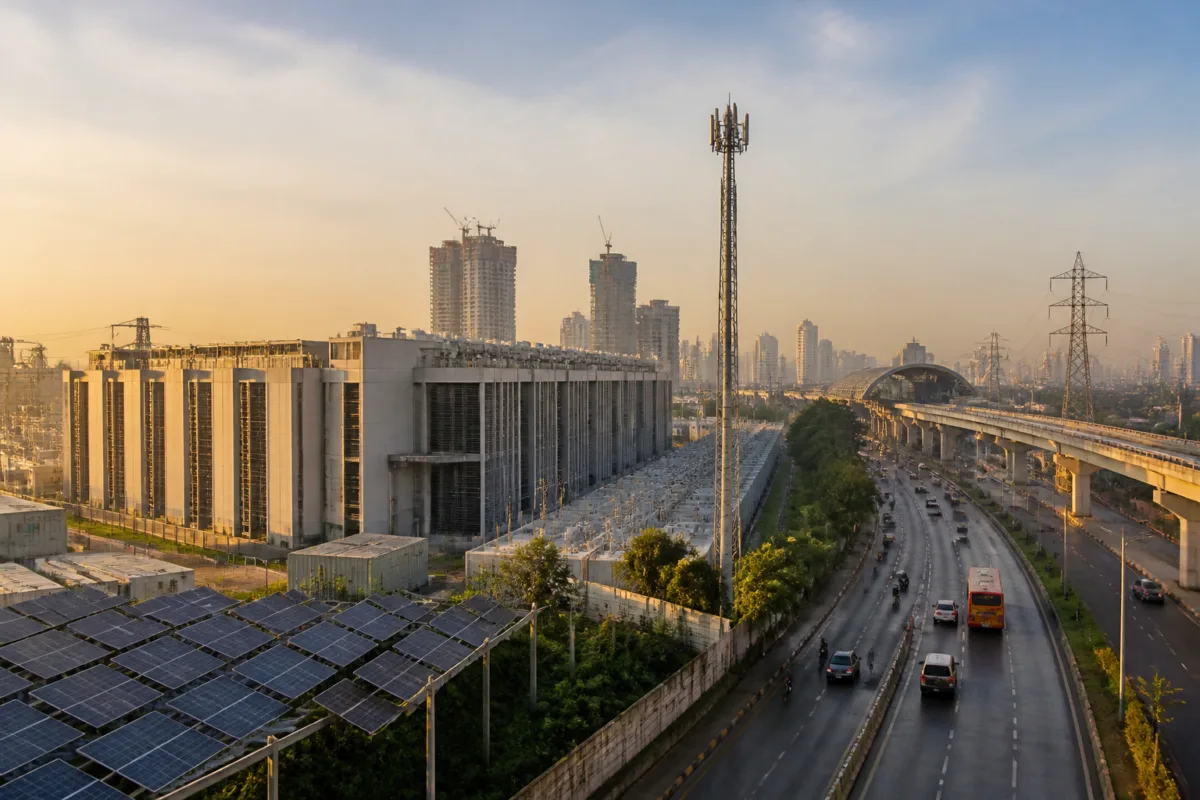
India’s private equity and venture capital market is showing a distinct change in direction: capital is returning, but a growing share of investor attention is moving towards infrastructure, data centres, renewable energy, telecom towers, toll roads and domestic manufacturing. The trend matters for cities because it links financial-market recovery with the physical systems that support urban growth.
Data sourced by the Times of India from research firm Venture Intelligence shows that private equity and venture capital investments reached $39 billion across 1,434 deals in calendar year 2025. During the first nine months of 2026, investments had already reached $32.7 billion through 1,076 deals. A record $6 billion was reported for September 2026 alone, placing the market on course to match or exceed the previous year’s total, according to Arun Natarajan, founder of Venture Intelligence.
The figures exclude investments related to the real estate sector. That distinction is important. The reported revival is not a direct measure of housing sales, property transactions or developer funding. Instead, it points to a broader pool of private capital supporting infrastructure and operating businesses that shape how cities function, including the energy, communications and transport systems on which buildings and urban economies depend.
The larger significance lies in where investors are placing money after two years of decline. Private equity and venture capital investments fell from $64.4 billion in 2021 to $48.9 billion in 2022, before declining further to $33.8 billion in 2023 and $33.5 billion in 2024. The recovery in 2025, followed by the strong first nine months of 2026, therefore represents more than a return to higher headline volumes. It also indicates a reassessment of which sectors are capable of attracting large, long-term commitments.
## Infrastructure becomes the centre of the recovery
According to Natarajan, one of the key developments in 2026 has been private equity investors “doubling down” on infrastructure. Large foreign investors have made major investments across renewable energy, telecom towers, data centres and toll roads. Canadian investors, including La Caisse, formerly CDPQ, CPP Investments and Brookfield, have deployed more than $3 billion in infrastructure companies in 2026, he said.
The source report does not provide a complete sector-wise breakdown of the total $32.7 billion invested during January-September. It does, however, identify infrastructure as a major area of renewed interest. That focus is consequential for urban development because infrastructure assets often sit below the visible layer of the city. Power supply, digital connectivity, transport corridors and data-processing capacity may not be experienced as individual real estate products, but they determine the reliability and scale of urban activity.
The investment pattern also suggests that private capital is favouring assets with tangible operations and identifiable infrastructure demand. Renewable energy projects, telecom towers, data centres and toll roads are not interchangeable businesses, but they share a dependence on long-term physical networks, predictable usage or strategic access. Their presence in the investment narrative shows how capital is being connected to the country’s expanding infrastructure requirements.
This does not mean that every infrastructure transaction will translate directly into better public services. The supplied evidence does not establish project-level outcomes, consumer prices, construction timelines or service quality. It does show that these sectors are increasingly important destinations for institutional capital, making their ownership, financing and operating models more relevant to the future of cities.
## Geopolitics is changing the definition of an attractive asset
The report links the shift in investment priorities to geopolitics, national security, import substitution and supply-chain resilience. These factors are increasing the strategic importance of businesses with domestic manufacturing capabilities and tangible assets, according to Aniket Dharamshi, co-founder and managing partner of Value Quest Investment Advisors.
This is a notable change in the way investment opportunities are being assessed. The decision is no longer presented only through the lens of short-term growth or technology-sector exposure. Physical capacity, domestic production and the ability to support essential systems are becoming part of the investment case. For urban economies, that can include the factories, power systems, logistics networks and digital infrastructure that make local production and services possible.
Dharamshi also connected the artificial-intelligence build-out with rising demand for data-centre infrastructure and power. The report does not quantify this demand or identify specific capacity additions. Nevertheless, the connection highlights a direct relationship between digital growth and conventional infrastructure. Artificial intelligence may be discussed as software, but its expansion requires buildings, electricity, cooling systems, telecommunications and land.
That relationship creates a more complicated infrastructure landscape. Data centres and telecom networks can attract private investment because they are linked to fast-growing digital demand, while renewable energy can provide part of the power system needed to support that expansion. The source material does not establish whether these investments are coordinated within a common planning framework. It does indicate that technology and physical infrastructure are increasingly being considered together by investors.
## What the numbers establish—and what they do not
The available figures establish a strong recovery in the overall PE-VC market. Investments rose from $33.5 billion in 2024 to $39 billion in 2025, based on Venture Intelligence data cited by the report. By September 2026, the market had reached $32.7 billion, with 1,076 deals, compared with 1,434 deals during all of 2025. The September figure of $6 billion was described as a record monthly investment level.
These totals should not be read as a simple measure of the number of businesses receiving capital. The average size of deals may vary significantly, and the report does not provide the value distribution between large infrastructure transactions and smaller investments. The concentration of capital in a few large transactions could therefore influence the headline total. Dharamshi specifically noted that whether the broader revival results in higher core PE-VC deployment will depend on economic and earnings growth, valuation expectations and a more stable investment environment.
The data also does not show how much infrastructure investment is new capital, how much represents acquisitions or how much is directed towards expansion of existing assets. Nor does it establish how these investments are distributed geographically across India. Those omissions matter for urban analysis because the effects of infrastructure finance depend on location, project type, regulatory conditions and the relationship between private assets and public systems.
Still, the direction is clear within the limits of the supplied evidence. Infrastructure has become a prominent part of the recovery, foreign investors are making large commitments, and the investment cycle is being shaped by forces beyond conventional domestic growth expectations. The significance is therefore structural even though the available data does not yet provide a complete map of project-level outcomes.
## The institutional question behind private capital
The renewed flow of capital raises questions about how private investment interacts with public planning and governance. Infrastructure assets often operate within regulated sectors or depend on public permissions, land, connectivity and demand generated by wider urban development. The report identifies the sectors attracting money, but it does not describe the approval systems, concession structures, tariff arrangements or public obligations attached to individual investments.
That gap is important. A private investment announcement can indicate confidence in a sector, but it does not by itself guarantee timely delivery, equitable access or integration with city plans. For toll roads, the relevant questions would include how they connect with existing networks and how users are affected. For data centres, power availability and the relationship with local infrastructure would be material. For renewable energy, transmission and the ability to connect generation to demand would influence the practical value of investment. These project-level questions are not answered in the source report and should not be inferred from the aggregate numbers.
The investment trend nevertheless places greater pressure on institutions to make infrastructure pipelines legible and accountable. As more international capital enters sectors considered strategically important, the terms governing ownership, operation, risk and public access become part of the urban policy landscape. The supplied material does not indicate how governments or regulators are responding to this shift, making that an area requiring further reporting rather than assumption.
## A recovery tied to physical capacity
India’s PE-VC market has recovered from the sharp fall recorded after 2021, but the character of the recovery is as important as its size. The new capital is being drawn towards infrastructure and domestic manufacturing at a time when geopolitical uncertainty, supply-chain concerns and artificial-intelligence demand are influencing investment decisions.
For cities, the central issue is that financial recovery is increasingly being expressed through physical assets. The next phase of urban growth will depend not only on real estate development, which is excluded from the reported figures, but also on the infrastructure systems that supply power, enable communications, move goods and support digital services.
The evidence confirms a strong investment revival and a clear increase in infrastructure interest. It does not yet establish whether the capital will produce more resilient networks, wider access or faster project delivery. Those questions will depend on the terms of individual transactions, the performance of the economy and the stability of the investment environment—factors that investors themselves identify as decisive for the market’s next stage.

