


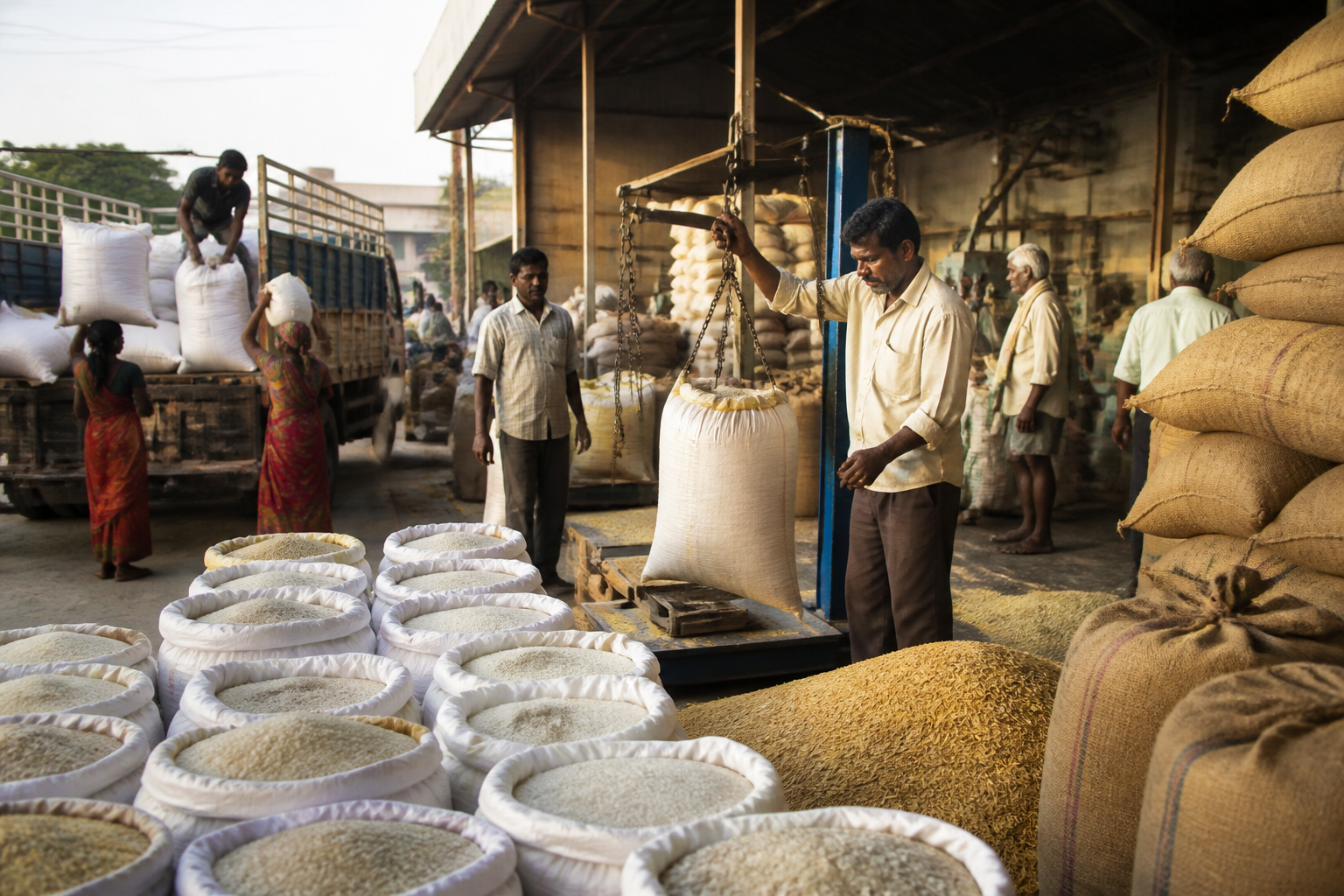
Fine rice prices in Telangana have risen by 20 to 30 per cent in recent months, but the price increase is not only a retail-market story. It reflects a tightening link between the state’s procurement system, the supply available to private millers and traders, farmer incentives, working-capital constraints and consumer fears about the next crop.
Popular fine rice varieties are now selling at around Rs 60 to Rs 70 per kg. Wholesale prices have also moved sharply. RNR rice, which was earlier available at about Rs 2,400 per quintal, is now priced at around Rs 3,300. BPT has risen to approximately Rs 3,000 per quintal, while the Jaisriram variety is selling at about Rs 4,500 per quintal. Overall, fine rice prices have increased by roughly Rs 1,000 per quintal.
The reported increase has taken place gradually over the past two or three months, according to Md Saleem, a farmer-cum-trader in Gudur in Mahbubabad district. His account points to a change in how paddy is moving through Telangana’s agricultural and public-distribution system. Under the state government’s Sanna Biyyam, or fine rice, public distribution scheme, farmers are reportedly preferring to sell more of their crop to the government because of an additional Rs 500 bonus.
That incentive changes the availability of rice outside the government procurement channel. When farmers receive an attractive price from the state, less paddy is necessarily available for direct purchase by private millers and traders. The remaining stocks then face stronger demand, particularly when consumers and market participants expect supplies to tighten.
This is the central tension visible in the current price movement. Government procurement supports the public distribution system and provides farmers with a guaranteed buyer and an additional incentive. At the same time, higher procurement can reduce the quantity available to private market participants for processing and trading. The effect is not automatically a policy failure; it is a distributional trade-off within the same supply chain.
Telangana’s procurement numbers show the scale of the state’s role. The government procures close to half of the state’s total paddy production each season to support the public distribution scheme. During the 2025–26 Kharif season, Telangana recorded 148.03 lakh metric tonnes of paddy production, of which the state procured 70.82 lakh metric tonnes. That means the government’s procurement operation is not a marginal intervention in the market. It is large enough to influence the quantity of paddy available to other participants.
The available figures also show that production and procurement are operating against a smaller cultivated area. The area under paddy cultivation declined by 15.84 per cent during the Kharif season compared with the previous year. The area sown fell from 67.24 lakh acres to 56.6 lakh acres. The supplied report does not establish a single cause for this decline, but the reduction is important because it limits the amount of land from which the next supply cycle can be generated.
The combination of high public procurement and a reduced sown area creates a more tightly watched market. Farmers have a strong reason to use the government channel when it offers a Rs 500 bonus. Millers and traders, meanwhile, have less access to independently sourced paddy and must compete for the stocks that remain outside the procurement system. Consumers are responding to the possibility of future scarcity by buying in advance, according to the Federation of All India Rice Millers Association.
The climate signal in the price story is therefore operating partly through expectations. The association said concerns about the possible impact of El Nino on the next crop, along with forecasts of lower production, had encouraged consumers to stock rice. V. Mohan Reddy, a member of the federation, said fear of El Nino and expectations of lower production had led people to buy in advance. The report does not establish that El Nino has already reduced the current crop. It establishes that concern about the next crop has affected present demand.
That distinction matters for interpreting the price rise. A market can experience pressure before a physical shortage is confirmed if households, retailers or traders begin building inventories. Advance buying removes stocks from immediate circulation and can raise demand for varieties that are already perceived as scarce. In this case, the reported price increases are linked to both actual procurement patterns and expectations about future production.
The structure of rice milling adds another layer. According to Reddy, nearly 85 per cent of the paddy being processed by millers comes from the government under Custom Milling agreements. Only 10 to 15 per cent of millers process their own rice. This indicates that many mills are functioning primarily as processors of government-procured paddy rather than as independent buyers and sellers operating with large privately owned stocks.
That arrangement affects how quickly private supply can respond to price signals. If millers have limited ownership of their own paddy, they cannot simply release privately held inventories whenever market prices rise. Their operations depend significantly on government-linked processing arrangements. The supplied report also says tighter constraints on obtaining loans have pushed millers towards job work, reinforcing their dependence on processing contracts rather than privately financed procurement.
The result is a supply chain with several distinct pressures. Farmers are responding to the state’s bonus and procurement offer. The government is securing rice for its public distribution scheme. Millers are processing a large share of government-linked paddy under Custom Milling agreements. Traders are facing reduced availability outside that system. Consumers are buying ahead because of concerns about the next crop. The retail price is the visible outcome of these overlapping decisions.
For urban households, the immediate issue is affordability. Fine rice varieties selling at Rs 60 to Rs 70 per kg represent a significant grocery expense, especially for households that prefer or depend on these varieties. The supplied material does not provide household expenditure data or compare the increase with wages, but it does establish that the price movement reaches the retail market rather than remaining confined to wholesale transactions.
The urban dimension also lies in the distance between procurement policy and household experience. A state scheme designed to support public distribution and provide farmers with an additional return can operate successfully within its stated purpose while also altering the supply available to commercial buyers. The impact is then felt in retail markets, where consumers encounter higher prices and fewer inexpensive alternatives within the same quality segment.
The data also highlights how food affordability is connected to land use and administrative choices. The decline in paddy cultivation area, the scale of government procurement and the design of the fine rice distribution scheme are not separate facts. Together, they shape how much grain enters different channels, who can access it and at what stage prices begin to rise. The available evidence does not allow the increase to be attributed exclusively to climate fears, procurement or credit conditions. It points instead to an interaction among all three.
The policy landscape is consequently divided across multiple actors. The state government determines the procurement and bonus framework and uses the procured grain to support the Sanna Biyyam public distribution scheme. Farmers decide whether the government’s price and bonus are more attractive than private sales. Millers process government-linked paddy under Custom Milling agreements, while traders compete for remaining stocks. Consumers and retailers determine how strongly advance buying translates into current demand.
The current episode also shows why procurement statistics need to be read alongside market-access statistics. A government may procure a large share of production, but the effect on prices depends on how much grain is directed towards public distribution, how much remains for private processing, how much millers own themselves and whether credit allows them to purchase stocks. In the reported case, the private side of the system appears constrained by both reduced availability and tighter lending conditions.
What the evidence confirms is a sustained increase in fine rice prices, a large government role in Telangana’s paddy market, a Rs 500 farmer incentive under the fine rice procurement system, a decline in the paddy-sown area and strong dependence of millers on government-linked processing. What remains uncertain is the eventual effect of El Nino on the next crop and whether the current price movement will continue at the same pace. Those questions will depend on future production, procurement volumes, consumer buying behaviour and the amount of rice available outside the public distribution channel.
