


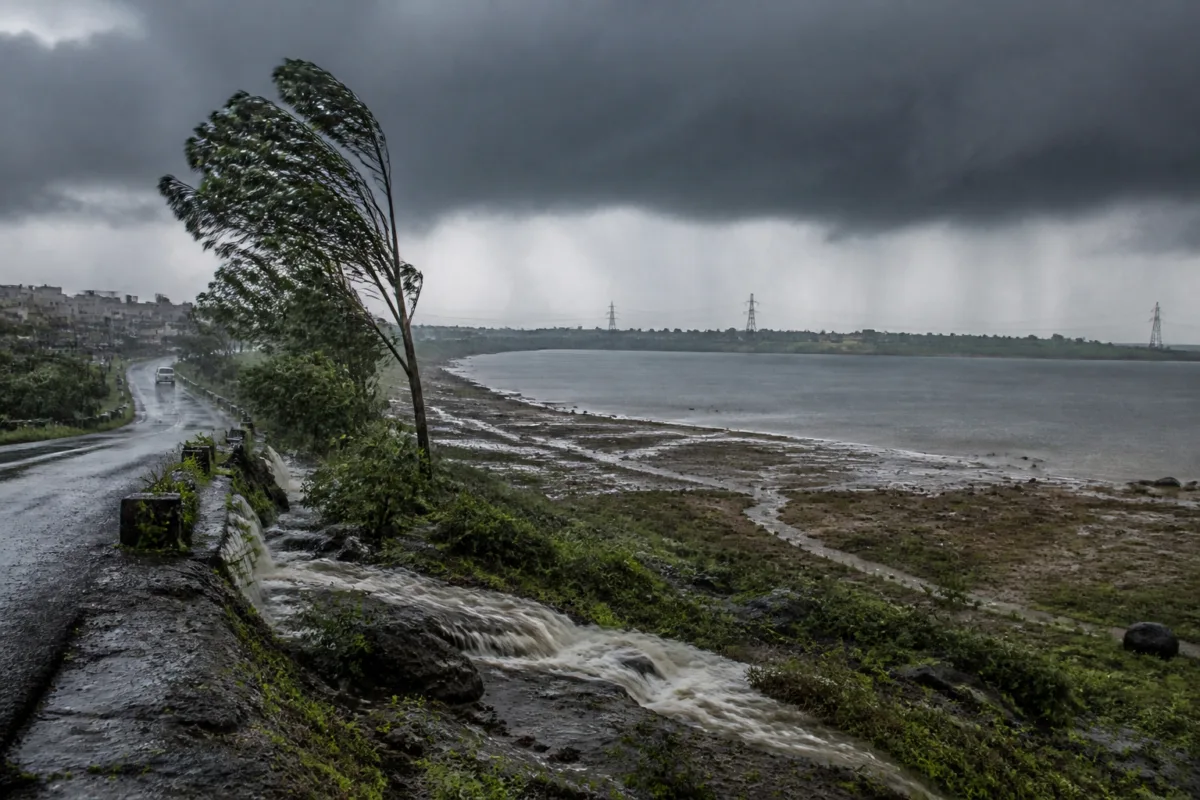
Cyclone Arnab may bring heavy rain to parts of Telangana, but the storm is unlikely to resolve the state’s wider water crisis. The central issue is not simply whether rain falls, but whether it reaches the river systems, reservoirs and catchment areas that support drinking-water supplies after a deficient monsoon and a prolonged dry spell.
According to the India Meteorological Department (IMD) authorities quoted by Deccan Chronicle, the cyclone is expected to cross the Andhra Pradesh coast on Wednesday before moving north through Wednesday and Thursday. The eastern Telangana districts of Bhadradri-Kothagudem, Mahbubabad, Mulugu and Khammam were placed under a red alert for Wednesday. Orange alerts were issued for Jayashankar Bhupalpally, Warangal, Suryapet, Nalgonda and Nagarkurnool.
The forecast indicates strong but temporary weather impacts rather than a state-wide water recovery. IMD officials said wind speeds could exceed 50 to 60 km/h and reach a maximum of 70 km/h. Andhra Pradesh is expected to bear the brunt of the cyclone, while Telangana could experience heavy but passing storms after landfall. The forecast therefore points to a concentrated episode of rainfall, with the heaviest effects expected in selected districts rather than across all the catchments on which Telangana depends.
A yellow alert was issued for Komuram Bheem Asifabad, Mancherial, Peddapalli, Karimnagar, Hanamkonda, Jangaon and Yadadri-Bhuvanagiri for Wednesday. The rest of the state, including Hyderabad, was placed under a green alert, with light to moderate rainfall expected. On Thursday, moderate rainfall was forecast in Komuram Bheem Asifabad, Mancherial, Peddapalli, Jayashankar Bhupalpally and Mulugu.
The alerts are important for immediate disaster management, but they do not provide a direct measure of water security. A storm can produce intense rainfall over a short period without generating the sustained inflows required to restore major reservoirs or river systems. If the ground cannot absorb the water quickly, a larger share may run off into streams and drains. That can raise the risk of local flooding while producing only limited storage gains.
The distinction matters because Telangana’s water position is determined by more than rainfall within its administrative boundaries. The state’s water security depends on flows across the wider Krishna and Godavari basins, including catchment areas outside Telangana in Maharashtra and Karnataka. Rain concentrated in the eastern districts may swell local streams and smaller water bodies, but it may not generate sufficient inflows into the reservoirs connected to drinking-water schemes.
This is the institutional challenge hidden behind the cyclone forecast. Weather warnings are issued district by district, while water availability is organised through river basins, reservoirs, irrigation systems and drinking-water networks. The geography of an emergency response is therefore different from the geography of water replenishment. A district can receive heavy rain and still remain dependent on water stored or flowing through systems beyond its boundaries.
The report also highlights why rainfall totals alone are an incomplete indicator of hydrological recovery. The impact of the storm will depend on where the rain falls, its intensity and duration, and the amount of water that moves into upstream catchments. The same volume of rain can have very different consequences depending on whether it is spread across reservoir catchments or concentrated over already saturated urban and rural surfaces.
For cities such as Hyderabad, the distinction has direct significance even if the capital is forecast to receive only light to moderate rainfall. Urban drinking-water systems rely on dependable sources and distribution infrastructure, not merely on rain recorded within the city. A green alert in Hyderabad does not remove the pressure created by depleted sources elsewhere, just as heavy rain in an eastern district does not automatically replenish the reservoirs serving the state’s wider water demand.
The immediate benefit of the cyclone could be local. The rainfall may temporarily relieve parched areas, recharge some smaller water bodies and improve soil moisture. Those gains may support local users and reduce short-term dryness in affected districts. However, the report says the cyclone rains are unlikely to replenish Telangana’s river systems over the following week, underlining the difference between temporary relief and sustained restoration.
That distinction also affects how governments should interpret weather events in water-stressed regions. A heavy-rain warning requires emergency preparedness for wind, flooding and disruption. A water-security response requires a longer assessment of reservoir levels, basin-wide rainfall, catchment inflows, drinking-water demand and the condition of local sources. The two responses may overlap, but neither can substitute for the other.
The supplied report does not provide reservoir levels, current storage figures or quantified rainfall deficits. It therefore cannot establish how much additional water the cyclone will contribute to individual reservoirs or drinking-water schemes. What it does establish is the mechanism by which the rainfall may fall short: the storm’s effects are expected to be concentrated, temporary and unevenly distributed across the larger Krishna and Godavari basins.
The reference to a deficient monsoon and the looming impact of El Niño places the forecast within a broader climate and planning concern. Telangana’s water system is being asked to absorb the consequences of a weak seasonal rainfall pattern, while the incoming storm may deliver water in a short and potentially disruptive burst. This creates a management problem in which too little rainfall over the season can coexist with intense rainfall over a few days.
For residents, the practical consequence is that a cyclone forecast should not be read as a guarantee of improved drinking-water availability. People in the districts under red, orange and yellow alerts face immediate weather-related risks, while households dependent on stressed sources may continue to experience water insecurity after the storm passes. The same event can therefore be both a hazard and a limited source of relief.
The next assessment will depend on what happens after landfall: where the storm moves, which districts receive sustained rain, how much water enters upstream catchments and whether reservoir inflows rise. Those indicators will reveal whether Cyclone Arnab has produced more than local runoff and temporary soil-moisture gains. Until then, the evidence supports a narrower conclusion: the storm may ease conditions in some parts of Telangana, but it is not, by itself, a solution to the state’s water crisis.

