


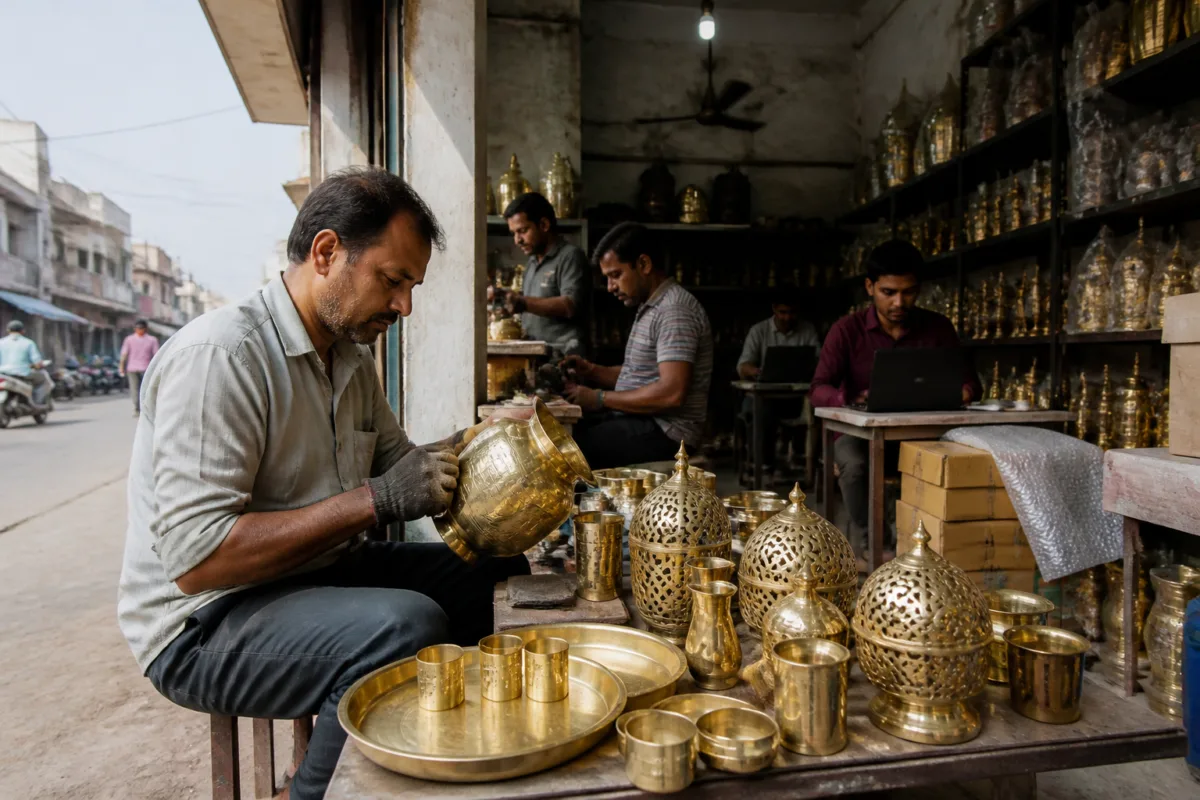
Moradabad’s ambition to become a global industrial hub is being built around a familiar strength: its dense network of small manufacturers, artisans and exporters. The harder question is whether that traditional industrial base can acquire the technology, market access, governance systems and shared infrastructure needed to compete in a more demanding global marketplace.
The ambition was discussed at the UP Dialogues-Moradabad Chapter, themed “Heritage, development and global possibilities”. Industry leaders, academics and policymakers examined how the city and its wider region could expand exports while retaining the value of its brassware and handicraft economy. The discussions placed micro, small and medium enterprises (MSMEs), rather than a single large industrial project, at the centre of Moradabad’s proposed transformation.
According to Yogesh Kumar, joint commissioner (industries), Moradabad’s annual exports are valued at around ₹11,460 crore. Exports from the wider Moradabad division are nearly ₹19,800 crore. The figures indicate the scale of an industrial economy that is already connected to international markets, even though much of its production is associated with traditional manufacturing and craft-based work.
That distinction matters. A city can be a major exporter without having the institutional and physical systems usually associated with a global industrial hub. Export value alone does not show how many firms have access to testing facilities, design support, reliable logistics, digital marketplaces, quality certification or affordable finance. The material supplied for the event does not provide a detailed assessment of these capacities, but the priorities identified by participants point to the gaps that local industry is attempting to address.
Moradabad district has more than 1.2 lakh MSME units, while the division has 3.44 lakh units, according to the report. The breadth of this base is both the region’s principal economic asset and a coordination challenge. A large number of small firms can sustain employment, specialised skills and supplier networks. At the same time, fragmented production can make it difficult to standardise quality, invest in technology, develop brands and negotiate access to distant markets.
The discussions therefore focused on technological upgradation, product finishing, branding, packaging and e-commerce. These are not merely marketing concerns. For small manufacturers, they determine whether a product can be presented consistently, meet buyer expectations and reach customers without depending entirely on intermediaries. Digital commerce may widen market access, but it also places new demands on product photography, inventory management, fulfilment, payment systems, customer service and compliance. The event report does not establish how widely these capabilities are currently available among Moradabad’s enterprises.
The challenge is particularly significant for a cluster whose identity is closely tied to traditional craftsmanship. The reference to Moradabad as India’s Brass City is an economic and cultural advantage, but heritage products must also adapt to changing design preferences, production standards and purchasing channels. Modernisation, in this context, does not necessarily mean replacing craft with automated production. It can also mean improving finishing, reducing defects, strengthening design capacity and helping artisans present their work to new buyers.
The policy instruments highlighted at the event reflect this blended approach. The One District One Product programme, the Vishwakarma Shram Samman Yojana and common facility centres were identified as mechanisms that could support traditional industries. The report does not specify the number, location or capacity of common facility centres in the region, nor does it quantify the outcomes of the schemes in Moradabad. Their significance, however, lies in the institutional model they represent: shared support for enterprises that may not be able to purchase specialised equipment or services individually.
Common facilities can address a structural problem in MSME clusters. A small unit may not have the capital or order volume to justify separate investments in advanced machinery, testing, finishing or training. Shared facilities can potentially reduce that barrier, provided they are accessible, maintained and aligned with what manufacturers actually need. The supplied report records the call for such support but does not establish whether existing facilities are operating at scale or how effectively firms are using them.
The same issue applies to finance. The event highlighted CM-YUVA, described as offering interest-free, collateral-free loans for eligible projects, as a way to encourage youth entrepreneurship. Such a scheme can lower the entry barrier for new businesses, but access depends on eligibility, application support, project preparation and the ability of first-time entrepreneurs to navigate official systems. The report identifies the scheme as a policy option but does not provide data on applications, approvals, disbursements or business survival.
The emphasis on transparent governance, law and order and digital public services adds another layer to the industrial-hub question. Manufacturers and exporters do not operate only inside factories or workshops. They depend on permits, inspections, transport, payments, documentation and public agencies. When these processes are predictable and accessible, the cost of doing business can become easier to manage. When they are fragmented or opaque, smaller firms generally have fewer resources to absorb delays and administrative uncertainty.
The event also called for greater participation by women in handicrafts and better access to training and digital marketplaces for women artisans. This places the industrial strategy within the household and community economies that support craft production. Yet the report does not provide figures on women’s participation, earnings, ownership of enterprises or access to finance. Those gaps matter because a global hub strategy cannot be assessed only through export totals; it must also show who is able to participate in the value chain and who remains excluded from its higher-value segments.
Moradabad’s reported numbers provide a useful starting point but not a complete performance scorecard. Annual exports of around ₹11,460 crore from the district and nearly ₹19,800 crore from the division show economic weight. The more than 1.2 lakh MSME units in the district and 3.44 lakh in the division show industrial breadth. What remains unavailable in the supplied material is equally important: employment trends, firm-level productivity, export concentration, women-owned enterprises, technology adoption, logistics costs and the share of businesses selling through digital channels.
Without these indicators, it is difficult to determine whether the region’s proposed transformation is broad-based or concentrated among established exporters. A global hub requires not only headline export value but also the ability of smaller firms to move up the value chain. That means converting local skill into stronger products, more reliable production and durable market relationships. The event’s focus on finishing, packaging, branding and technology suggests that participants recognise this requirement, although the report does not outline measurable targets or deadlines.
The institutional challenge is to connect multiple programmes rather than treat them as isolated benefits. Product promotion, artisan support, youth loans, common facilities and digital public services address different parts of the same production system. If they operate separately, a manufacturer may receive assistance for one stage while remaining constrained by another. The source report records the presence of policymakers and industry representatives at the discussion, but it does not describe a single coordinating authority, funding framework or delivery timetable for the global-hub ambition.
That absence does not make the ambition insignificant. It clarifies what the next phase of the conversation must establish. A designation or aspiration by itself will not change how a small workshop secures finance, obtains technical assistance, fulfils an export order or reaches a customer. The practical test will be whether firms can access shared infrastructure, modern production support and digital markets in ways that are affordable and repeatable.
Moradabad therefore represents a wider urban-economic question: how can established craft and manufacturing cities modernise without weakening the local networks that made them productive? The answer cannot be read from export figures alone. It will depend on the quality of the institutions surrounding enterprises, the reach of technology and training, the participation of women and young entrepreneurs, and the ability of public schemes to work together.
The UP Dialogues discussion confirms that Moradabad’s global industrial hub push is currently an agenda for strengthening an existing industrial ecosystem, not evidence that a new formal status has already been secured. The reported export and MSME figures establish the scale of the opportunity. The next developments to monitor are concrete implementation details: access to common facilities, technology adoption, youth-loan outcomes, digital-market participation, women’s inclusion and any formal targets or institutional plan for the proposed transformation.

