


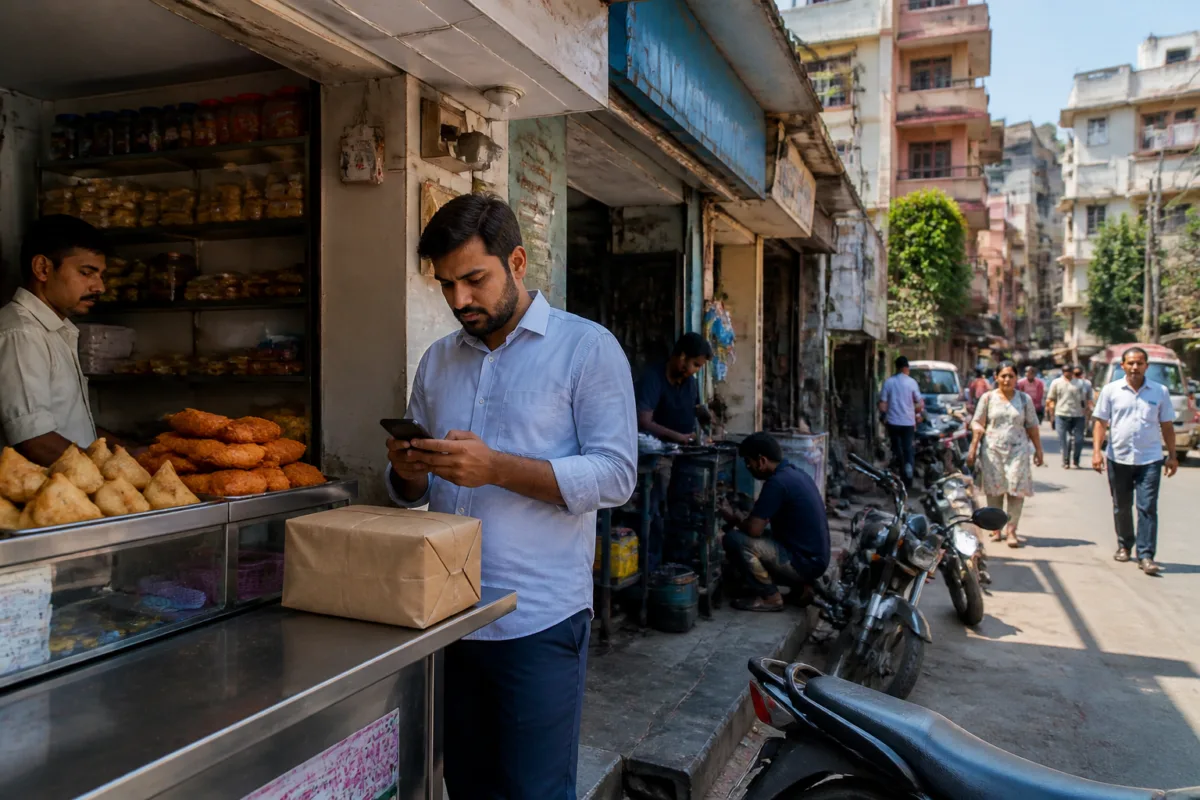
A new report on Maharashtra’s nano enterprises points to a problem that sits at the intersection of urban livelihoods, digital commerce and local economic planning: many very small businesses can produce or provide services, but struggle to reach enough customers to grow. The report, prepared jointly by non-profit organisation de Asra and public policy research and consulting organisation Artha Global, surveyed 2,000 enterprises across six districts and found that market access remained a major constraint, while adoption of digital marketplaces was negligible.
The findings matter because nano enterprises occupy a large part of the everyday urban economy. They include food counters, beauty salons, retail outlets, repair shops, small manufacturing units, photographers, designers and other independent service providers. The report defines them as businesses with annual revenue between Rs 20 lakh and Rs 2 crore, generally employing one to three people. Their scale is small, but their presence is embedded in neighbourhood commerce and household livelihoods.
The six districts covered by the survey were Mumbai, Pune, Nashik, Chhatrapati Sambhajinagar, Amravati and Nagpur. Taken together, they represent different urban and regional markets within Maharashtra. The report does not present market access as a problem confined to one city or one type of enterprise. Instead, it describes a shared constraint across businesses that often depend on physical footfall, personal networks and repeat local customers.
That distinction is important. A business may be operationally productive and still remain commercially vulnerable if it cannot consistently find customers beyond its immediate surroundings. The report states that the challenge is not simply entering a physical or digital marketplace, but converting productive capacity into sustained and scalable demand. In other words, the difficulty lies not only in listing a business online. It lies in creating a dependable flow of transactions after the listing exists.
For urban policymakers, this shifts the question from whether small businesses are digitally literate to whether the surrounding market system allows them to use digital tools effectively. A generic training session may explain how to create an account or upload a product. It may not resolve concerns about fraud, delivery, pricing, customer acquisition or the time required to manage digital orders. The report’s findings suggest that these practical conditions are central to adoption.
The digital gap is particularly clear in the survey’s finding that less than 1% of the enterprises used the Open Network for Digital Commerce, or related seller applications. ONDC is intended to enable participation in a networked digital marketplace, but the report indicates that its availability has not translated into meaningful use among the surveyed nano businesses.
That low adoption should not be read simply as resistance to technology. The report identifies several reasons for reluctance: concerns over fraud, logistics and price competition. Each concern reflects a business risk. A small enterprise may have limited staff to respond to online customers, little capacity to absorb a failed delivery or return, and insufficient room to reduce prices while maintaining margins. For a business employing one to three people, a new digital channel can create additional work before it creates additional revenue.
The result is a market access trap. Physical footfall limits the customer base, but digital expansion appears risky or difficult. Remaining local may constrain growth, while moving online can expose the enterprise to operational costs and competitive pressures it is not equipped to manage. The report does not claim that digital marketplaces alone can resolve the problem. Its policy recommendation is more specific: digital initiatives should move beyond generic literacy programmes towards localised business training and handholding tailored to particular activities.
This activity-specific approach is significant. The requirements of a food counter are different from those of a beauty salon, repair shop, photographer or small manufacturer. A food business may need support with delivery coordination and order timing. A repair shop may depend on location-based discovery and service scheduling. A manufacturer may need product cataloguing, packaging and logistics. The report does not provide separate adoption figures for these sectors, but its recommendation recognises that a single digital training model may not address their different operating realities.
The financing findings reinforce the same structural problem. The report says access to loans remains difficult, while many entrepreneurs are reluctant to take on large debt because they are uncertain whether investment will generate higher revenue. That concern is not presented as a lack of ambition. It is linked to the consequences of failure: borrowers must continue servicing loans even when the investment does not produce the expected return.
This creates a connection between market access and credit access. A business that cannot reliably reach customers may hesitate to borrow for equipment, expansion, staff or digital systems. Without investment, it may struggle to improve capacity or compete in new markets. But borrowing before demand is established can increase financial exposure. The report’s findings therefore place finance after, or alongside, the question of demand rather than treating credit as an isolated solution.
The issue is also relevant to how cities understand employment and economic resilience. Nano enterprises are not only commercial units; they are small-scale livelihood platforms. Their owners and workers operate close to consumers and often serve neighbourhood needs. When such businesses remain dependent on narrow catchment areas, their ability to withstand changes in footfall, competition or operating costs may be limited. The supplied report does not quantify closures, employment losses or income changes, so the extent of that vulnerability cannot be established from its findings alone. It does, however, identify the mechanisms that make growth difficult.
The report also draws attention to economic networks that are not always included in conventional digital commerce discussions. De Asra founder Anand Deshpande said nano enterprises could benefit from accessing temple and wedding economies to reach consumers. That suggestion points to demand clusters built around events, religious activity and social occasions. For small businesses, these networks may offer concentrated opportunities to find customers, but participating in them could require better information, coordination, packaging, scheduling and payment systems.
Former Maharashtra bureaucrat Nitin Kareer, speaking at the report’s release, called for a state-level policy to improve market access for nano enterprises. He also said a lack of creativity among many businesses might be limiting their ability to expand their customer base. The report does not establish how creativity was measured or how widely that factor applied across the surveyed enterprises. The more concrete institutional question is how a state-level policy would connect training, platforms, finance and logistics without reducing the problem to entrepreneurial motivation alone.
That policy design challenge is central. Responsibility for market access is likely to be distributed across multiple actors: state departments, local administrations, digital commerce networks, lenders, logistics providers and business-support organisations. The input does not specify an existing state programme or funding structure that brings these functions together. It does establish that the report recommends tailored handholding and that a state-level policy was proposed at the event.
The scale of the survey provides a useful signal, but it also defines what remains unknown. The 2,000 enterprises were surveyed across six districts, yet the supplied material does not provide a district-wise breakdown, sector-wise adoption rate, gender composition, enterprise survival rate or comparison between businesses that use digital platforms and those that do not. It also does not state whether the less-than-1% ONDC figure reflects current active use, past registration or use of related seller applications over a defined period.
Those details would matter for designing interventions. If adoption is low mainly because of fraud concerns, trust and grievance mechanisms may be important. If logistics is the primary barrier, local delivery partnerships could matter more than additional platform training. If price competition is the decisive issue, digital visibility without margin protection may not improve business outcomes. The report identifies all three concerns, but the supplied account does not rank them.
The evidence nevertheless makes one point clear: market access cannot be separated from the institutional conditions surrounding small businesses. A platform may provide visibility, but enterprises still need a workable way to receive orders, fulfil them, price their services, manage risk and sustain demand. Credit may provide capital, but it does not remove uncertainty about whether new investment will produce revenue. Training may build skills, but it must be linked to the actual business activity and local market.
For Maharashtra’s cities and towns, the larger urban question is whether economic policy can support the everyday enterprises that operate below the scale of formal chains and large companies. The report’s findings do not offer a measure of the total contribution of nano enterprises to employment or output, and they do not establish a single remedy. They do show that the gap between being capable of producing something and being able to reach customers remains a significant constraint.
The next stage of the policy debate will therefore depend on how the report’s recommendations are translated into implementation. The important details to watch are whether Maharashtra develops a state-level market-access policy, whether digital support becomes sector-specific, and whether enterprises receive continuing handholding rather than one-time literacy sessions. Until those mechanisms are defined, the survey’s central warning remains: for nano enterprises, the hardest part of growth may not be production, but finding sustained demand without taking on risks they cannot absorb.

