


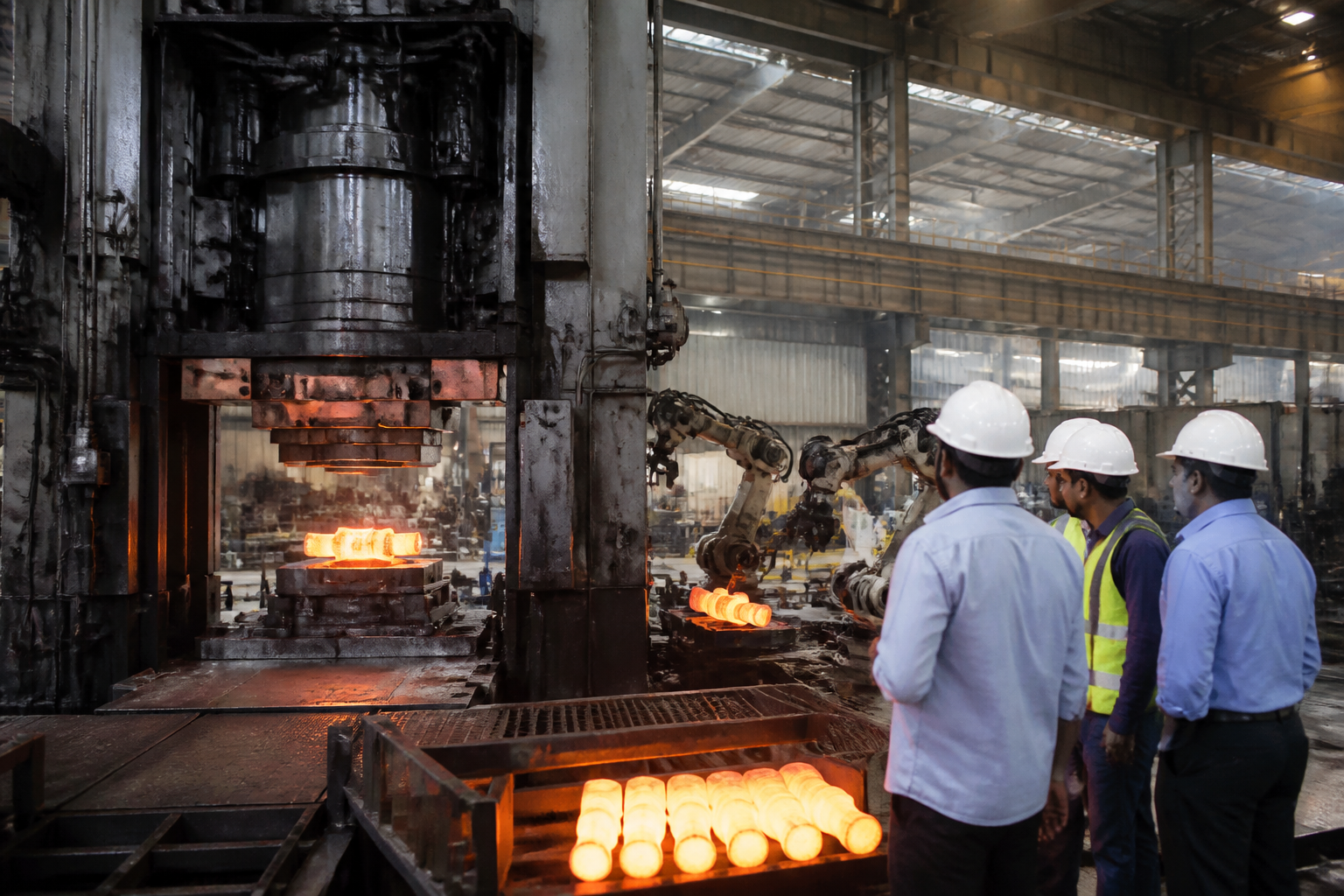
Tamil Nadu’s forging industry is facing a transition that reaches well beyond the factory floor. For decades, Chennai’s automotive ecosystem created dependable demand for forged crankshafts, gears, axles and other engine and transmission components. But the shift towards electric vehicles is reducing the number of moving powertrain parts in vehicles, forcing companies to search for growth in aerospace, defence, wind energy, railways and specialised industrial equipment.
The challenge is not simply to find new customers. It is to move from supplying forged blanks to producing more complex, certified and higher-value components. That transition will determine whether the Chennai-Bengaluru industrial cluster remains competitive as the composition of vehicle manufacturing changes and as other sectors demand more advanced materials, testing systems and engineering capabilities.
About 70% of the Chennai forging cluster’s products currently go into automotive applications, according to the report by Times of India – Chennai. The remaining 30% is supplied to non-auto sectors, while defence, aerospace, railways and energy account for only a small share for most companies. This concentration has supported the cluster’s scale, but it also exposes manufacturers to a structural change in the automotive value chain.
Electric vehicles do not eliminate the need for metal components. They do, however, alter the mix of components that forging companies traditionally produce. S Ravishankar, vice-president of the Association of Indian Forging Industry and managing director of Super Auto Forge, said engine and powertrain parts form a large portion of forging industry production, while motors and batteries have comparatively little forging content. In that sense, EV adoption is not merely a cyclical challenge; it affects the product base around which much of the industry has been built.
The Chennai cluster’s existing strengths provide a starting point for diversification. Tamil Nadu has a significant forging base anchored by the Chennai-Bengaluru corridor, with additional capabilities in Coimbatore and other industrial centres. The state’s strengths include precision components, cold and warm forging and engineering skills. Ravishankar said the Chennai-Bengaluru cluster compares strongly with other Indian forging centres in product sophistication and value addition, while noting that high-end precision forgings and cold and warm forging are concentrated largely in the corridor.
That industrial depth is important because companies entering aerospace, defence or energy cannot compete only by adding another production line. These sectors require different production systems and longer routes to market. Vidyashankar Krishnan, chairman and managing director of MM Forgings, identified certification, metallurgy and patient capital as factors that have slowed faster diversification. The requirements include special alloys such as nickel-based alloys, titanium and high-alloy steels, along with advanced laboratories and metallurgical capabilities.
They also include sector-specific certifications, traceability systems, non-destructive testing, specialised heat treatment and multi-axis machining. Aerospace and defence production is typically characterised by low volumes, a wide variety of products and lengthy qualification cycles, according to Krishnan. For a manufacturing cluster accustomed to automotive volumes and established supplier relationships, this represents a significant institutional and financial adjustment.
The move towards value addition is already visible in company-level performance. MM Forgings is shifting from supplying forged blanks to delivering finished components. Machined products account for about 67% of the company’s sales, while realisation per tonne increased from Rs 1.93 lakh to Rs 2.02 lakh over a year, according to the report. The figures illustrate the economic logic of diversification: the same basic metalworking capability can generate greater value when it is combined with machining, complex geometries, specialised materials and closer integration with the customer’s final product.
Sundram Fasteners offers another indication of how the transition could develop. Arathi Krishna, the company’s managing director, said non-auto businesses including wind energy, aerospace, industrial equipment and railways currently contribute about 35% of its revenue. The company expects that share to rise to 50% over time, while its precision-parts business is projected to grow at a compound annual growth rate of 20% over the next three years.
These plans do not mean that automotive manufacturing is becoming irrelevant to the cluster. Instead, the automotive sector is functioning as the industrial base from which companies can build broader capabilities. Automotive supply chains have created engineering talent, process discipline, quality systems and relationships with demanding customers. The question is whether these capabilities can be transferred into sectors with different certification regimes, order sizes, materials and delivery cycles.
Tamil Nadu’s policy ecosystem is intended to support part of this transition. The state’s defence industrial corridor has five nodes: Chennai, Coimbatore, Hosur, Salem and Trichy. The corridor is designed to build an aerospace and defence manufacturing ecosystem, giving companies a policy platform through which they can seek new opportunities beyond conventional vehicle components.
However, an industrial corridor is not only a collection of designated locations. Its effectiveness depends on whether companies can access testing facilities, laboratories, skilled workers, certification support, finance and reliable supplier networks. The forging industry’s requirements point to the importance of shared industrial capabilities, particularly for smaller firms that may not be able to independently fund advanced laboratories, robotic systems or multi-axis machining equipment.
Automation is becoming another part of the transition. Ravishankar said automation was becoming necessary regardless of company size, as manufacturers face labour shortages and rising quality requirements. The growing availability of local robotic and automation integrators could help smaller firms adopt these systems. But automation alone cannot close the capability gap. It must operate alongside metallurgy, process engineering, traceability and quality assurance systems that are accepted by customers in regulated sectors.
This is where the structure of Tamil Nadu’s industrial base matters. The state has a strong small and medium enterprise presence in Chennai and Coimbatore, and these firms form part of the wider manufacturing ecosystem. Their participation can broaden the benefits of diversification, but their ability to enter aerospace, defence or energy supply chains will depend on the cost and availability of certification, testing and specialised equipment.
The cluster’s future competitiveness will therefore be shaped by two linked measures. The first is scale, which helps companies remain cost-competitive globally. The second is the value generated from every tonne of material processed. Krishnan described this as the difference between volume and profitability: scale supports competitiveness, while precision machining, complex parts, better materials and demanding applications improve returns.
The larger urban question is whether Chennai’s manufacturing economy can adapt without losing the industrial density that made it successful. The shift beyond auto parts involves factories, but it also involves technical institutes, industrial land, logistics systems, laboratories, finance providers and public agencies. If these parts do not develop together, diversification may remain limited to a few larger firms rather than becoming a cluster-wide transformation.
The evidence supplied in the report confirms that the transition has begun. Companies are increasing machining and non-auto exposure, while the EV cycle is creating pressure to reduce dependence on engine and transmission components. What remains uncertain is the pace at which smaller manufacturers can meet the certification, capital and technology requirements of new sectors. For Chennai and Tamil Nadu, the next phase of industrial growth will depend on whether their automotive expertise can be converted into a broader precision-engineering base.
