


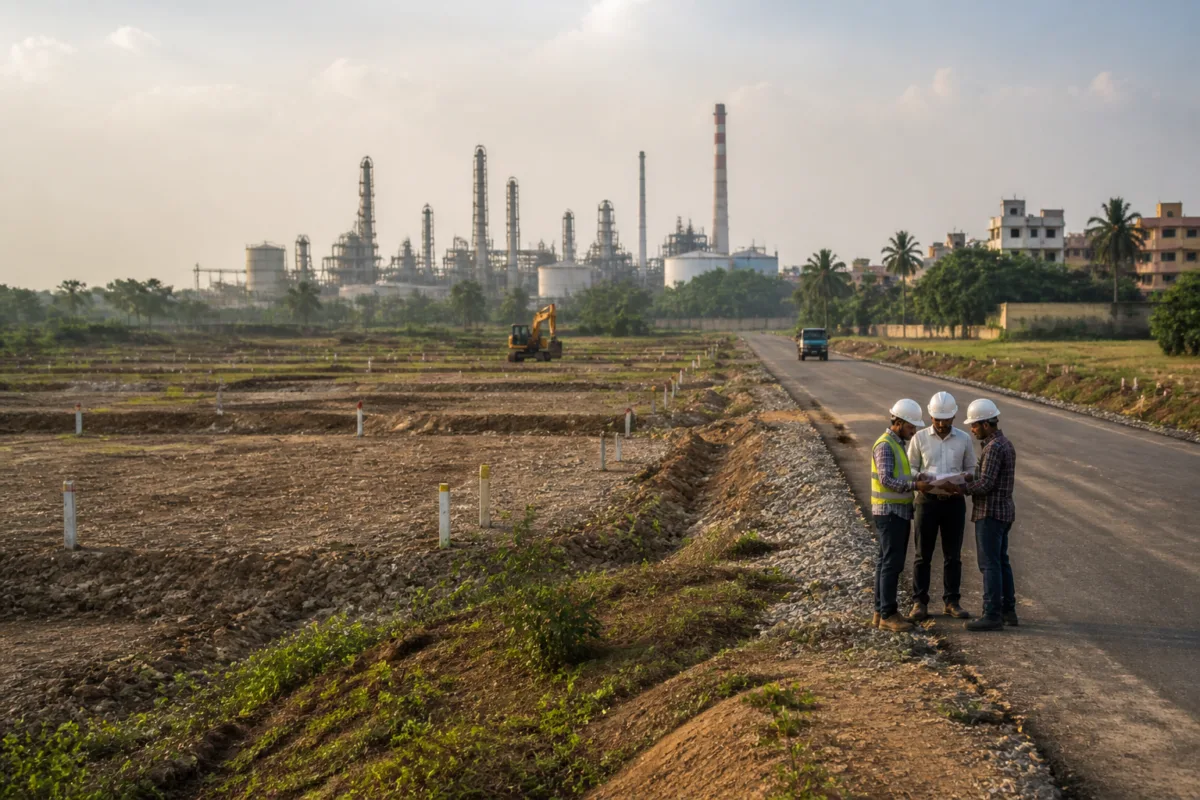
West Bengal is considering amendments to its land reform framework that could ease industrial land assembly in priority sectors while retaining safeguards against land hoarding, according to a report by the Times of India.
The proposed changes include a possible revision of Section 14Y of the West Bengal Land Reforms Act, 1955. The provision currently restricts landholding in non-urban areas to 24.2 acres, a limit that industrial groups have long regarded as an obstacle to expansion.
The draft reform paper is reportedly with the state legal department for vetting. The proposal may adopt a sector-by-sector approach, with relaxations for priority industries subject to periodic review, the report said, citing sources familiar with the development.
The move comes after West Bengal announced a new industrial policy on November 5. That policy places emphasis on creating a land bank but does not itself set out changes to land reform rules. The proposed amendments could therefore determine how much land is available for large industrial projects and how quickly it can be assembled under the new policy.
Nripendra Singh, executive director of the West Bengal Industrial Development Corporation, acknowledged at a Bengal Chamber of Commerce and Industry session that existing land laws are restrictive and said a new policy was being prepared. During an interaction with Credai West Bengal president Sushil Mohta, Singh said standard operating procedures could be introduced in phases from January 2027. The operational guidelines for the industrial policy are expected to be released in December, according to the report.
The state’s industrial policy identifies 15 focus sectors, including electric-vehicle manufacturing, defence, textiles, food processing, biotechnology, petrochemicals, marine products and shipbuilding. Land availability and the legal ability to consolidate parcels will be important implementation issues for projects in these sectors, although the government has not yet published the proposed amendments.
A more flexible landholding regime could help industrial projects assemble larger sites, but the reported proposal also points to a continuing policy tension: enabling investment without allowing speculative accumulation or excessive concentration of land. The suggested sector-wise relaxation and periodic review are intended to address that concern, but the final safeguards will only be clear once the draft is approved and its procedures are made public.
Industry representatives at the session also sought wider promotion of the new policy, incentives for women-led businesses and consistency in implementation. Haldia Petrochemicals managing director and chief executive Navneet Narayan said the policy should not be changed arbitrarily after implementation.
For industrial developers and landowners, the immediate outcome is not yet a change in entitlement. The amendments remain under consideration, and the next material steps are legal vetting, publication of the operational guidelines and the possible phased rollout of standard operating procedures from January 2027.

