


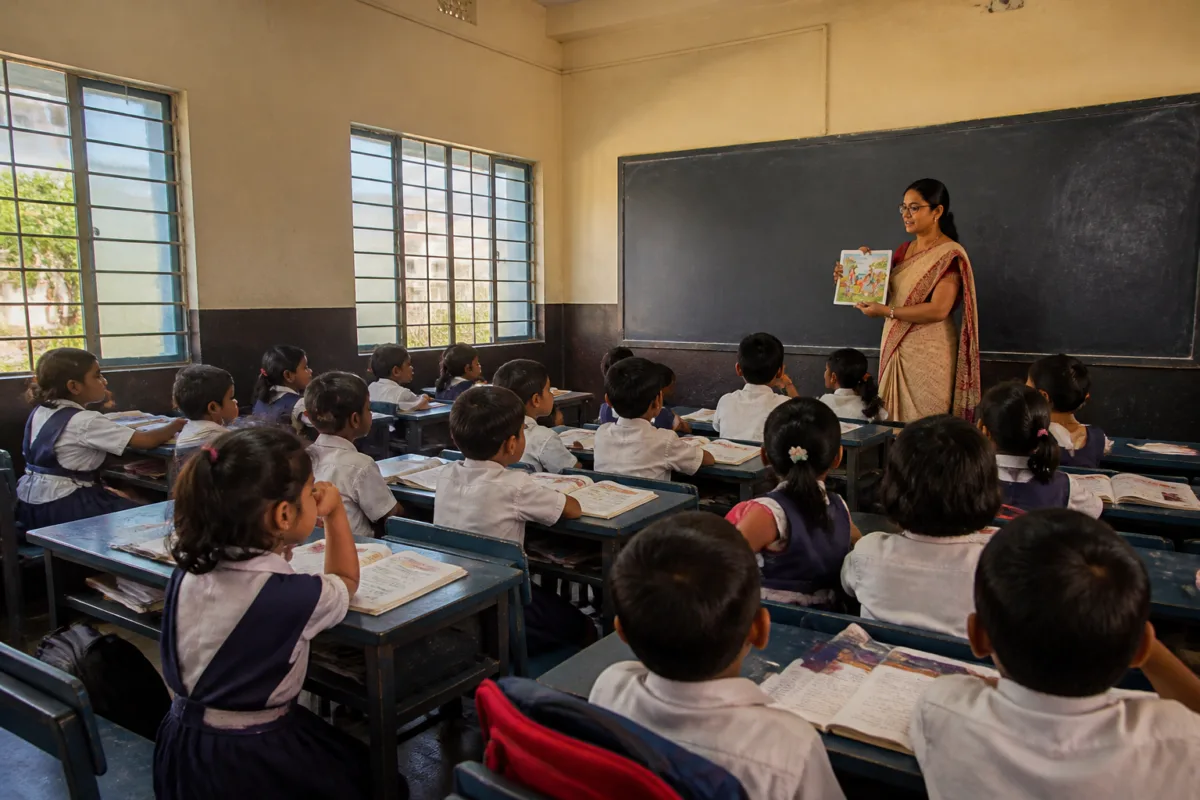
West Bengal is considering a new primary education model in which one teacher would take responsibility for each class and rotate across subjects on different days, School Education Minister Dipak Barman said at a meeting involving education authorities from 21 districts.
Under the proposed arrangement, primary schools would not necessarily have separate teachers for Bengali, English, geography and mathematics. Instead, teachers who have completed the required examinations would be expected to teach all subjects at the primary level, with one teacher assigned to a class on a particular day and another taking over on the next day.
Barman said the government was examining a system in which responsibility for a group of children would be clearly assigned to an individual teacher. Using the example of a class with 20 students, he said the teacher responsible for the class would be answerable for the children’s learning outcomes at the end of the academic year.
The minister said the proposed accountability model would require teachers to explain poor learning outcomes. If a substantial number of students in a class failed to learn adequately, the teacher concerned could be questioned about the reasons, according to the report published by Sangbad Pratidin.
The proposal is linked to a planned change in student-teacher ratios. Barman said the current ratio in primary education was approximately one teacher for every 26 students. At the secondary level, he said, one teacher currently serves between 50 and 52 students. The government plans to recruit 13,000 teachers, after which the primary-level ratio could be reduced to one teacher for every 20 students. The secondary-level ratio would also be reduced, he said, without specifying the proposed figure.
The minister also indicated that teacher salary increases could be linked to student progress. Teachers could be asked to explain why their pay should rise in the following year, with the assessment based on the development of the students under their responsibility. The report does not specify the proposed legal, administrative or evaluation framework for such a system.
The issue was discussed at an administrative, infrastructure and teaching-related meeting held at the West Bengal Council of Higher Secondary Education. The meeting brought together the chairpersons of the primary education councils of 21 districts, along with the heads of the primary and secondary boards and the Higher Secondary Education Council. The school education minister also attended.
The proposed changes come as the state government signals a greater focus on education quality and considers incorporating West Bengal into the National Education Policy framework. The report states that the previous government had opposed the national policy, but it does not provide details of the current government’s implementation plan, timeline or the specific provisions that would be adopted.
The immediate administrative questions include how teachers would be allocated across classes, how subject competence would be assessed, and how student progress would be measured before salary decisions are made. The government’s next steps, including the recruitment process and any formal notification on the primary-school model, have not been announced in the supplied report.

