


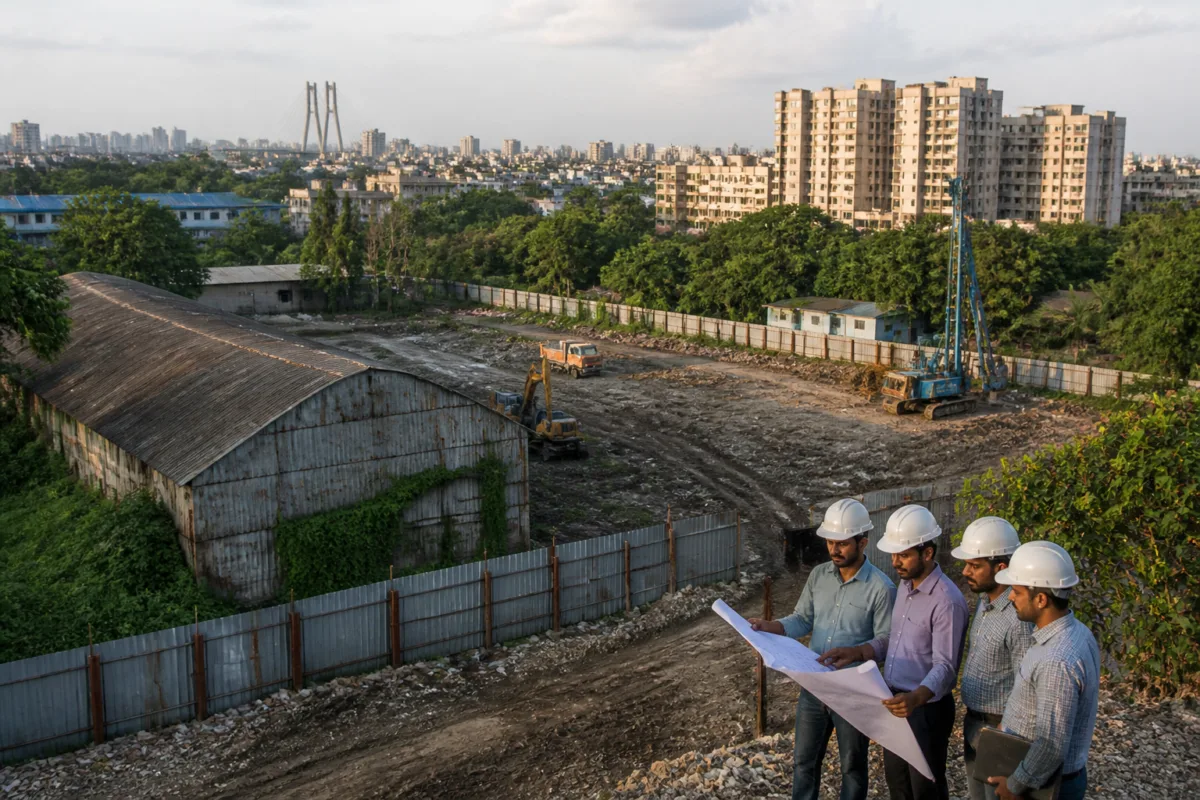
West Bengal’s cabinet has approved a proposal to adopt the Urban Land (Ceiling and Regulation) Repeal Act, 1999, a move that could make it easier to assemble larger urban land parcels for townships, housing, commercial projects and redevelopment, according to a Hindustan Times report. The proposal is scheduled to be placed before the West Bengal Assembly during its winter session beginning December 4.
The proposed West Bengal urban land ceiling repeal would remove a long-standing regulatory constraint that developers say has complicated land aggregation, ownership structures and project financing. If approved by the Assembly, it could bring the state closer to several other states that adopted Parliament’s 1999 repeal of the Urban Land (Ceiling and Regulation) Act, 1976.
The 1976 law imposed limits on the amount of vacant urban land that an individual, family or company could hold. In the Kolkata urban agglomeration, including Howrah and surrounding areas, the ceiling was 500 square metres. The limit was 2,000 square metres in the Asansol-Durgapur urban agglomeration.
The original law was repealed by Parliament in 1999, but West Bengal retained it. The continued application of the framework has been a concern for developers seeking to undertake large residential and commercial projects, the report said.
Joydeep Paul, senior director for occupier strategy and solutions, industrial and logistics, and branch head for Kolkata at Knight Frank India, said a simplified land regime could facilitate larger contiguous developments and make Kolkata and other urban centres more attractive to institutional investors and private equity funds. He cautioned that the effect would depend on clear implementation, title certainty, faster approvals and supporting infrastructure.
Sushil Mohta, president of CREDAI West Bengal and chairman of Merlin Group, described the cabinet decision as a major urban reform. He said the 500-square-metre ceiling in the Kolkata urban agglomeration made it difficult to develop modern townships, information technology campuses and large housing projects on a single landholding.
According to Mohta, developers had sometimes divided landholdings across multiple companies to remain within the prescribed ceiling. He said this complicated land titles, raised legal costs, slowed approvals and made projects less attractive to pension funds, private equity firms and global investors.
The proposed repeal could support integrated developments combining housing, offices, retail, schools, hospitals, green spaces and other social infrastructure. It could also create opportunities to redevelop large old properties and closed industrial sites into residential and commercial projects, the report said. These outcomes, however, would depend on title resolution, approvals and supporting infrastructure rather than on the repeal alone.
The report cited JLL data showing that housing launches in Kolkata rose from about 9,500 units in 2021 to 17,164 units in 2025, while sales increased from 7,183 units to 14,195 units over the same period. Mohta said the proposed reform could help sustain this activity by enabling larger developments and improving the city’s appeal to institutional investors.
The next steps identified by Mohta include resolving pending Urban Land Ceiling proceedings and appeals, reviewing land-ceiling provisions under Section 14M of the West Bengal Land Reforms Act, 1955, and addressing issues concerning bargadars, or sharecroppers. He also called for a modern township policy, possible land banks for information technology, logistics and industrial parks, and a time-bound single-window approval system.
The proposed repeal therefore represents a change in the state’s landholding framework, not an immediate guarantee of new townships or investment. Its urban impact will depend on how pending cases, land titles, approvals, utilities, power, infrastructure and wider regulatory compliance are handled after the legislative process.

