


Subheadline: Lemon, tomato and coriander prices have risen sharply even as higher arrivals push down the cost of several other vegetables at Navi Mumbai’s wholesale market.
Standfirst: A sharp divergence in Vashi APMC vegetable prices over the past 15 to 20 days shows how quickly weather, crop arrivals and distribution routes can reshape the urban food basket. Wholesale lemon prices rose from ₹25 a kilogram on August 20 to ₹55 on September 7, while tomatoes and coriander also became more expensive. At the same time, brinjal, okra, bottle gourd, beans and cluster beans became cheaper as arrivals increased. The pattern is not a uniform inflation story. It is a picture of a market responding unevenly to supply disruptions, seasonal perishability, changing trade routes and the costs added between the wholesale yard and the consumer.
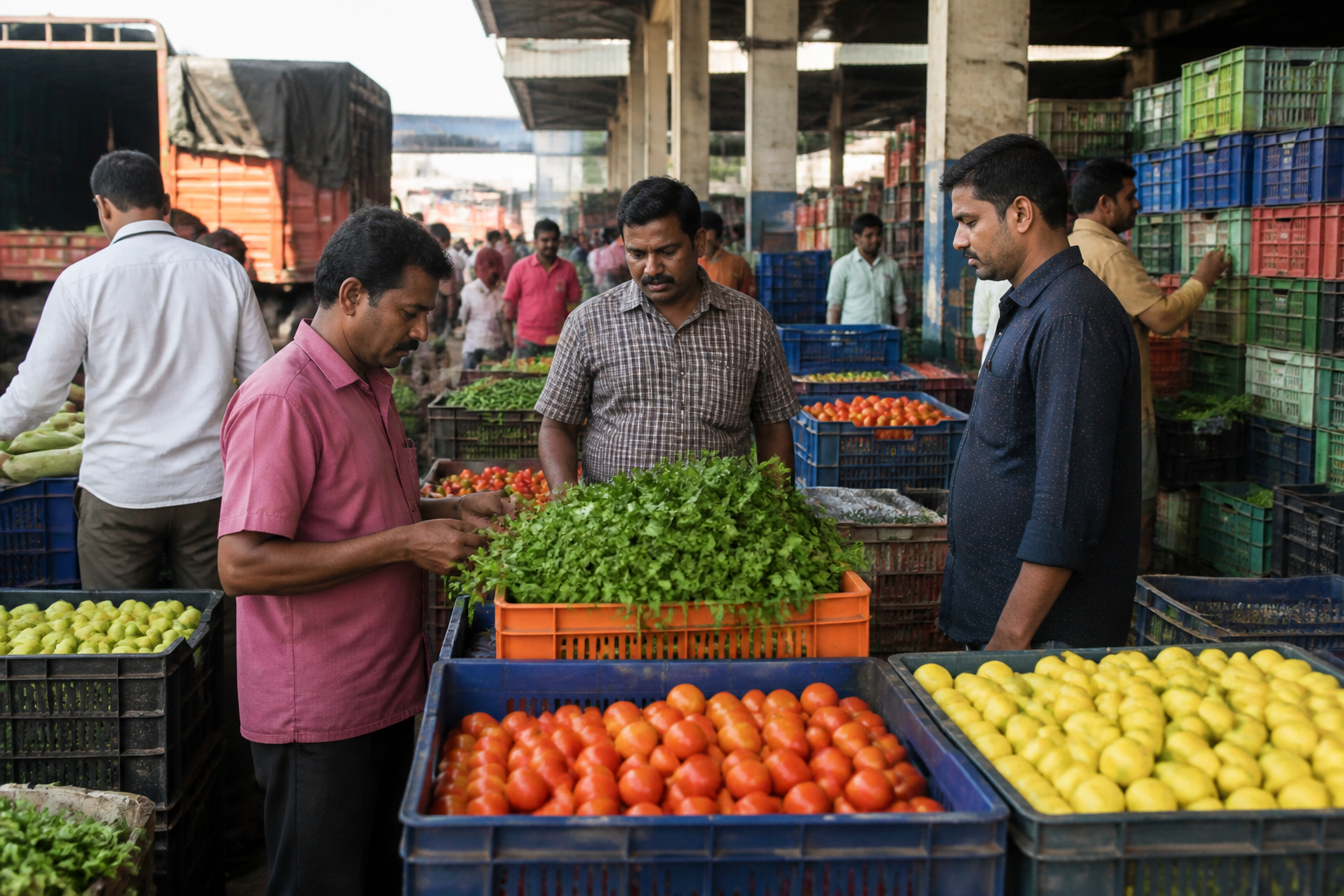
Vashi APMC vegetable prices have moved in opposite directions across different commodities, according to a report by Loksatta – Navi Mumbai. The report attributes the changes mainly to fluctuations in arrivals at the Mumbai Agricultural Produce Market Committee’s wholesale vegetable market in Vashi. While increased supplies have reduced the prices of several vegetables, lower arrivals of lemons, tomatoes and coriander have pushed their wholesale rates higher.
The sharpest increase has been recorded for lemons. Their wholesale price rose from ₹25 a kilogram on August 20 to ₹38 on September 1 and then to ₹55 on September 7. That represents an increase of 120 per cent in about 15 days. Tomato prices rose from ₹14 to ₹22.50 a kilogram, an increase of 60.7 per cent. Coriander sourced from the Nashik region increased from ₹6 to ₹11 a kilogram, or 83.3 per cent.
These figures show how a relatively small change in arrivals can quickly affect a city’s food market. The price movement is particularly visible in products that have limited storage flexibility or are highly dependent on regular arrivals. Coriander, the report notes, deteriorates quickly during the monsoon. When supplies fall, the market has less room to absorb the disruption through storage or delayed sales.
The same market is recording lower prices for several other vegetables. Brinjal declined from ₹32 to ₹17 a kilogram, a fall of 46.9 per cent. Bottle gourd fell from ₹21 to ₹13, okra from ₹35 to ₹22, and beans from ₹45 to ₹30. Cluster beans declined from ₹60 to ₹50. Carrot prices moved in the opposite direction, rising from ₹20 to ₹24 a kilogram.
This divergence is important because it complicates the way urban food inflation is experienced. A household does not buy a single representative vegetable. It buys a basket of products with different production cycles, source regions, perishability levels and transport requirements. A fall in the price of brinjal or okra may provide some relief, but it does not necessarily offset an increase in tomatoes, lemons and coriander, especially when those items are regular components of household cooking and food-service purchases.
The reported cause of the higher prices is a decline in arrivals from parts of Nashik, Junnar and other producing regions after rainfall affected some crops. Demand has remained steady, while the volume reaching Vashi APMC has fallen for the affected commodities. In contrast, good rainfall across much of Maharashtra, excluding Marathwada, has supported production and increased arrivals for other vegetables. The result is a market in which weather is not producing one common price trend; its effects vary by crop and growing region.
That distinction matters for interpreting wholesale prices. Rain can increase production prospects in some areas while damaging or delaying the supply of particular crops in others. The timing of harvest, road movement and the condition of produce on arrival also influence the effective supply available to buyers. The report does not provide crop-wise arrival volumes, so the precise scale of the disruption cannot be established from the available information. It does, however, show a clear relationship between reported changes in arrivals and prices at the wholesale market.
The gap between wholesale and retail prices adds another layer to the urban supply chain. According to the report, retail prices are generally ₹10 to ₹20 a kilogram higher than wholesale rates because of transport, handling and vendor costs. This means that a decline in wholesale prices may not immediately or fully reach consumers. Likewise, an increase at the wholesale level can become more pronounced by the time the produce reaches neighbourhood markets.
For consumers in Navi Mumbai and the wider Mumbai region, the wholesale market is therefore only one stage in the price-setting process. Produce must move from farms to the market, be sorted and handled, and then be transported to retail points. Each stage introduces costs and potential losses. These costs are especially significant for vegetables that deteriorate quickly, because unsold or damaged produce affects the margins of traders and vendors and may be reflected in the final retail price.
The report also points to a structural change in how produce reaches markets. Traders claim that direct marketing has reduced arrivals at Vashi APMC by 50 to 60 per cent. According to their account, some produce from local villages is now being sent directly to Virar, Borivali, Dadar and other markets instead of coming through the Vashi market. This claim is attributed to traders and is not independently quantified in the supplied material, but it raises an important question about the changing role of wholesale market yards.
If produce is distributed through multiple direct channels, Vashi APMC may no longer provide the same consolidated picture of regional supply that it once did. Lower arrivals at one market do not necessarily mean that the entire urban region is facing an equivalent shortage. Some produce may be bypassing the market and reaching other distribution points. At the same time, a fragmented network can make it more difficult to compare prices, track volumes and understand where supply is tightening.
The reported impact of municipal enforcement action adds another operational concern. Traders say that drives against encroachments and unauthorised businesses have affected market activity. Their argument is that if goods brought for sale cannot be sold at the appropriate locations, the disruption can affect the entire trading chain. The report does not establish the scale of this effect, but the claim indicates that market infrastructure includes more than the wholesale yard itself. Loading points, vending spaces, access routes and retail locations all influence how efficiently food moves through the city.
The market’s expected near-term trajectory is linked to arrivals. Information cited in the report suggests that supplies could remain higher and that arrivals from Gujarat and local areas may increase after Diwali. That expectation is not a forecast independently established in the supplied material, but it identifies the next factor traders are watching: whether additional supply can stabilise prices for commodities that have recently become expensive.
The evidence currently confirms a sharp, crop-specific shift rather than a broad-based increase across all vegetables. Lemon prices have more than doubled from the August 20 level, while tomato and coriander prices have also risen substantially. At the same time, several vegetables have become cheaper as arrivals increased. The available report does not provide retail price series, daily arrival volumes, comparable data from other markets or confirmation from market authorities. Those gaps limit any conclusion about the full effect on household budgets across Navi Mumbai.
What the episode does establish is the dependence of urban food prices on a supply chain that is sensitive to rainfall, crop geography, perishability, transport costs and the organisation of wholesale trade. Vashi APMC remains a key reference point for understanding that chain, but the reported movement of produce through direct marketing channels suggests that the market’s numbers must increasingly be read alongside what happens outside the yard. The next significant indicators will be whether arrivals rise as expected, whether wholesale reductions reach retail markets, and whether prices for lemons, tomatoes and coriander stabilise after the current supply disruption.
