


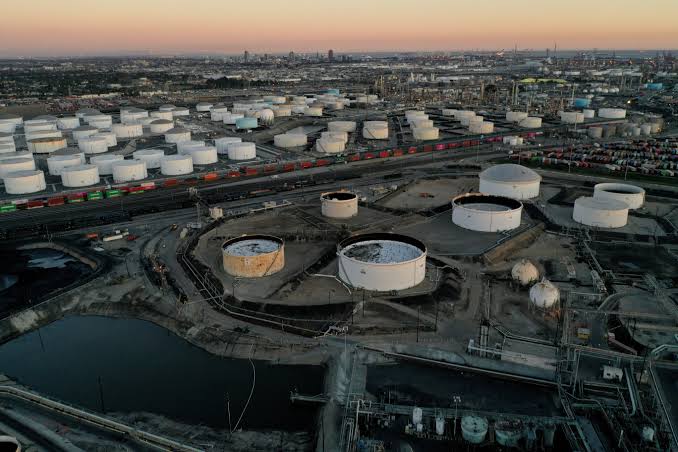
US diesel prices have climbed to an average of $5.85 per gallon from about $3.76 in recent months, according to a report by Aaj Tak Business, placing fresh pressure on the freight, farming and industrial systems that keep American cities supplied. The increase has also turned a geopolitical conflict into an infrastructure and cost-of-living problem, because diesel is used far beyond private transport.
The reported price rise comes as the United States faces pressure from several directions at once. Ukrainian attacks on Russian refineries and energy facilities have affected diesel availability, while disruptions linked to the conflict involving Iran have added pressure to crude oil markets and tanker movements. US President Donald Trump has blamed the Russia-Ukraine conflict for the current diesel strain and called on Ukrainian President Volodymyr Zelenskyy to stop attacks on Russian oil refineries and diesel-related facilities.
The political dispute over the main cause of the increase matters because diesel prices are shaped by several connected systems rather than by crude oil alone. Refinery capacity, inventories, export restrictions, shipping routes and seasonal demand all influence how much fuel reaches markets. The supplied report presents the current US situation as the result of a tightening supply chain in which international disruptions are meeting low domestic storage levels.
According to the report, Ukraine has targeted more than 20 Russian refineries and oil-linked facilities during the summer. Russian President Vladimir Putin has acknowledged that the attacks have placed pressure on the Russian economy. Ukraine has described the attacks as a response to Russian strikes on its territory. Russia subsequently imposed some restrictions on diesel exports until the end of September, raising concerns about international availability.
The reported supply pressure extends beyond Eastern Europe. The report says that the conflict involving Iran has affected oil supply and tanker movement in the Middle East, with disruptions around the Strait of Hormuz adding to pressure on global markets. Brent crude was trading above $107 a barrel on September 14, compared with about $70 before the conflict began, according to the supplied material. Higher crude prices generally increase the cost base for refined fuels, although the final diesel price also depends on refining, inventories, taxes, distribution and local market conditions.
This is why the diesel issue is fundamentally an urban logistics story. Trucks move a large share of goods between ports, warehouses, factories, wholesale markets and retail outlets. Delivery vehicles connect distribution centres to neighbourhoods, while freight trains and industrial machinery also depend on diesel. When the fuel becomes more expensive, the immediate effect is not limited to filling stations. Transport operators face higher operating costs, manufacturers pay more to move inputs and finished goods, and retailers may eventually pass part of the increase on to consumers.
The same chain reaches the agricultural economy. Farmers use diesel-powered tractors and other equipment, making fuel availability and price important during planting and harvesting. A sustained increase can therefore affect the cost of food before products enter city markets. The report also links diesel prices to possible increases in the cost of clothing, furniture, cosmetics and online deliveries, all of which depend on layers of transport and distribution.
The pressure is particularly significant because diesel demand is not uniform throughout the year. The report says that US fuel storage levels at the end of August were unusually low for that period. Conditions on the East Coast were described as more serious, with diesel and heating-oil inventories at record lows. This creates a narrower buffer against supply disruption just as seasonal demand is expected to rise.
Two forms of demand could intensify that pressure. Farmers use more diesel during the harvest season, while households and businesses increase demand for heating fuel before winter. Diesel and heating oil are related products of the refining system, meaning that competing seasonal requirements can affect the availability and price of middle distillates. The supplied report does not establish how long the inventory shortfall will last, but it identifies the seasonal transition as an important pressure point.
US refineries are reportedly trying to increase diesel output, with production capacity at a level described as among the highest in several years. Higher domestic production, however, does not automatically resolve the wider market problem. If refineries elsewhere face operational difficulties or if export flows are restricted, international supplies can remain tight even when one major market increases output.
This distinction between production capacity and usable supply is important for cities. Urban economies rely on continuous movement, not simply on the existence of fuel somewhere in the system. A refinery may have capacity, but fuel still has to be produced, stored, transported and delivered to the locations where trucks, farms, factories and heating systems need it. Low inventories reduce the time available to absorb a disruption and can make local markets more sensitive to changes in international prices.
The effects can also be uneven across geography. Areas dependent on long-haul trucking may experience greater exposure than places with shorter supply routes or stronger access to alternative transport. The report does not provide regional price comparisons within the United States, but the reference to tighter East Coast storage indicates that supply conditions may vary by location. This is relevant to urban planning and infrastructure because the resilience of a city depends partly on the redundancy of its freight, energy and storage networks.
The episode also highlights the limits of treating fuel inflation as a single-cause event. President Trump has rejected the view that the Iran conflict is the main reason for the US diesel increase, instead pointing to Ukraine’s attacks on Russian energy infrastructure. Yet the supplied report also notes that Trump had previously linked the Iran conflict to rising fuel prices. The competing explanations show how geopolitical events, refining constraints and inventory conditions can overlap in the same market.
For public authorities, the challenge is therefore both economic and operational. Governments must monitor fuel availability, protect the continuity of essential freight and assess how higher transport costs affect food, heating and consumer goods. The material supplied does not identify any specific US relief programme, emergency stock release or new fuel policy. It does, however, show why diesel inventories and refinery performance become public-interest issues when storage levels are low and seasonal demand is approaching.
The political consequences are also being discussed in the context of US inflation and the November midterm elections. The report says that higher diesel prices could add to inflationary pressure after tariff policies and the conflict involving Iran had already become sources of concern. Whether fuel prices become a decisive electoral issue is not established by the supplied evidence, but the connection between transport costs and household prices gives the issue a direct urban dimension.
The central lesson is that diesel functions as a form of invisible urban infrastructure. It powers the movement of goods, supports agricultural production, feeds industrial activity and helps maintain heating supply. When prices rise sharply, the impact travels through logistics networks before appearing in household budgets. The current US episode shows how vulnerable those networks can become when international supply is disrupted at the same time that domestic inventories are low.
The supplied report confirms a sharp reported increase in US diesel prices and identifies pressure from Russian refinery attacks, export restrictions, Middle East disruption, low storage and seasonal demand. It does not independently establish the relative contribution of each factor or indicate how long the increase will persist. The developments most relevant to cities are the level of East Coast inventories, refinery output, Russian export restrictions, crude prices and the cost of moving essential goods through the winter period.

