


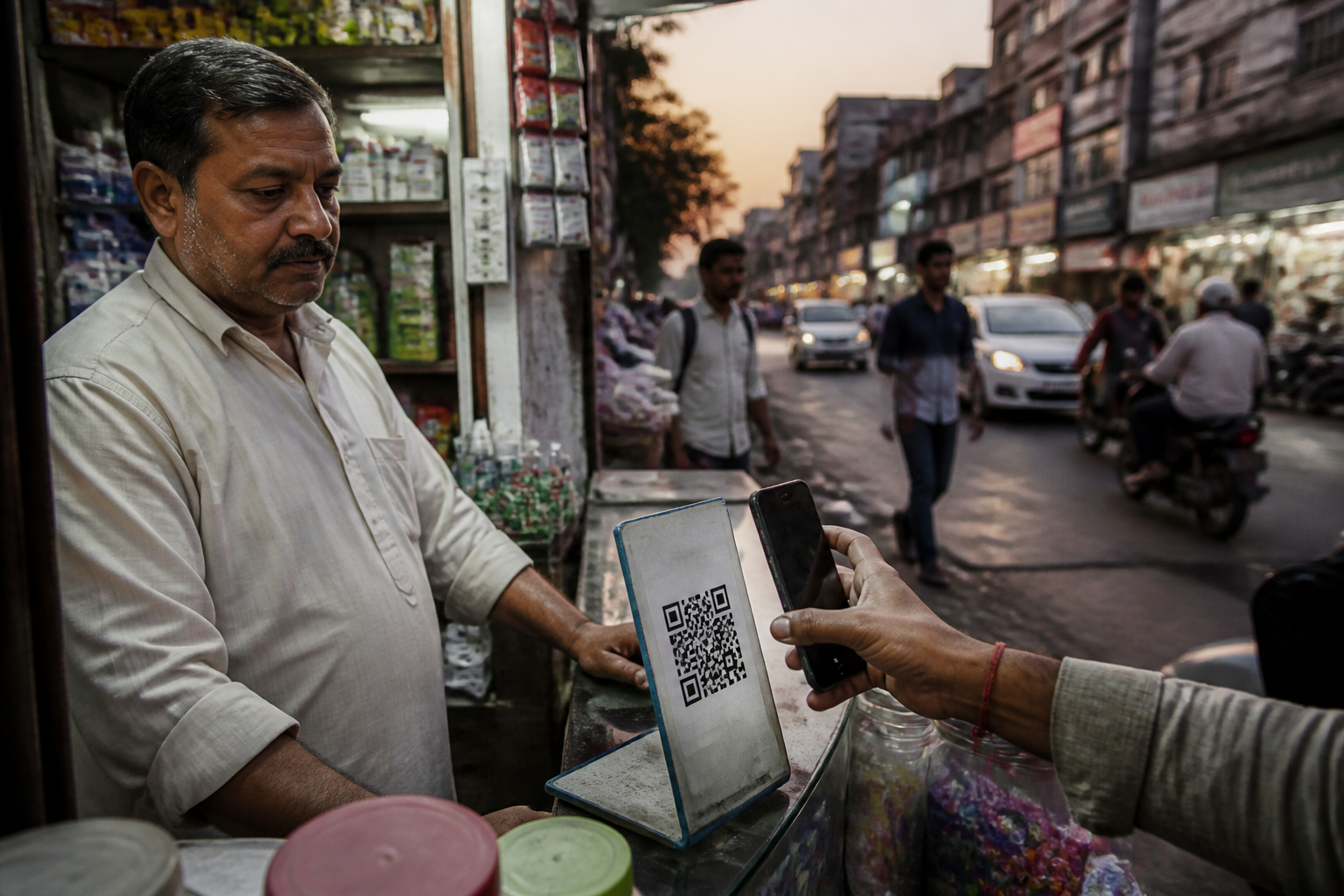
A report by Aaj Tak Business says the government will introduce a 0.4% Merchant Discount Rate (MDR) on selected Unified Payments Interface (UPI) payments above ₹2,000 from 15 October, while keeping the charge away from consumers. The report does not include a named government authority, notification or National Payments Corporation of India circular confirming the proposed change, so the central announcement requires verification before publication.
According to the report, the proposed charge would apply to certain Person-to-Merchant (P2M) transactions, which are payments made by individuals to shops, businesses or other commercial entities. Person-to-Person (P2P) transfers would remain free, regardless of the amount, while P2M payments of up to ₹2,000 would also attract no charge.
MDR is the fee associated with accepting and processing a digital payment. In the arrangement described by Aaj Tak Business, the merchant, rather than the customer, would bear the charge. The report gives the example of a ₹5,000 purchase: a 0.4% MDR would amount to ₹20, but that amount would not be collected from the consumer at the point of payment.
The report also says that the charge for a general merchant transaction would be capped at ₹300. On that basis, a payment of ₹75,000 or more would not result in an MDR above ₹300 for the merchant. The supplied material does not identify the institutions that would collect or distribute the fee, explain whether the cap would apply per transaction or account, or provide the legal or operational framework for implementation.
The proposed structure, as described, separates everyday low-value digital payments from larger commercial transactions. Aaj Tak Business says payments of up to ₹2,000 account for more than 95% of total P2M volume. The report does not provide the underlying dataset, period, methodology or source for that figure, which should also be checked against official payment-system data before it is used as an established measure.
The report lists separate charges for several sectors. It says payments above ₹2,000 for railways, telecommunications, insurance, fuel and agricultural inputs would attract a flat ₹5 charge. It also includes electricity, water, piped-gas bills and school or university fees in the flat-₹5 category. Payments linked to mutual funds, securities and stockbrokers are described as carrying a 0.02% charge, capped at ₹300.
These distinctions matter because UPI is used across very different parts of the urban economy. A payment at a neighbourhood retailer, a utility bill, a school fee and a transport purchase may all use the same customer-facing interface but involve different merchants, intermediaries and settlement arrangements. The report presents the proposed fee schedule as a way to classify these transactions, but it does not establish how banks, payment apps, acquiring institutions or merchants would apply the categories in practice.
For consumers, the immediate effect described in the report would be limited: customers would not be directly charged for the specified UPI payments. However, the report raises an unresolved operational question about how merchants would absorb the cost. A business could treat the MDR as a payment-processing expense, negotiate its commercial arrangements, or seek changes in pricing. The supplied material does not say whether merchants would be legally permitted to pass the charge on to customers, nor does it include a government clarification on that point.
That question is significant for small retailers, where payment costs can be more visible than they are for large businesses. The report mentions tea shops, shopping malls, vegetable purchases and street-food payments while explaining UPI usage. It does not, however, provide evidence on merchant margins, the share of payments received through UPI, or the likely effect of the proposed MDR on different categories of businesses. Any assessment of the burden on small merchants would therefore require additional data.
The report’s account also leaves the institutional structure unclear. It attributes the decision broadly to the government but does not name the ministry, department or regulator responsible for the announcement. It does not identify whether the proposed change would be implemented through a government notification, an NPCI rule, a banking instruction or agreements among payment-system participants. Those details are essential because they would determine the scope of the charge, the entities responsible for collection and the mechanism for handling disputes.
The absence of a primary document is particularly important because the reported start date is specific and close to the publication date. A formal notification or circular would be expected to clarify whether the threshold applies to the gross transaction value, whether multiple payments can be split to avoid the threshold, how recurring bills are classified, and whether refunds or failed transactions are included. None of those points is established in the supplied report.
The proposed MDR would also have implications for the economics of digital payments. UPI payments are presented in the report as largely free for merchants and consumers. Introducing a fee for selected higher-value merchant transactions could change the incentives surrounding payment acceptance, particularly where merchants compare digital-payment costs with cash handling, card acceptance and other electronic instruments. The article does not provide comparative charges or evidence of how merchants currently choose between these payment methods.
The distinction between P2P and P2M is central to the reported proposal. A transfer between two individuals would remain free, while a payment to a business above the stated threshold could attract a merchant-side charge. In practice, identifying the recipient and classifying the transaction would be an important part of implementation. The supplied report explains the categories conceptually but does not describe how the payment system would verify them or prevent misclassification.
Aaj Tak Business also says that the customer would not have to pay the MDR. That statement is presented as the reported policy position, not as a rule supported by a cited notification in the supplied material. Until the responsible authority issues a formal clarification, the treatment of surcharges, merchant pricing and customer complaints remains unresolved.
The larger urban issue is the cost of operating a digitally mediated marketplace. QR-code payments have become part of daily transactions across formal businesses and small shops, but the infrastructure behind a simple scan involves banks, payment apps, payment processors and merchant accounts. Any change to the fee structure can therefore affect not only financial institutions but also the way urban consumers pay for transport, utilities, education, retail goods and services.
The available evidence confirms only that Aaj Tak Business has reported a proposed 0.4% MDR for specified P2M transactions above ₹2,000, with sector-specific charges and a merchant-side payment obligation. It does not independently establish that the government has formally approved or notified the measure. Publication should await confirmation from the relevant government department, NPCI, the Reserve Bank of India or another identifiable authority, together with the official effective date and complete fee schedule.
