


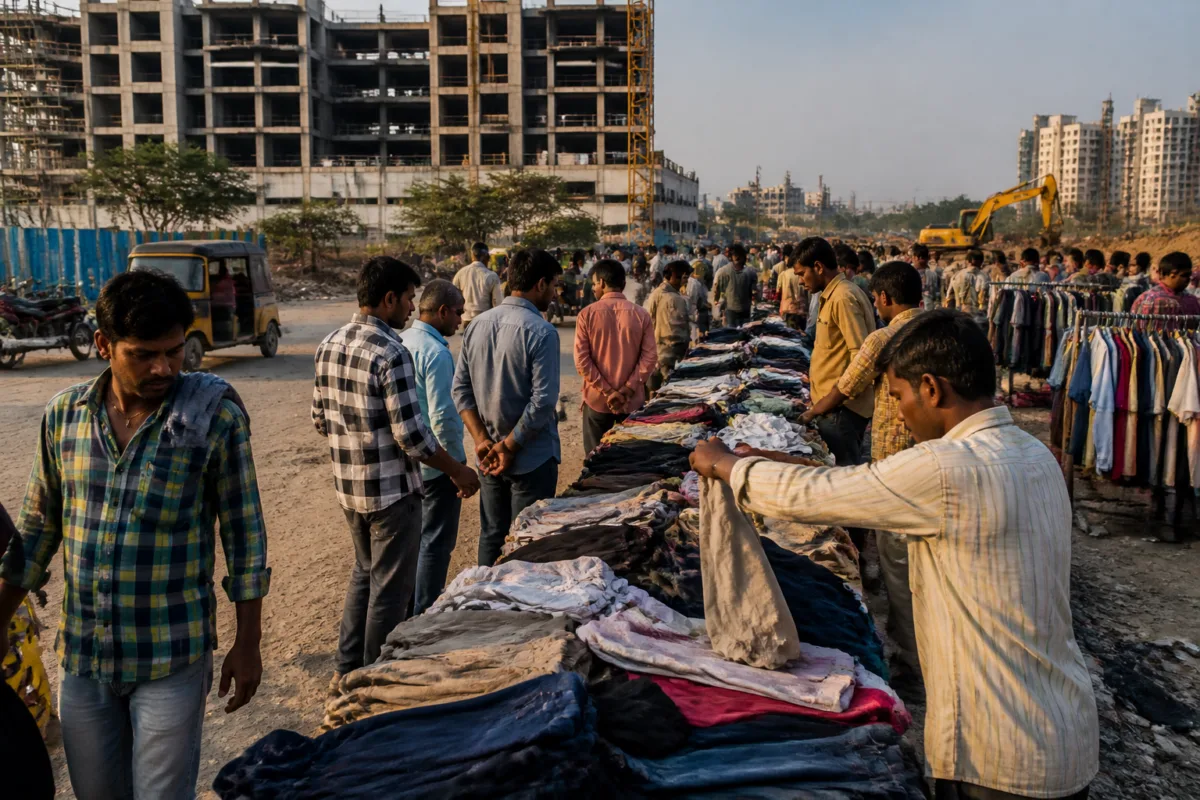
Thukkuguda’s weekly market, where a shirt or pair of trousers can cost just Rs 50, offers a small but revealing view of how rapidly developing urban edges absorb migrant workers. The market’s demand is being driven by people who have moved to the area for construction, real estate, industrial and other employment opportunities, turning an inexpensive clothing bazaar into part of the local infrastructure of work and settlement.
The market is not simply responding to consumer preference. It is responding to the economic conditions of a workforce managing several competing expenses while living close to employment sites. Ram Prasad, a migrant worker from Bihar quoted by Telangana Today, said the market was convenient because a pair of clothes costing Rs 50 remained affordable when workers had other expenses to manage. His comment places the market within a wider pattern: low-cost retail becomes important when wages, accommodation costs, food expenses and travel requirements leave limited room for discretionary spending.
The reported demand also shows how employment hubs create markets beyond formal commercial centres. Construction workers and employees in nearby establishments are among the regular customers. Many have come from different parts of the country, according to the report, and the weekly market has become a shopping destination for workers from several States. Its importance comes from proximity, price and the ability to meet an immediate everyday need without requiring a larger retail trip.
This is a common but often overlooked feature of urban expansion. New employment areas are usually described through land development, industrial investment, office space, roads or large projects. Less attention is paid to the everyday systems that allow the incoming workforce to live and work in those areas. Affordable clothing, food, transport, rented rooms and small retail services are not peripheral to the growth process. They are part of the social and economic arrangements that make a new employment cluster functional.
In Thukkuguda, the weekly market appears to be filling that gap through a low-cost and flexible retail format. Renuka, a vendor who travels from Champapet every week, told Telangana Today that many workers visit the market looking for affordable clothes and that most of her customers work at construction sites or in nearby establishments. Her account also shows that the market connects different parts of the metropolitan area: the sellers may travel into Thukkuguda, while the buyers arrive from workplaces and settlements around the emerging hub.
That movement is significant because it reveals that the area’s economic geography is wider than its construction sites or industrial premises. A market that draws vendors from Champapet and workers from different States depends on circulation across the city’s expanding edge. It also reflects the way informal commerce can respond faster than formal retail to a newly concentrated but price-sensitive population. The source report does not establish the market’s size, turnover or exact number of workers, but the accounts of vendors and customers indicate a steady relationship between labour inflows and demand for inexpensive goods.
The reported growth of construction and real estate activity is central to this relationship. As projects expand, they require workers on site and create demand for services around those sites. The article also refers to companies connected with defence, aeronautics, gems and other sectors in the surrounding area. Together with construction and real estate ventures, these activities are described as transforming the locality into an emerging employment hub.
The important point is not that every new job automatically creates a thriving urban economy. Rather, the market illustrates how employment growth becomes visible in ordinary transactions. A worker buying a second-hand shirt is participating in a chain that links land development, labour mobility, household budgeting, informal retail and local transport. These links are rarely captured in headline measures of urban expansion, yet they shape whether workers can sustain themselves near their workplaces.
Affordability is the market’s strongest attraction. For workers whose daily expenses must be tightly controlled, second-hand clothing provides a practical alternative to higher-priced formal retail. Divya, another vendor quoted in the report, said migrant workers were particularly interested in used garments because they wanted to keep everyday costs low. The market therefore serves a population whose needs are not defined only by availability, but by the price at which goods can be accessed.
This distinction matters for planning around employment hubs. A location may attract companies and construction projects, but workers still need affordable ways to meet basic needs. If those services are absent, people must travel farther or depend on more expensive options. In Thukkuguda, the weekly market has emerged as an informal response to that requirement. It provides clothing at a price point that the workers interviewed consider manageable and does so through a periodic rather than permanent retail arrangement.
The market also demonstrates how migrant workers are not merely temporary users of a developing area. Their presence is helping shape local demand. The source describes workers who have moved to Thukkuguda in search of livelihoods and who now form a regular customer base. That suggests a transition from a project-centred landscape to a more complex urban environment, where people need access to goods and services throughout the period of employment.
At the same time, the available evidence has clear limits. The report records statements from two vendors and one migrant worker, but it does not provide official estimates of the migrant population, household incomes, rental conditions, market footfall or the duration of the market’s operation. It also does not establish whether the workforce is permanently settled in Thukkuguda or moves between project locations. These gaps matter because the scale and permanence of local demand cannot be measured from individual accounts alone.
What can be established is the connection described by the people who use and operate the market. Construction, real estate and industrial activity have brought more workers into the area. Those workers need low-cost everyday goods. Vendors have responded by selling used clothes through a weekly market, and the market has gained importance as an accessible shopping destination. The relationship is direct, even if its full scale remains undocumented in the supplied report.
The Thukkuguda example therefore raises a wider question about how urban authorities and developers understand growth corridors. Formal plans often focus on land use, investment and physical infrastructure. But an employment hub also depends on the availability of affordable services for the people who build, operate and support it. Informal markets may supply some of those services, but their contribution can remain invisible until authorities begin treating them as part of the area’s economic life.
That does not mean every informal market should be formalised or displaced by organised retail. The report provides no evidence to assess the market’s regulatory status, safety conditions or land arrangements. It does show, however, that affordability and convenience are producing demand that formal planning cannot ignore. A market serving construction workers is connected to the broader question of whether urban expansion includes the needs of its workforce.
For Thukkuguda, the weekly market is a modest indicator of a larger transformation. Defence, aeronautics, gems, construction and real estate activity are drawing workers and creating new patterns of movement and consumption. The Rs 50 garment is the visible end of that process. Behind it is an emerging urban economy in which migrant labour, informal commerce and expanding development are becoming increasingly interdependent. Further evidence on workforce numbers, settlement patterns and local services would be needed to determine how deeply that transformation has taken root.

