


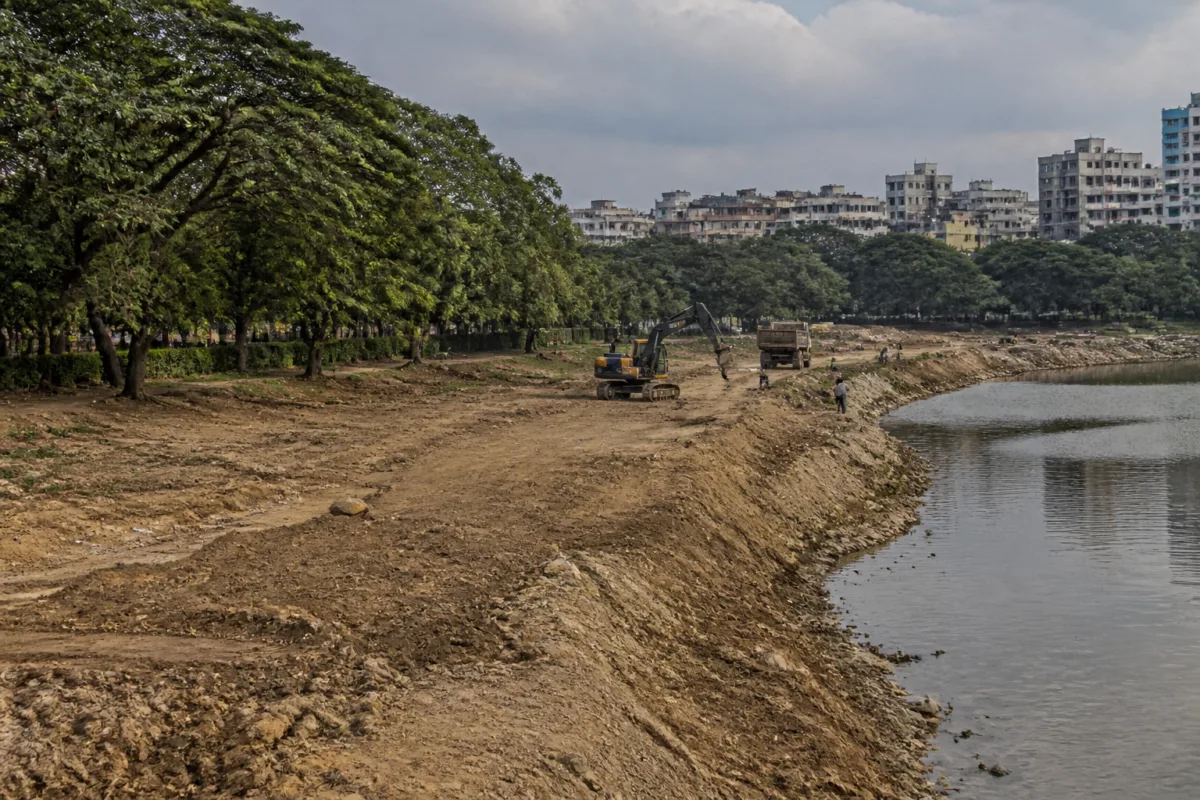
The expansion of the lake at Hyderabad’s Krishna Kanth Park is being presented as a Rs 7.5-crore rejuvenation project, but the work has also exposed a central urban planning conflict: improving a public water body while removing a substantial part of the park’s established green cover. At Yousufguda, a project intended to add recreational and landscape infrastructure has already changed the character of a space used daily by walkers.
According to Telangana Today, the lake inside the park is being expanded from three acres to 12 acres, or four times its existing size. The plan includes upgraded walking paths, an open-air gym and boating facilities. Hyderabad Disaster Response and Asset Protection Agency, or HYDRAA, launched the rejuvenation and expansion plan in October. The project therefore combines water-body intervention with a broader public-space redevelopment programme rather than treating the lake as an isolated engineering asset.
That combination is what makes the Krishna Kanth Park work significant. A park is not only a location for paths and facilities. Its tree canopy and dense foliage also form part of the everyday environmental infrastructure of a neighbourhood. The report describes the park as one of Hyderabad’s popular and largest parks and says it served as a green sanctuary for thousands of daily walkers. The removal of trees has consequently been experienced not merely as construction activity, but as a visible change in the functioning and atmosphere of the public space.
The reported scale of tree removal is substantial. Sources in the Greater Hyderabad Municipal Corporation’s Urban Biodiversity wing told Telangana Today that more than 200 trees were enumerated before work began. Of these, 30 have been cut, while the remaining 170 are to be relocated. The sources also said that the GHMC-UBD wing obtained permission from the Tree Protection Committee before the work started.
The project’s administrative pathway is important because it shows that the tree clearance was not described in the report as an unauthorised act. The trees were enumerated, permission was obtained from the relevant committee, and a relocation plan was identified. At the same time, the existence of formal permission has not resolved the public dispute. Morning walkers and environmental activists have questioned the ecological cost of removing greenery from a mature urban park, particularly when the work has left parts of the site looking barren and dusty.
The proposed destination for the relocated trees is near Sunnam Cheruvu, where HYDRAA is developing a new site. This creates a second geographical component to the project. The impact of the decision will not be assessed only at Krishna Kanth Park; it will also depend on what happens to the trees moved to the new location. The supplied report does not provide details on the species, size, survival rate, transplantation method or monitoring arrangements for those trees. Those details would be necessary to establish how much of the existing ecological value can realistically be retained.
Tree relocation is also not equivalent to preserving an established canopy at its original location. The available account confirms that 170 trees are planned for translocation, but it does not establish how many have already been moved, whether all will survive, or how long the replacement landscape would take to provide comparable shade and habitat. These gaps do not invalidate the project’s stated plan, but they limit what can be concluded about its environmental outcome.
The same distinction applies to lake expansion. Increasing the water area from three acres to 12 acres may alter the park’s hydrological and recreational profile, but the supplied material does not explain the engineering rationale, the condition of the existing lake, the source of the project funding beyond its stated cost, or the design used to balance water, pathways, boating and vegetation. It also does not state whether an environmental assessment was undertaken or what safeguards were included in the project plan.
The project thus brings together responsibilities held by multiple public institutions. HYDRAA is identified as the agency that launched the rejuvenation and expansion plan. GHMC-UBD is associated with the removal and relocation of trees, while the Tree Protection Committee provided the reported permission. The division of responsibility matters because public concerns about the project span several areas: lake works, tree protection, park management, construction execution and the future maintenance of the expanded public space.
This institutional structure can make accountability difficult for residents unless project information is made accessible. The report identifies the project cost, the proposed increase in lake area, the facilities planned and the number of trees affected. It does not, however, include a public project schedule, a detailed tree inventory, a relocation monitoring report or an explanation of how the final landscape will compensate for the immediate loss of canopy. Those documents would help residents evaluate the work against its stated objectives rather than relying only on the appearance of the construction site.
The dispute also reflects a wider pressure on established urban parks. Cities frequently attempt to add visible amenities such as boating, gyms and upgraded pathways because these facilities can make public spaces more attractive and more actively used. But the construction of such amenities can also consume the very ecological qualities that made the park valuable. At Krishna Kanth Park, the reported expansion has placed water infrastructure, recreation and green cover in direct competition for the same limited area.
For walkers, the immediate impact is clear in the description of cleared foliage and a dusty construction zone. The longer-term outcome remains less certain. The planned 12-acre lake and new facilities may create a different kind of public space, but the supplied report does not establish whether the completed project will provide an equivalent level of shade, biodiversity or everyday comfort. Nor does it record a detailed response from HYDRAA or the GHMC explaining how those concerns will be addressed.
What the evidence confirms is that Krishna Kanth Park’s lake expansion is not simply a beautification exercise. It is a physical reconfiguration of a major neighbourhood park involving a fourfold increase in water area, a Rs 7.5-crore project and more than 200 affected trees. What remains unestablished is whether the tree relocation programme will preserve comparable ecological value and how the redesigned park will balance its new recreational functions with the green cover that residents say defined it. The next important evidence will be the project’s implementation details, the progress and survival of relocated trees, and the final condition of the park’s landscape.

